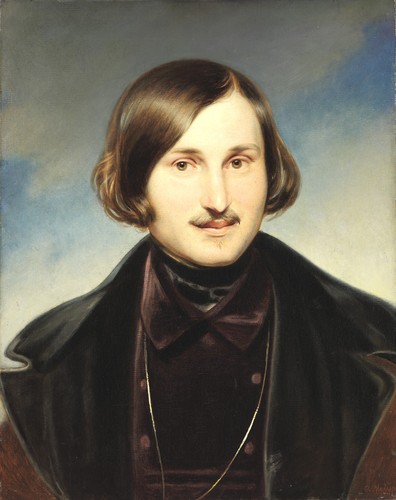
Николай Васильевич Гоголь
Personal Information
Description
Nikolai Vasilievich Gogol (Russian: Николай Васильевич Гоголь; Ukrainian: Микола Васильович Гоголь) (31 March [O.S. 19 March] 1809 – 4 March [O.S. 21 February] 1852) was a Ukrainian-born Russian novelist, humourist, and dramatist He is considered the father of modern Russian realism. His early works, such as Evenings on a Farm Near Dikanka, were heavily influenced by his Ukrainian upbringing and identity. His more mature writing satirised the corrupt bureaucracy of the Russian Empire, leading to his exile. On his return, he immersed himself in the Orthodox Church. The novels Taras Bul'ba (1835; 1842 [revised edition]) and Dead Souls (1842), the play The Inspector-General (1836, 1842), and the short stories Diary of a Madman, The Nose and The Overcoat (1842) are among his best known works. With their scrupulous and scathing realism, ethical criticism as well as philosophical depth, they remain some of the most important works of world literature.
Books
The Inspector-General
A corrupt village wrongly suspects the idiot assistant of a medicine-show operator of being the emperor's omnipotent inspector general in disguise.
Sobranie sochineniĭ
Sorotchintzy fair
This story is based on a traditional Russian country tale about a beautiful young girl who is wooed and won at the Sorotchintzy fair by a dashing suitor who uses the villagers', and his future father-in-law's superstitions to overcome the obstacles to the hand of his lady love.
Forms of the Novella
Gogol, N. The overcoat. Melville, H. [Billy Budd, sailor]( James, H. The Aspern papers. Chopin, K. [The awakening]( Conrad, J. Heart of darkness. Joyce, J. [The dead]( Kafka, F. The metamorphosis. Lawrence, D.H. St. Mawr. Porter, K.A. Pale horse, pale rider. Pynchon, T. The crying of Lot 49.
Best Russian short stories
Marriage
The Government inspector
A classic comedy of Russian provincial life. A penniless young traveller is mistaken for a government inspector whose arrival is expected with panic by the corrupt local officials. He is bribed and feted and finally betrothed to the Mayor's daughter. After he has left with his pockets full of money, the mistake is discovered and the arrival of the real inspector is announced.
Petersburg tales
Written in the 1830s and early 1840s, these comic stories tackle life behind the cold and elegant façade of the Imperial capital from the viewpoints of various characters, such as a collegiate assessor who one day finds that his nose has detached itself from his face and risen the ranks to become a state councillor (‘The Nose’), a painter and a lieutenant whose romantic pursuits meet with contrasting degrees of success (‘Nevsky Prospect’) and a lowly civil servant whose existence desperately unravels when he loses his prized new coat (‘The Overcoat’). Also including the ‘Diary of Madman’, these Petersburg Tales paint a critical yet hilarious portrait of a city riddled with pomposity and self-importance, masterfully juxtaposing nineteenth-century realism with madcap surrealism, and combining absurdist farce with biting satire.
Four Great Russian Plays
Les deux héritages: L'inspecteur général; Les débuts d'un aventurier
Book digitized by Google from the library of the University of Michigan and uploaded to the Internet Archive by user tpb.
Мертвые души
Dead Souls is a socially critical black comedy. Set in Russia before the emancipation of serfs in 1861, the "dead souls" are dead serfs still being counted by landowners as property, as well as referring to the landowners' morality. Through surreal and often dark comedy, Gogol criticizes Russian society after the Napoleonic Wars. He intended to also offer solutions to the problems he satirized, but died before he ever completed the second part of what was intended to be a trilogy. The work famously ends mid-sentence.