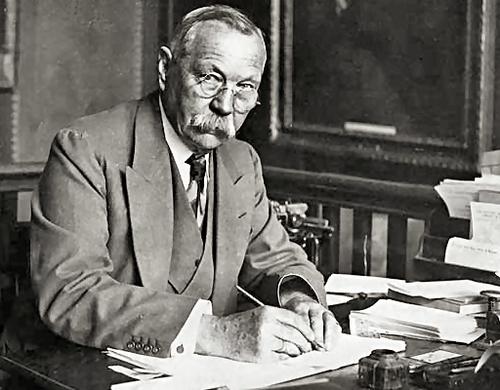
Arthur Conan Doyle
Personal Information
Description
Sir Arthur Ignatius Conan Doyle KStJ, DL (22 May 1859 – 7 July 1930) was a Scottish writer and physician, most noted for creating the fictional detective Sherlock Holmes and writing stories about him which are generally considered milestones in the field of crime fiction. He is also known for writing the fictional adventures of a second character he invented, Professor Challenger, and for popularising the mystery of the Mary Celeste. He was a prolific writer whose other works include fantasy and science fiction stories, plays, romances, poetry, non-fiction and historical novels.
Books
Rodney Stone
From the book:On this, the first of January of the year 1851, the nineteenth century has reached its midway term, and many of us who shared its youth have already warn-ings which tell us that it has outworn us. We put our grizzled heads together, we older ones, and we talk of the great days that we have known; but we find that when it is with our children that we talk it is a hard matter to make them understand. We and our fathers before us lived much the same life, but they with their railway trains and their steamboats belong to a diffe-rent age. It is true that we can put history-books into their hands, and they can read from them of our weary struggle of two and twenty years with that great and evil man. They can learn how Freedom fled from the whole broad continent, and how Nelson's blood was shed, and Pitt's noble heart was broken in striving that she should not pass us for ever to take refuge with our brothers across the Atlantic. All this they can read, with the date of this treaty or that battle, but I do not know where they are to read of ourselves, of the folk we were, and the lives we led, and how the world seemed to our eyes when they were young as theirs are now.
The Green Flag
The Green Flag is a short story written by Arthur Conan Doyle first published in the Pall Mall Magazine in june 1893.
Novels (Sign of Four / Study in Scarlet)
Contains: - [Sign of Four]( - [Study in Scarlet](
Into the Mummy's Tomb
Arthur Weigall Thc Malevolence of Ancient Egyptian Spirits Louisa May Alcott Lost in a Pyramid, or The Mummy's Curse Various Egyptologists Raiding Mummies' Tombs Sir Arthur Conan Doyle The Ring of Thoth Tennessee Williams The Vengeance of Nitocris H. P. Lovecraft Under thc Pyramids Howard Carter, with A. C. Mace Opening King Tutankhamen's Tomb Agatha Christie The Adventure of the Egyptian Tomb An Ancient Egyptian Priest The Demon-Possessed Princess Mark Twain The Majestic Sphinx Sir H. Rider Haggard Smith and thc Pharaohs Edgar Allan Poe Some Words with a Mummy Ray Bradbury Colonel Stonesteel's Genuine Horne-Made Truly Egyptian Mummy Rudyard Kipling Dead Kings (excerpt) Sir Arthur Conan Doyle Lot No. 249 Elizabeth Peters The Locked Tomb Mystery Sax Rohmer Thc Death-Ring of Sncfcru Anne Rice The Mummy or Ramses the Damned (excerpt) Bram Stoker The Jewel of Seven Stars (abridged)
A Study in Scarlet
Convalescing in London after a disastrous experience of war in Afghanistan, Dr John Watson finds himself sharing rooms with his enigmatic new acquaintance, Sherlock Holmes. But their quiet bachelor life at 221B Baker Street is soon interrupted by the grisly discovery of a dead man in a grimy 'ill-omened' house in south-east London, his face contorted by an expression of horror and hatred such as Watson has never seen before. On the wall, the word rache - German for 'revenge' - is written in blood, yet there are no wounds on the victim or signs of a struggle. Watson's head is in a whirl, but the formidable Holmes relishes this challenge to his deductive powers, and so begins their famous investigative partnership.
The Return of Sherlock Holmes
The Return of Sherlock Holmes is a 1905 collection of 13 Sherlock Holmes stories, originally published in 1903–1904, by Arthur Conan Doyle. The stories were published in the Strand Magazine in Britain and Collier's in the United States. Contains: [Adventure of the Empty House]( [Adventure of the Norwood Builder]( [Adventure of the Dancing Men]( [Adventure of the Solitary Cyclist]( [Adventure of the Priory School]( Black Peter [Adventure of Charles Augustus Milverton]( [Six Napoleons]( [Adventure of the Three Students]( [Adventure of the Golden Pince-Nez]( [Adventure of the Missing Three-Quarter]( [Adventure of the Abbey Grange]( [Second Stain](
Great Adventures of Sherlock Holmes [adaptation]
Adaptations of: The adventure of the speckled band -- The Boscombe Valley mystery.
The Adventures of Sherlock Holmes [12 stories]
The Adventures of Sherlock Holmes is a collection of twelve short stories by Arthur Conan Doyle, first published on 14 October 1892. It contains the earliest short stories featuring the consulting detective Sherlock Holmes, which had been published in twelve monthly issues of The Strand Magazine from July 1891 to June 1892. The stories are collected in the same sequence, which is not supported by any fictional chronology. The only characters common to all twelve are Holmes and Dr. Watson and all are related in first-person narrative from Watson's point of view. Contains: [Scandal in Bohemia]( [Red-headed League]( [Case of Identity]( [Boscombe Valley Mystery]( [Five Orange Pips]( [Man with the Twisted Lip]( [Adventure of the Blue Carbuncle]( [Adventure of the Speckled Band]( [Adventure of the Engineer's Thumb]( [Adventure of the Noble Bachelor]( [Adventure of the Beryl Coronet]( [Adventure of the Copper Beeches](
The Tragedy of the Korosko
"A disparate group of Western tourists collect aboard the Nile steamer Korosko, anticipating a trip filled with sightseeing and civilised colonial pleasures. But when, during a morning excursion in the desert, they are kidnapped by a group of dervish camel-men, their relationships, their beliefs and their very survival are placed in jeopardy." "In The Tragedy of the Korosko, Arthur Conan Doyle evokes the uncertainty of the late-Victorian era, a time of white supremacy and cultural hegemony, but also a time when the moral authority of Western imperialist powers was starting to be called into question. Each of Conan Doyle's carefully drawn characters takes their part in the cultural and spiritual debate that underlies the story, and each emerges with a greater understanding, be it personal or universal, at the close."--BOOK JACKET.
His Last Bow [8 stories]
The adventure of Wisteria lodge.--The adventure of the cardboard box.--The adventure of the red circle.--The adventure of the Bruce-Partington plans.--The adventure of the dying detective.--The disappearance of Lady Frances Carfax.--The adventure of the devil's foot.--His last bow.
Return of Sherlock Holmes. 1/3 (Adventure of the Empty House / Adventure of the Norwood Builder / Adventure of the Six Napoleons / Adventure of the Three Students)
Contains: [Adventure of the Empty House]( [Adventure of the Norwood Builder]( [Adventure of the Three Students]( [Adventure of the Six Napoleons](
Short Stories (Adventures of Sherlock Holmes / Memoirs of Sherlock Holmes [11 stories])
- [Adventures of Sherlock Holmes]( [Scandal in Bohemia]( [Red-headed League]( [Case of Identity]( [Boscombe Valley Mystery]( [Five Orange Pips]( [The Man with the Twisted Lip]( [Adventure of the Blue Carbuncle]( [Adventure of the Speckled Band]( [Adventure of the Engineer's Thumb]( [Adventure of the Noble Bachelor]( [Adventure of the Beryl Coronet]( [Adventure of the Copper Beeches]( - [Memoirs of Sherlock Holmes]( (11 stories) [Silver Blaze]( [Adventure of the Yellow Face]( [Adventure of the Stockbroker's Clerk]( [Adventure of the Gloria Scott]( [Adventure of the Musgrave Ritual]( Adventure of the Reigate Squire Crooked Man [Adventure of the Resident Patient]( Adventure of the Greek interpreter [Naval Treaty]( Final Problem
The Crime of the Congo
King Leopold's rule was subject to severe criticism, especially from British sources. In this book Arthur Conan Doyle criticizes the 'rubber regime'. This book was written to aid the work of the Congo Reform Association. Doyle contrasts Leopold's rule to the British rule of Nigeria, arguing decency required that those who ruled primitive peoples to be concerned first with their uplift, not how much could be extracted from them.