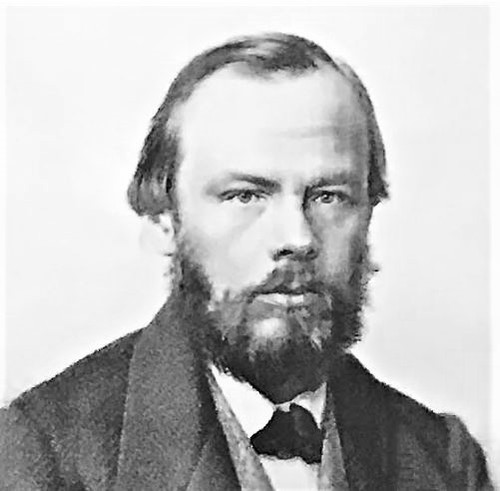
Фёдор Михайлович Достоевский
Personal Information
Description
Russian novelist Fyodor Mikhailovitch Dostoyevsky was a journalist and short-story writer, whose psychological penetration into the human soul profoundly influenced the 20th century novel. Dostoevsky's novels have much autobiographical elements, but ultimately they deal with moral and philosophical questions. He presented interacting characters with contrasting views or ideas about freedom of choice, Socialism, atheisms, good and evil, happiness and so forth. Dostoevsky's central obsession was God, whom his characters constantly search through painful errors and humiliations. Dostoyevsky's literary output explores human psychology in the troubled political, social and spiritual context of 19th-century Russian society. Considered by many as a founder or precursor of 20th-century existentialism, his Notes from Underground (1864), written in the embittered voice of the anonymous "underground man", was called by Walter Kaufmann the "best overture for existentialism ever written." A prominent figure in world literature, Dostoyevsky is often acknowledged by critics as one of the greatest psychologists in world literature. Фёдор Миха́йлович Достое́вский (рус. дореф. Ѳедоръ Михайловичъ Достоевскій; 30 октября [11 ноября] 1821, Москва, Российская империя — 28 января [9 февраля] 1881, Санкт-Петербург, Российская империя) — русский писатель, мыслитель, философ и публицист. Член-корреспондент Петербургской АН с 1877 года. Как в начале, так и в продолжении своего литературного творчества после четырёх лет каторги и ссылки за участие в кружке Петрашевского Достоевский выступал в качестве новатора в русле традиций русского реализма, что не получило должной оценки современников при жизни писателя. После смерти Достоевский был признан классиком русской литературы и одним из лучших романистов мирового значения, считается первым представителем персонализма в России. Творчество русского писателя оказало воздействие на мировую литературу, в частности, на творчество ряда лауреатов Нобелевской премии по литературе, на становление экзистенциализма и фрейдизма. К наиболее значительным произведениям писателя относятся романы «великого пятикнижия». Романы «Преступление и наказание», «Идиот», «Бесы» и «Братья Карамазовы» включены в список 100 лучших книг Норвежского книжного клуба 2002 года. Многие известные произведения Достоевского многократно экранизировались и инсценировались в театре, ставились балетные и оперные постановки. : :
Books
The Possessed
Бѣсы. 1/3
Part 1 of [Besy]( Also known as Demons or The Devils, this is Dostoyevsky’s most political novel. Though critical of the left-wing revolutionaries, split as they often were into disparate factions and cells the author also tacitly rebukes the conservative elite for failing to come to terms with the high levels of disaffection in the country, a stance that would ultimately lead to their downfall.
Crime and Punishment
Great Short Works of Fyodor Dostoevsky
Presents a collection of short stories by the Russian author, including "White Nights," "Notes from the Underground," and "A Gentle Creature."
Записки изъ подполья
Its nameless hero is a profoundly alienated individual in whose brooding self-analysis there is a search for the true and the good in a world of relative values and few absolutes. Moreover, the novel introduces themes — moral, religious, political and social — that dominated Dostoyevsky's later works.
Great Expectations and Related Readings
Great Expectations / novel by Charles Dickens -- The duke's children / short story by Frank O'Connor -- selection from Silent Dancing / autobiographical essay by Judith Ortiz Cofer -- You are a part of me / poem by Frank Yerby -- Time does not bring relief / poem by Edna St. Vincent Millay -- The pleasant Marey / article by Fyodor Dostoevsky -- The spinster's day/Journada de la soltera / poem by Rosario Castellanos ; translated by Magda Bogin -- The jilting of Granny Weatherall / short story by Katherine Anne Porter -- The house on the hill / poem by Edward Arlington Robinson.
Poor Folk and Other Stories (Бедные люди / Господин Прохарчин / Ползунков / Хозяйка)
Крокодил
ON the thirteenth of January of this present year, 1865, at half- past twelve in the day, Elena Ivanovna, the wife of my cultured friend Ivan Matveitch, who is a colleague in the same depart- ment, and may be said to be a distant relation of mine, too, expressed the desire to see the crocodile now on view at a fixed charge in the Arcade. As Ivan Matveitch had already in his pocket his ticket for a tour abroad (not so much for the sake of his health as for the improvement of his mind), and was consequently free from his official duties and had nothing whatever to do that morning, he offered no objection to his wife's irresistible fancy, but was positively aflame with curiosity himself.
The Best Short Stories of Dostoyevsky
White nights. -- The honest thief. -- The Christmas tree and a wedding. -- The peasant Marey. -- Notes from the underground. -- A gentle creature. -- The dream of a ridiculous man.
An Honest Thief and Other Stories
An honest thief. -- Uncle's dream. -- A novel in nine letters. -- An unpleasant predicament. -- Another man's wife. -- The heavenly Christmas tree. -- The peasant Marey. -- The crocodile. -- Bobok. -- The dream of a ridiculous man.
Récits, chroniques et polémiques
Le double.--Du danger de se livrer à des rêves ambitieux.--Monsieur Prokhartchine.--Un roman en neuf lettres.--Chronique pétersbourgeoise.--L'hôtesse.--Polzounkov.--Un cœur faible.--Un honnête voleur.--Un arbre de Noël et un mariage.--La femme d'un autre et le mari sous le lit.--Un petit héros.--Le rêve de l'oncle.--Stièpantchikovo et ses habitants.--Le temps.--L'époque.
Works (Бобок / Игрокъ / Скверный анекдот)
The stories in this volume demonstrate Dostoyevsky's genius for fusing caricature, irony and the grotesque to create a powerful dark humour. Jessie Coulson's introduction examines the personal and financial dramas that influenced Dostoyevsky.
Сон смешного человека
"The Dream of a Ridiculous Man" (Russian: Сон смешного человека, Son smeshnovo cheloveka) is a short story by Fyodor Dostoyevsky written in 1877. It chronicles the experiences of a man who decides that there is nothing of any value in the world. Slipping into nihilism with the “terrible anguish” he is determined to commit suicide. A chance encounter with a young girl, however, begins the man on a journey that re-instills a love for his fellow man. It was first published in A Writer's Diary.