
CISLEITHANIA AUTHOR · BIOGRAPHY · FICTION
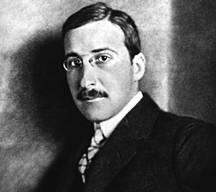
Stefan Zweig
Also known as: Стефан Цвейг, Stephen Branch
Stefan Zweig (geboren am 28. November 1881 in Wien, Österreich-Ungarn; gestorben am 23. Februar 1942 in Petrópolis, Brasilien) war ein österreichischer Schriftsteller, Übersetzer und Pazifist. Zweig gehörte zu den beliebtesten deutschsprachigen Schriftstellern seiner Zeit. Mit seinen vielgelesenen psychologischen Novellen wie Brennendes Geheimnis (1911), Angst, Brief einer Unbekannten, Der Amokläufer und literarisierten Biographien, darunter Magellan. Der Mann und seine Tat sowie Triumph und Tragik des Erasmus von Rotterdam, gehörte er zu den bedeutenden deutschsprachigen Erzählern zu Beginn des 20. Jahrhunderts. Seine Sprache ist durch Anschaulichkeit und klangliche Gefälligkeit gekennzeichnet; die Werke sind in ihrer Erzählweise sowie den stilistischen Mitteln weitgehend dem Realismus verpflichtet. Sie vereinigen klassische Elemente, darunter einen dramatischen Handlungsablauf, mit psychoanalytisch gezeichneten Figuren und betrachtet aus unterschiedlichen Perspektiven. So bot Zweig seiner breiten Leserschaft einen Zugang zu einer Literatur, in der ihre Gegenwart reflektiert wurde, ohne sie mit modernistischen Erzählweisen zu konfrontieren. Unter seinen zahlreichen Prosaarbeiten ragen besonders die Schachnovelle, die Sternstunden der Menschheit sowie seine Erinnerungen Die Welt von Gestern hervor.
Maria Concepcion walked carefully, keeping to the middle of the white dusty road, where the maguey thorns and the treacherous curved spines of organ cactus had not gathered so profusely.
— from Short stories
Most acclaimed

Schachnovelle
1943
Auf einem Passagierdampfer, der von New York nach Buenos Aires unterwegs ist, fordert ein Millionär gegen Honorar den mit einer Art mechanischer Präzision spielenden Schachweltmeister Mirko Czentovic zu einer Partie heraus. Der mitreisende Dr. B., ein österreichischer Emigrant, greift beratend ein und erreicht so ein Remis für den Herausforderer. Er hat sich, von der Gestapo, die ihn verhaftete, in ein Hotelzimmer gesperrt und von der Außenwelt hermetisch abgeschlossen, monatelang mit dem blinden Spiel von 150 Partien beschäftigt, um sich so seine intellektuelle Widerstandskraft zu erhalten. Durch diese einseitige geistige Anstrengung ergriff ihn ein Nervenfieber, dessentwegen man ihn entließ. Jetzt spielt Dr. B. zum ersten Mal wieder gegen einen tatsächlichen, freilich roboterhaft reagierenden Gegner. Es geht ihm bei dieser Partie lediglich darum, festzustellen, ob sein Tun damals während seiner Haft noch Spiel oder bereits Wahnsinn gewesen ist. Er schlägt den Weltmeister in der ersten Partie souverän, läßt sich aber, eigentlich gegen seinen Willen, auf eine Revanche ein. Während dieser zweiten Partie ergreift ihn wieder das Nervenfieber: er bricht die Partie ab und wird nie wieder ein Schachbrett berühren.
Short stories
For over three decades, Reynolds Price has been one of America's most distinguished writers, in a career that has been remarkable both for its virtuosity and for the variety of literary forms he has embraced. Now he shows himself as much a master of the story as he is of the novel, in a volume that presents fifty stories, including two early collections - The Names and Faces of Heroes and Permanent Errors - as well as more than two dozen new stories that have never been gathered together before. In his introduction, Mr. Price explains how, after the publication of his first two collections, he wrote no new stories for almost twenty years. "But once I needed - for unknown reasons in a new and radically altered life - to return to the story, it opened before me like a new chance...A collection like this then," he adds, "...will show a writer's pre-occupations in ways the novel severely rations (novels are partly made for that purpose - the release from self, long flights through the Other). John Keats's assertion that 'the excellence of every Art is its intensity' has served as a license and standard for me. From the start my stories were driven by heat - passion and mystery, often passion for the mystery I've found in particular rooms and spaces and the people they threaten or shelter - and my general aim is the transfer of a spell of keen witness, perceived by the reader as warranted in character and act.". There is, indeed, much for the reader to "witness" here of passion and mystery, of character and act. And the variety of stories - many of them set in Reynolds Price's native North Carolina, but a surprising number set in distant parts: Jerusalem in "An Early Christmas," the American Southwest in "Walking Lessons," and a number in Europe - will astonish even his most devoted readers. In short, The Collected Stories of Reynolds Price is as deeply rewarding a book as any he has yet published.