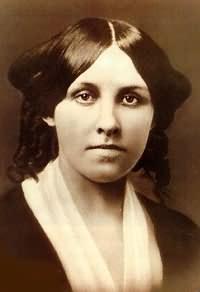

UNITED STATES AUTHOR · FICTION · CHILDREN
Louisa May Alcott
Also known as: Louisa M. Alcott, Alcott,Louisa May オルコット,ルイーザ・メイ
Louisa May Alcott was born in Germantown, Pennsylvania on November 29, 1832. She and her three sisters, Anna, Elizabeth, and May, were educated by their father, philosopher and teacher Bronson Alcott, and raised on the practical Christianity of their mother, Abigail May. Louisa spent her childhood in Boston and in Concord, Massachusetts, where her days were enlightened by visits to Ralph Waldo Emerson’s library, excursions into nature with Henry David Thoreau, and theatricals in the barn at "Hillside". Like her character, "Jo March" in Little Women, young Louisa was a tomboy. "No boy could be my friend till I had beaten him in a race," she claimed, "and no girl if she refused to climb trees, leap fences ..." For Louisa, writing was an early passion. She had a rich imagination and often her stories became melodramas that she and her sisters would act out for friends. Louisa preferred to play the "lurid" parts in these plays --"the villains, ghosts, bandits, and disdainful queens." At age 15, troubled by the poverty that plagued her family, she vowed: "I will do something by and by. Don’t care what, teach, sew, act, write -- anything to help the family; and I’ll be rich and famous and happy before I die, see if I won’t!"
"CHRISTMAS WON'T be Christmas without any presents, grumbled Jo, lying on the rug."
— from Little Women, 2002
Most acclaimed

The inheritance
In a chronicle of three generations of three working-class families, award-winning journalist Samuel G. Freedman tells the human story of the political transformation of twentieth-century America - the rise and fall of FDR's New Deal coalition and its displacement by the new conservatism of Ronald Reagan and Newt Gingrich. This is the single most important political phenomenon of our times. Freedman has selected three families who are at once singular and broadly representative. They are families who reached this country just as the century was beginning and struggled as blacksmiths and domestics and butchers and plumbers to gain a foothold. They are families who acted on their beliefs not only by voting but also by organizing neighborhoods and leading union chapters, canvassing precincts and watching polls and marching in torch-light parades. These families were pillars of the Democratic coalition that largely led America from 1932 until 1968 - community activists, trade unionists, machine politicians, with loyalties based on religion, ethnicity, and social class. These families equally embody the forces that shifted the majority into Republican hands for all but four years between 1968 and 1992 - grievances about taxes, crime, and reverse discrimination; the rise of suburbia and a shift to a new political machine based on private financing for development rather than public works. They are individuals who shifted from New Deal Democrats to Reagan Republicans to a mixture of GOP stalwarts, hesitant Clinton backers, and political dropouts. And in so doing, they carried with them a nation's destiny. The Inheritance will change our understanding of how and why America selects its leaders.
Little Women
2002
The girls gave their hearts into their mother's keeping, their souls into their father's; and to both parents...they gave a love that grew with their growth, and bound them tenderly together by the sweetest tie which blesses life and outlives death.Pretty Meg, tomboy Jo, shy Beth, and vain Amy, the four March sisters, are as different as sisters can be, but more devoted and loyal sisters you'll never find. For though the March girls fight, tease, nag, and scold as all sisters do, they do so with the knowledge that nothing is as precious as a sister's love. Discover the magic of family in the first part of this classic novel cherished by young girls everywhere.
Short stories
For over three decades, Reynolds Price has been one of America's most distinguished writers, in a career that has been remarkable both for its virtuosity and for the variety of literary forms he has embraced. Now he shows himself as much a master of the story as he is of the novel, in a volume that presents fifty stories, including two early collections - The Names and Faces of Heroes and Permanent Errors - as well as more than two dozen new stories that have never been gathered together before. In his introduction, Mr. Price explains how, after the publication of his first two collections, he wrote no new stories for almost twenty years. "But once I needed - for unknown reasons in a new and radically altered life - to return to the story, it opened before me like a new chance...A collection like this then," he adds, "...will show a writer's pre-occupations in ways the novel severely rations (novels are partly made for that purpose - the release from self, long flights through the Other). John Keats's assertion that 'the excellence of every Art is its intensity' has served as a license and standard for me. From the start my stories were driven by heat - passion and mystery, often passion for the mystery I've found in particular rooms and spaces and the people they threaten or shelter - and my general aim is the transfer of a spell of keen witness, perceived by the reader as warranted in character and act.". There is, indeed, much for the reader to "witness" here of passion and mystery, of character and act. And the variety of stories - many of them set in Reynolds Price's native North Carolina, but a surprising number set in distant parts: Jerusalem in "An Early Christmas," the American Southwest in "Walking Lessons," and a number in Europe - will astonish even his most devoted readers. In short, The Collected Stories of Reynolds Price is as deeply rewarding a book as any he has yet published.