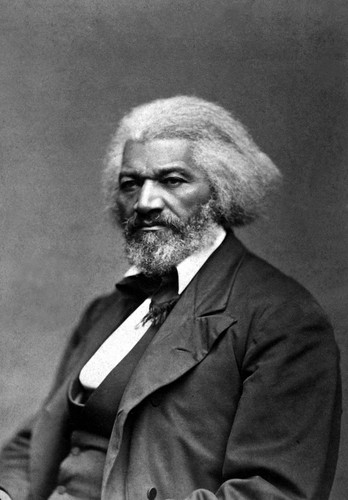
Frederick Douglass
1970
"We are deeply honored to announce that Thornwillow Press is working with renowned literary critic, historian, filmmaker, and Harvard University professor Henry Louis Gates Jr. to publish an exquisite letterpress, hand-bound edition: Frederick Douglass: Portrait of a Free Man. This exciting publication brings together the powerful Narrative of the Life of Frederick Douglass, with two monographs by Professor Gates, which offer readers new and profound insights. In many ways, Henry Louis Gates Jr.'s scholarship has defined the field of African American studies. He is one of the foremost public intellectuals of our day. "As any biographer of Douglass knows," says Gates, "there was not a Frederick Douglass; there were many Douglasses. And that, for him, was his ultimate claim on being fully and equally and complexly human." In Frederick Douglass: Portrait of a Free Man, Gates brings us the monograph "Binary Opposition in Douglass' Narrative", which explores the literary conventions and binary oppositions Douglass used, and gives the reader a deeper insight into the narrative. Gates second monograph, "Camera Obscura", examines the vital power photos have on public opinion, both in terms of abolition and contemporary society, and brings to light the fact that Frederick Douglass was the most photographed American of the 19th century. In a time when caricatures in mainstream media portrayed Black people as naturally subjugated and unintelligent, Douglass knew that art, in the hands of racist whites, did not depict reality. Photography, on the other hand, gave a true "likeness" and as a tool for social change, could be key in altering long-held stereotypes and prejudices about Black people. Douglass posed for 160 photographs over the course of his lifetime, and in doing so, gave people a new image: that of a dignified, intelligent, free Black man. Because how we see things, says Henry Louis Gates Jr. in Frederick Douglass: Portrait of a Free Man is how we view them. The edition contains fine art photographs throughout to illustrate this salient point. The timing of the publication of Frederick Douglass: Portrait of a Free Man is particularly poignant because Thornwillow Press calls Newburgh, NY home, and in 1870, Frederick Douglass visited our city to commemorate the passage of the Civil Rights Act that enforced the terms of the 15th Amendment. In honor of his visit to Newburgh and his legacy of voter rights, a city-wide commemoration is being planned for 2020. We are exceptionally pleased to bring this publication into being at such an auspicious moment."--Publisher's kickstarter prospectus (viewed 2019 May 13).