
UNITED STATES AUTHOR · PHILOSOPHY · HISTORY
R. Buckminster Fuller
Also known as: Buckminster Fuller, Richard Buckminster Fuller
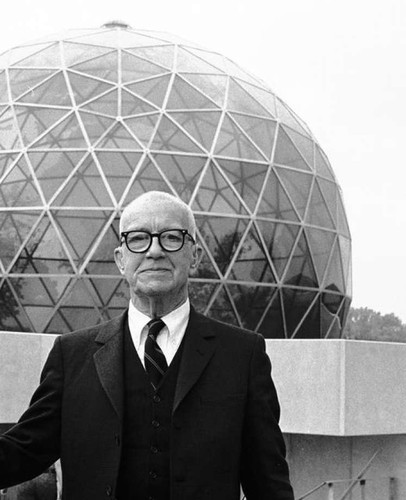
Richard Buckminster Fuller (/ˈfʊlər/; July 12, 1895 – July 1, 1983)was an American architect, systems theorist, author, designer, inventor, and futurist. Fuller published more than 30 books, coining or popularizing terms such as "Spaceship Earth", "Dymaxion" house/car, ephemeralization, synergetic, and "tensegrity". He also developed numerous inventions, mainly architectural designs, and popularized the widely known geodesic dome. Carbon molecules known as fullerenes were later named by scientists for their structural and mathematical resemblance to geodesic spheres. Fuller was the second World President of Mensa from 1974 to 1983.
When the body functions spontaneously, that is called instinct.
— from Intuition
Most acclaimed

Intuition
"How reliable is our intuition? How much should we depend on gut-level instinct rather than rational analysis when we play the stock market, choose a mate, hire an employee, or assess our own abilities? In this engaging and accessible book, David G. Myers shows us that while intuition can provide us with useful - and often amazing - insights, it can also dangerously mislead us."--BOOK JACKET.
R. Buckminster Fuller
Pattern-Thinking reassesses the work of Buckminster Fuller—unique hybrid between theoretician, architect, designer, educator, inventor, and author—as advancing contemporary models of design research, practice, and pedagogy. Drawing extensively on Fuller’s archive, the book follows his unique process of translation between the physical and conceptual dimensions of design, to redefine our understanding of the relationships between geometry, structure, language, and intellectual property. Rather than being organized around a chronology of distinct narratives, Pattern-Thinking follows these parallel explorations as the basis for Fuller’s artifacts and inventions. In the space between lines, models, words, and patents, it traces his ambition to measure physical experience in an ever-expanding pattern of relationships, while coordinating these into a conceptual network of words and concepts that shape the basis for his thinking. Advocating a multidisciplinary and political perspective, Fuller’s transversal logic expands the knowledge base of contemporary models of design, which seek to find broader participation and to address new publics.
Inventions
Today"s readers are fascinated by the idea of "life before technology." Inventions examines the ideas, machines, and technology that have shaped the modern age. Divided into four chapters--Communication, Inventions in the Home, Transportation, and Microtechnology--it charts the developments that led to the cell phone revolution and reveals the incredible growth of the information superhighway. Stunning computer-generated artwork shows how robotics can be used in complex surgery, as well as in heavy industry, and looks ahead to the propulsion technology that will one day take human beings to Mars.