
UNITED STATES AUTHOR · HISTORY · FEDERAL GOVERNMENT
Jane Jacobs
Also known as: Джейн Джекобс, Jane Margaret Jacobs
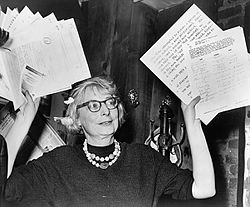
Jane Jacobs (born Jane Butzner; May 4, 1916 – April 25, 2006) was a Canadian and American journalist, author, and activist best known for her influence on urban studies. Her influential book The Death and Life of Great American Cities (1961) argued that urban renewal did not respect the needs of most city-dwellers. The book also introduced sociology concepts such as "eyes on the street" and "social capital". Jacobs was well known for organizing grassroots efforts to protect existing neighborhoods from "slum clearance" – and particularly for her opposition to Robert Moses in his plans to overhaul her neighborhood, Greenwich Village. She was instrumental in the eventual cancellation of the Lower Manhattan Expressway, which would have passed directly through SoHo and Little Italy, and was arrested in 1968 for inciting a crowd at a public hearing on the project. After moving to Toronto in 1968, she joined the opposition to the Spadina Expressway and the associated network of expressways in Toronto planned and under construction. As a mother and a female writer who criticized experts in the male-dominated field of urban planning, Jacobs endured scorn from established figures, who called her a "housewife" and a "crazy dame." She did not have a college degree, or any formal training in urban planning, and was criticized for being unscholarly and imprecise. She was also accused of inattention to racial inequality, and her concept of "unslumming" has been compared with gentrification. Source: Jane Jacobs. (2016, May 4). In Wikipedia, The Free Encyclopedia. Retrieved 10:55, May 4, 2016, from `
This book is an attack on current city planning and rebuilding.
Most acclaimed

The Death and Life of Great American Cities
The Death and Life of Great American Cities was described by The New York Times as “perhaps the most influential single work in the history of town planning. . . . [It] can also be seen in a much larger context. It is first of all a work of literature; the descriptions of street life as a kind of ballet and the bitingly satiric account of traditional planning theory can still be read for pleasure even by those who long ago absorbed and appropriated the book’s arguments.” Jane Jacobs, an editor and writer on architecture in New York City in the early sixties, argued that urban diversity and vitality were being destroyed by powerful architects and city planners. Rigorous, sane, and delightfully epigrammatic, Jane Jacobs’s tour de force is a blueprint for the humanistic management of cities. It remains sensible, knowledgeable, readable, and indispensable.
Edge of Empire
2005
Edge of Empire examines struggles over urban space in four contemporary first world cities: two sites in London and two sites in the Australian cities of Perth and Brisbane. Through these examples the spatialised cultural politics of a number of 'postcolonial' processes are unravelled: the imperial nostalgias of the one-time heart of empire, the City of London; the struggle of diasporic groups to make a homespace in the old imperial heartlands; the unsettling presence of Aboriginal claims for the sacred in the space of the modern city; and the emergence of hybrid spaces in the contemporary city. This book is about the unruly spatial politics of race and nation, nature and culture, past and present. This is a 'global geography of the local'. The book is distinctive in that it takes theories of colonialism and postcolonialism to the space of the city - it gives real space to the spatial metaphors of much contemporary social theory. If the contemporary city is a postmodern space it has not-so-hidden geographies of imperialism and postcolonialism. The global reach of the book - its focus of two poles of one trajectory of British imperialism - provides a global assemblage which form a basis for understanding the unruly fortunes of imperialism over space and time. This is not simply a material geography of territory, it is also an imaginative geography of desire and memory.
The Question of Separatism
In 1980, Jacobs offered an urbanistic perspective on Quebec's sovereignty in her book The Question of Separatism: Quebec and the Struggle over Separation. Jacobs was an advocate of a Province of Toronto to separate the city proper from Ontario. Jacobs said, "Cities, to thrive in the twenty-first century, must separate themselves politically from their surrounding areas."