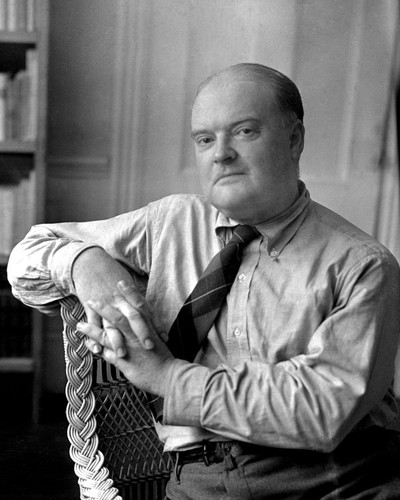
Edmund Wilson
Personal Information
Description
There is no description yet, we will add it soon.
Books
Literary essays and reviews of the 1920s & 30s
This collection provides us with his essays and reviews that were collected in "The Shores of Light" and the book that put him in the big leagues of artistic criticism, "Axel's Castle". This volume also supplies some reviews that were not collected in book form. You not only get a look at the writers and artists of his time, but also discover how Wilson sees them in the context of the artists of earlier times. For example, Axel's Castle examines literature from 1870-1930 through the works of six writers: W.B. Yeats, James Joyce, T. S. Eliot, Gertrude Stein, Marcel Proust, and Paul Valéry. He sees them as the culmination of a movement that began much earlier and discusses its origins and how these writers represent a fulfillment of the issues raise by Romanticism and so forth. This book is helpful in providing a context for understanding these writers within their culture, their artistic goals, and how things were viewed at the time—rather than passing judgment on those decades in retrospect. This book also has a chronology of Wilson's life, notes on the text, other notes that explain certain issues within the text that a modern reader might need help with, as well as an index.
Edmund Wilson, the man in letters
"Among the major writers of the Hemingway and Fitzgerald generation, Edmund Wilson defied categorization. He wrote essays, stories and novels, cultural criticism, and contemporary chronicles, as well as journals and thousands of letters about the literary life and his own private world." "Here for the first time in print is Wilson's personal correspondence to his parents, lovers and wives, children, literary comrades, and friends from the different corners of his life. Various writers and thinkers - including Lionel Trilling, Cyril Connolly, and Isaiah Berlin - take their places alongside upstate New York neighbors in this gallery of letters that extends from the teens to the early 1970s. These letters complete the picture of Wilson the man, offering unguarded moments and flinty opinions that enrich our understanding of a complex and troubled personality. Four times married and many times in love; traveling through Depression America, the USSR, postwar Europe, the Middle East, and Haiti; and writing on a Balzacian scale, Wilson as a correspondent reveals the exhilaration and chaos of being himself." "Arranged by correspondent and moving through the phases of his career, Edmund Wilson, the Man in Letters constitutes an exemplary autobiography cum cultural history. The writing itself is vintage Wilson - a blending of classical and conversational styles that stands as part of the modern American canon and is filled with the emotions and tastes of a master."--BOOK JACKET.
The higher jazz
Edmund Wilson, the preeminent American literary critic of the first half of the twentieth century, often fretted that he was not taken seriously as a creative writer. Though he completed in draft this short novel, now entitled The Higher Jazz, it was never published. In mid-career, in 1939, Wilson planned a novel in three parts that would carry a man through fifteen years as a stockbroker, a Russian diplomat, and a writer. When he started on the first section of this book, set in the 1920s, it carried him away from his original project. His hero was instead transformed into a German American businessman who, aspiring to become a composer, seeks the spirit of America in music that combined the contemporary popular and the modern classical, in what Wilson called elsewhere "the higher jazz." This portrayal of the 1920s provides a sense of the elusive glories of the Boom Era. Neale Reintz has edited The Higher Jazz for the general reader. His introduction sets the novel in the historical context of Wilson's life and writings, and his annotations explain the topical references and, more important, illustrate Wilson's method of composition.
From the uncollected Edmund Wilson
Many of Wilson's writings have been anthologized. But there is another body of work - over fifty fine essays on aspects of contemporary literature and ideas - that have been scattered in a variety of magazines, including The New Yorker, The New Republic, Vanity Fair, and The Nation. The editors, who recognize Wilson (1895-1972) as one of America's greatest men of letters of the twentieth century, also view his writing as a powerful antidote to late twentieth-century trends and fads and have collected his pieces here in the conviction that Wilson's writing is a permanently important model. Now a new generation of readers - as well as his loyal followers - will have access to this rich literary heritage in a single volume. . The collection is organized chronologically and leads the reader through the journeyman writing at Hill School and Princeton, the essays on literary modernism and contemporary culture written in the 1920s, the socially-focused critiques of the 1930s, and the diverse assortment of book reviews of the late period. Across this full range of moods and literary styles, Wilson is a powerful spokesman for writers and a guardian of imagination and decency for the informed citizen.
The fifties
The Fifties is a sweeping social, political, economic, and cultural history of the ten years that Halberstam regards as seminal in determining what our nation is today. Halberstam offers portraits of not only the titans of the age: Eisenhower Dulles, Oppenheimer, MacArthur, Hoover, and Nixon, but also of Harley Earl, who put fins on cars; Dick and Mac McDonald and Ray Kroc, who mass-produced the American hamburger; Kemmons Wilson, who placed his Holiday Inns along the nation's roadsides; U-2 pilot Gary Francis Powers; Grace Metalious, who wrote Peyton Place; and "Goody" Pincus, who led the team that invented the Pill.
Galahad
Galahad deals with a boys prep school, religion, and sex, I thought of Daisy pictures Greenwich Village life in the 20's.