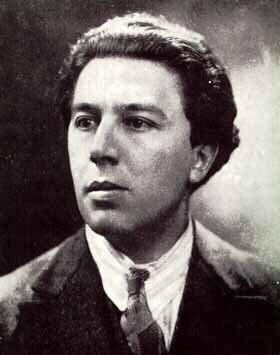
André Breton
Personal Information
Description
French writer and poet, co-founder of Surrealism
Books
Conversations
Nadja
The first surrealist romance, the principle narrative of Nadja is an account of the author's relationship with a girl in the city of Paris. The first-person narrative is supplemented by forty-four photographs of various surreal people, places, and objects which the author visits or is haunted by in Nadjar's presence, and which inspire him to meditate on their reality or lack of it.
Correspondance
Œuvres complètes
Free rein
Free Rein is a gathering of seminal essays by Andre Breton, the foremost figure among the French surrealists. Written between 1936 and 1952, they include addresses, manifestoes, prefaces, exhibition pamphlets, and theoretical, polemical, and lyrical essays. Together they display the full span of Breton's preoccupations, his abiding faith in the early principles of surrealism, and the changing orientations, in light of crucial events of those years, of the surrealist movement within which he remained the leading force.
Manifestes du surréalisme
„Die Maniteste des Surrealismus” sind die grundlegenden theoretischen Schriften des Surrealismus, jener bedeutenden historischen Avantgarde unseres Jahrhunderts, als deren Initiator und Organisator, vor allem aber auch Theoretiker, Lyriker und Romancier André Breton zu gelten hat (neben Aragon, Desnos, Eluard, Soupault). Bretons „Manifeste“ begründen die surrealistische Bewegung als einen Protest gegen die arbeitsteilig-zweckrationale Sonderung des bürgerlichen Alltags. „Dialektischer gefaßt aber heißt das: Hier wurde der Bereich der Dichtung von innen gesprengt, indem ein Kreis von engverbundenen Menschen ‚dichterisches Leben‘ bis an die äußersten Grenzen des Möglichen trieb.“ So formulierte Walter Benjamin die Intention des Surrealismus, Schluß zu machen mit der Autonomie der bürgerlichen Kunst, ihrer Trennung von der Lebenspraxis, was seinerzeit ein revolutionär-utopisches Moment enthielt: Infragestellung der Autonomie des schöpferischen Subjekts durch die kollektive Praxis der „écriture automatique“, des automatischen Schreibens, die zugleich den Primat des Bewußtseins zurückweist, Infragestellung aber auch der individuellen Form der Rezeption. Denn den Gegensatz zwischen Produktion und Rezeption aufzuheben liegt in der Logik der Bretonschen Forderung beschlossen, daß es gelte, „die Poesie zu praktizieren”. André Breton: 1896 in Tinchebray/Normandie geboren; publizierte 1924 das erste „Manifeste du Surréalisme“; gründete wichtige Zeitschriften, u. a.: „Littérature“ (1919 mit Soupault und Aragon), „La Révolution Surréaliste“ (1924 mit Péret, Eluard und Aragon), „VVV“ (1942 mit Duchamp und Max Ernst); veranstaltete in Paris 1938 und 1947 die großen Surrealistenausstellungen; starb 1966 in Paris.
Un listón alrededor de una bomba
"Breton's well-known phrase about Frida Kahlo's work provides the title for the catalog to the exhibition held at the Museo Casa Estudio Diego Rivera y Frida Kahlo in Mexico City, commemorating Breton's 1939 exhibition of Mexican art in Paris. In the form of an anthology, texts by Rivera, Breton, Luis Cardoza y Aragón (besides Breton and Kahlo) are reunited as a tribute to the founder of French surrealism, and to his connection with Mexican art and two of its more illustrious figures"--Handbook of Latin American Studies, v. 58.
The Magnetic Fields
Les Champs magnétiques (The Magnetic Fields) is a book by André Breton and Philippe Soupault. It is famed as the first work of literary Surrealism. Published in 1920, the authors used a surrealist automatic writing technique. The book is considered Surrealist, rather than Dadaist, because it attempts to create something new rather than react to an existing work. Les Champs magnetiques is characterised by rich textured language that often seems to border on the nonsensical. This is considered a "normal" result of automatic writing and is considerably more logical than the output from other Surrealist techniques, such as "exquisite corpse" (a method whereby each of a group of collaborators, in sequence, adds words or images to a composition). The division between chapters was the point where the writers stopped writing at the end of the day. The next chapter was started the following morning. Breton gave many interviews about the creation of the book.
Break Of Day
"Originally published in France in 1934, Break of Day is Andre Breton's second collection of critical and polemical essays, following The Lost Steps (Nebraska 1996). In fewer than two hundred pages, it captures the first full decade of the surrealist movement. The collection opens with an essay composed in 1924 that examines key elements of surrealism and concludes with Breton's harsh revaluation in 1933 of automatic writing."--BOOK JACKET.
The lost steps =
The Lost Steps (Les Pas perdus) is Andre Breton's first collection of critical and polemical essays. Composed between 1917 and 1923, these pieces trace his evolution during the years when he was emerging as a central figure in French (and European) intellectual life. They chronicle his tumultuous passage through the Dada movement, proclaim his explosive views on Modernism and its heroes, and herald the emergence of Surrealism itself. Along the way, we are given Breton's serious commentaries on his Modernist predecessors, Guillaume Apollinaire and Alfred Jarry, followed by his not-so-serious Dada manifestoes.