Discover

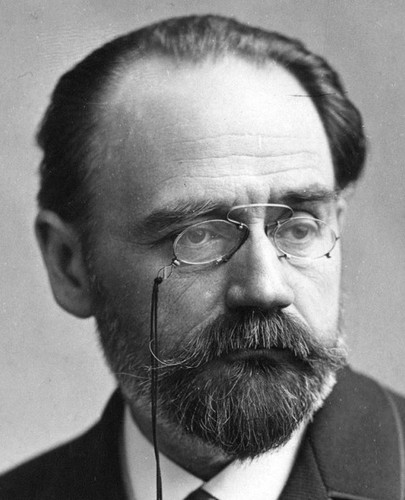
Émile Zola

Personal Information

Born April 2, 1840
Died September 28, 1902 (62 years old)
rue Saint-Joseph, France
Also known as: Émile Édouard Charles Antoine Zola, Эмиль Золя
144 books
4.1 (36)
245 readers

Description

Emile Zola was a French journalist and novelist known for his series of 20 novels known collectively as Les Rougon-Macquart (1871-93). Zola's style was called literary naturalism; his novels were attacked and even banned for their frankness and sordid detail, and caused quite a bit of controversy in their day. The same traits made him a best-selling author and a star of French literature in his day. In 1898 he then further incurred the wrath of French officials when he published the open letter "J'Accuse," in defense of Alfred Dreyfus, an Army officer who had been convicted of treason. Zola was sentenced to prison for libel, fled to England, and was granted amnesty a few months later. He died in Paris from carbon monoxide poisoning -- the victim of a stopped-up chimney -- a few months before Dreyfus was officially exonerated.

Books

Newest First

The Penguin Book of Horror Stories

0.0 (0)
27

The Monk of horror, or The Conclave of corpses, by Anonymous The Astrologer's prediction, or The Maniac's fate, by Anonymous The expedition to Hell, by James Hogg Mateo Falcone, by Prosper Merimee [Facts in the Case of M. Valdemar]( by Edgar Allan Poe Le Grande Breteche, by Honore de Balzac The romance of certain old clothes, by Henry James Who knows?, by Guy de Maupassant The body snatcher, by Robert Louis Stevenson The death of Olivier Becaille, by Emile Zola The boarded window, by Ambrose Bierce Lost hearts, by M.R. James The sea-raiders, by H.G. Wells The derelict, by William Hope Hodgson Thurnley Abbey, by Perceval Landon The fourth man, by John Russell In the penal colony, by Franz Kafka The waxwork, by A.M. Burrage Mrs. Amworth, by E.F. Benson The reptile, by Augustus Muir Mr. Meldrum's Mania, by John Metcalfe The beast with five fingers, by William Fryer Harvey Dry September, by William Faulkner Couching at the door, by D.K. Broster The two bottles of relish, by Lord Dunsany The man who liked Dickens, by Evelyn Waugh Taboo, by Geoffrey Household The thought, by L.P. Hartley Comrade death, by Gerald Kersh Leningen versus the ants, by Carl Stephenson The brink of darkness, by Yvor Winters Activity time, by Monica Dickens Earth to Earth, by Robert Graves The dwarf, by Ray Bradbury The Portabello Road, by Muriel Spark No flies on Frank, by John Lennon Sister Coxall's revenge, by Dawn Muscillo Thou shalt not suffer a witch ..., by Dorothy K. Haynes The terrapin, by Patricia Highsmith [Man from the south]( by Roald Dahl Uneasy home-coming, by Will F. Jenkins The Aquarist, by J.N. Allan An interview with M. Chakko, by Vilas Sarang

Œuvres complètes

Émile Zola, Etienne Bonnot de Condillac, Ivan Illich, André Chénier, André Malraux, Saint-John Perse, Stéphane Mallarmé, René Char, Joris-Karl Huysmans, Julien Green, Nicolas Malebranche, Honoré Daumier, Antonin Artaud, Auguste comte de Villiers de L'Isle-Adam, Mikhail Aleksandrovich Bakunin, Arthur Rimbaud, Stéphanie Félicité, comtesse de Genlis, Paul Éluard, Flavius Josephus, Pierre de Bérulle, Jean-Georges Lefranc de Pompignan, Saint Bernard of Clairvaux, H. R. Casgrain, Louis Armand de Lom d'Arce baron de Lahontan, Joachim Trotti de La Chétardie, Jules Michelet, Marie de Gournay, Cyrano de Bergerac, Augustin Louis Cauchy, François-René de Chateaubriand, P. J. G. Cabanis, William Robertson, Augustine of Hippo, X. Barbier de Montault, Henri-Dominique Lacordaire, Isabelle de Charrière, Jean-Louis Petit, Simone Weil, Alexis de Tocqueville, Maximilien Robespierre, Georges Bataille, Georges Canguilhem, Octave Crémazie, Pierre Reverdy, André Breton, J. S. Stas, Charles Rollin, Jean de La Bruyère, Benedictus de Spinoza, Dominique François Jean Arago, Honoré de Balzac, Roland Barthes, Sigmund Freud, Henri Michaux, Helvétius, Pierre de Ronsard, Madame de La Fayette, Victor Segalen, Bernard Le Bovier de Fontenelle, Maurice Blondel, Charles Baudelaire, Jean-Jacques Rousseau, Jean Gerson, George Sand, Charles Fourier, Thomas Jan Stieltjes, Jean Meslier, Louis Bourdaloue, Montaigne, Michel de, Boileau, Xavier de Maistre, Irène Némirovsky, Jean-Joseph Rabearivelo, Adam de La Halle, Isabelle Eberhardt, Esdras Minville, Dante Alighieri, Joseph de Maistre, Louis Auguste Blanqui, Teresa of Avila, Luc de Clapiers marquis de Vauvenargues, Jacques Prévert, Alfred de Vigny, Alfred Jarry, Saʻadia ben Joseph, Christiaan Huygens, François Rabelais, Jacques Roumain, Blaise Pascal, Pierre Corneille, Gabriel Bonnot de Mably, Hippocrates, Henri Marie Boudon, Saint-Just
0.0 (0)
1

Bête humaine

4.0 (2)
12

Did possessing and killing amount to the same thing deep within the dark recesses of the human beast? La Bête humaine (1890), the seventeenth novel in the Rougon-Macquart series, is one of Zola's most violent and explicit works. On one level a tale of murder, passion, and possession, it is also a compassionate study of individuals derailed by atavistic forces beyond their control. Zola considered this his 'most finely worked' novel, and in it he powerfully evokes life at the end of the Second Empire in France, where society seemed to be hurtling into the future like the new locomotives and railways it was building. While expressing the hope that human nature evolves through education and gradually frees itself of the burden of inherited evil, he is constantly reminding us that under the veneer of technological progress there remains, always, the beast within. This new translation captures Zola's fast-paced yet deliberately dispassionate style, while the introduction and detailed notes place the novel in its social, historical, and literary context. - Back cover.

L' argent

0.0 (0)
2

Aristide Rougon, known as Saccard, is a failed property speculator determined to make his way once more in Paris. Unscrupulous, seductive, and with unbounded ambition, he schemes and manipulates his way to power. Financial undertakings in the Middle East lead to the establishment of a powerful new bank and speculation on the stock market; Saccard meanwhile conducts his love life as energetically as he does his business, and his empire is seemingly unstoppable. Saccard, last encountered in The Kill (La Curée) in Zola's Rougon-Macquart series, is a complex figure whose story intricately intertwines the worlds of politics, finance, and the press. The repercussions of his dealings on all levels of society resonate disturbingly with the financial scandals of more recent times. This is the first new translation for more than a hundred years, and the first unabridged translation in English. The edition includes a wide-ranging introduction and useful historical notes. - Back cover.

Savage Paris

0.0 (0)
0

"Part of Emile Zola's multigenerational Rougon-Macquart saga, The Belly of Paris is the story of Florent Quenu, a wrongly accused man who escapes imprisonment on Devil's Island. Returning to his native Paris, Florent finds a city he barely recognizes, with its working classes displaced to make way for broad boulevards and bourgeois flats. Living with his brother's family in the newly rebuilt Les Halles market, Florent is soon caught up in a dangerous maelstrom of food and politics. Amid intrigue among the market's sellers - the fishmonger, the charcutiere, the fruit girl, and the cheese vendor - and the glorious culinary bounty of their labors, we see the dramatic difference between "fat and thin" (the rich and the poor) and how the widening gulf between them strains a city to the breaking point."--Goodreads.

The Flood

5.0 (1)
0

"When the rain comes pouring down Mrs Farmer has no choice but to let the farm animals inside with some very funny results. She ends up with dogs in the kitchen, pigs in the laundry, cows in the dining room, sheep in the sitting room & hens that lay eggs in all sorts of surprising places. When the water recedes she sends them all back outside ... but not for long. A delightful story about finding companionship in unlikely places."--Provided by publisher.
