
UNITED STATES AUTHOR · BIOGRAPHY · FRENCH AUTHORS
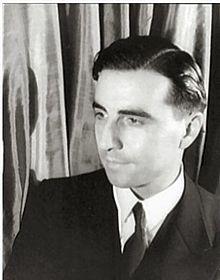
Julien Green
Also known as: Julian Green, Julian Hartridge Green
Green, Julien (1900-98). Catholic novelist, dramatist, and memorialist, born of American parents from the Southern states, which serve as a location for some of his fiction, but brought up in Paris and of French nationality. His early novels, such as Mont-Cinère (1926), Adrienne Mesurat (1927), and Léviathan (1928), evoke a claustrophobic world in which the characters' attempts to escape turn to passion, violence, and madness; they reflect Green's difficulties in reconciling sexuality, particularly homosexuality, with Catholicism. His work in the 1930s explores the possibility of escape from this bleak world through fantasy, and his later fiction, including Moïra (1950), Chaque homme dans sa nuit (1960), and L'Autre (1971), moves towards a more optimistic vision in which salvation is finally possible. In the 1950s he turned to drama, with three plays, Sud (1953), L'Ennemi (1954), and L'Ombre (1956), which show considerable dramatic talent and reflect the concerns of the novels. His spiritual and aesthetic evolution is recounted and explored in a third major area, his work as an autobiographer and, especially, diarist, whose Journal, begun in 1926, constitutes, with those of Gide and Mauriac, one of the major 20th-c. examples of the genre. [Nicholas Hewitt] [Source]
Architectural history is mostly a tale of men and buildings, not places.
— from Paris, 1937
Most acclaimed

Paris
1937
"Paris, with its majestic buildings, elegant boulevards, and colourful neighbourhoods, is often hailed as the most beautiful city in the world. In this lavishly illustrated book, one of the city's leading historians links the beauty of Paris to its harmonious architecture, the product of a powerful tradition of classical design running from the Renaissance to the twentieth century. Anthony Sutcliffe traces the main features of the development of Parisian building and architecture since Roman times, explaining the interaction of continuity and innovation and relating it to power, social structure, the property market, fashion, and the creativity of its architects. Three hundred illustrations, most in colour, complement the text, expressing the full character of Paris architecture." "Sutcliffe describes in fascinating detail how Paris merged medieval tradition with a Renaissance architecture imported from Italy - first by order of the Crown, then by the aristocracy, the Church, and the middle classes. Under Louis XIV this style became clearly French. After 1789 revolutions and industrialization threatened to undermine Parisian classicism, but it was reinforced by Haussmann in mid-century as part of the most impressive urban development project of all time. Because of Haussmann, says Sutcliffe, public and private buildings conformed to a more rigid design convention than any that Paris had previously known, a classical tradition that remained entrenched until the 1950s, when modernism made its impact in a high-rise revolution during the de Gaulle era. However, explains Sutcliffe, by 1970 this modernist architecture was rejected by the Paris public, and in the last decade the city has seen the emergence of a restrained neo-modern architecture that blends sensitively with the Parisian tradition."--BOOK JACKET.
Œuvres complètes
1990
En introduction, histoire critique des oeuvres de Pascal, et inventaire descriptif des sources. En première partie, écrits biographiques, mémoires et témoignages du XVIIe siècle relatifs à Pascal et à sa famille. Oeuvres historiques de Gilberte Pascal et de Marguerite Périer. (jaquette).
Journal
The journal of the brothers Edmond and Jules de Goncourt is one of the masterpieces of nineteenth-century French literature, a work that in its richness of color, variety, and seemingly casual perfection bears comparison with the great paintings of their friends and contemporaries the Impressionists. Born nearly ten years apart into a French aristocratic family, the two brothers formed an extraordinarily productive and enduring literary partnership, collaborating on novels, criticism, and plays that pioneered the new aesthetic of naturalism. But the brothers’ talents found their most memorable outlet in their journal, which is at once a chronicle of an era, an intimate glimpse into their lives, and the purest expression of a nascent modern sensibility preoccupied with sex and art, celebrity and self-exposure. The Goncourts visit slums, brothels, balls, department stores, and imperial receptions; they argue over art and politics and trade merciless gossip with and about Hugo, Baudelaire, Degas, Flaubert, Zola, Rodin, and many others. And in 1871, Edmond maintains a vigil as his brother dies a slow and agonizing death from syphilis, recording every detail in the journal that he would continue to maintain alone for another two decades.