Discover
Jun 19, 1623 — Aug 19, 1662· 39 yrs

KINGDOM OF FRANCE AUTHOR · EARLY WORKS TO 1800 · APOLOGETICS

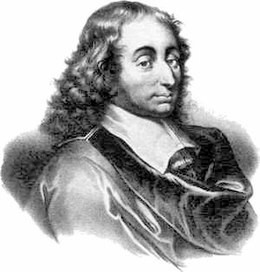
Blaise Pascal

Also known as: BLAISE PASCAL, Blaise Blaise Pascal

30
BOOKS
5.0
AVG RATING (3)
1
READERS

Blaise Pascal (19 June 1623 – 19 August 1662) was a French mathematician, physicist, inventor, philosopher, and Catholic writer. Pascal was a child prodigy who was educated by his father Étienne Pascal, a tax collector in Rouen. His earliest mathematical work was on projective geometry; he wrote a significant treatise on the subject of conic sections at the age of 16. He later corresponded with Pierre de Fermat on probability theory, strongly influencing the development of modern economics and social science. In 1642, he started some pioneering work on calculating machines (called Pascal's calculators and later Pascalines), establishing him as one of the first two inventors of the mechanical calculator.

birth house of Blaise Pascal, Kingdom of France
Wikipedia

Most acclaimed

#2

Great books of the Western World

0.0 (0)

Discusses the selection of works for and purpose of the set "Great Books of the Western World" and provides tools for use with the set, including author-to-idea and idea-to-author indexes and a ten-year reading list.

#1

Pensées

0.0 (0)

The important essay defending religion written by the mathematician and philosopher in the seventeenth century. Despite not being a gambler, Blaise Pascal proposed one of the most well-known bets in history: Every man's life is a wager against God. Still, it's a gamble that any man can win. Give up vices like alcohol, desire, sin, and other earthly pleasures, and you will either live happily ever after or in a different world. You can never lose if you live each day as though God exists.\ Although Pascal came up with his wager in the seventeenth century, his insightful writings still hold true today. Everything is debatable in this collection of fragments meant to serve as a defense of Christianity. Pascal demonstrates how skepticism and commitment go hand in hand by discussing topics such as the nature of love and the connection between scientific research and religious conviction.
#3

Œuvres complètes

1990

0.0 (0)

En introduction, histoire critique des oeuvres de Pascal, et inventaire descriptif des sources. En première partie, écrits biographiques, mémoires et témoignages du XVIIe siècle relatifs à Pascal et à sa famille. Oeuvres historiques de Gilberte Pascal et de Marguerite Périer. (jaquette).

Books

Newest First
