Discover

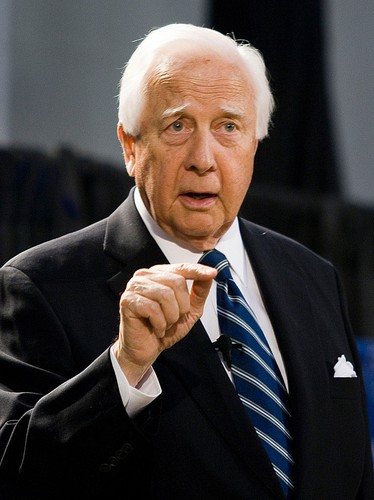
David McCullough

Personal Information

Born July 7, 1933
Died January 1, 2022 (88 years old)
Pittsburgh, United States
Also known as: David G. McCullough, David Gaub McCullough
21 books
4.4 (16)
318 readers

Description

David Gaub McCullough has been widely acclaimed as a “master of the art of narrative history.” He is twice winner of the Pulitzer Prize, twice winner of the National Book Award, and has received the Presidential Medal of Freedom, the nation’s highest civilian award.

Books

Newest First

Mornings on horseback

0.0 (0)
35

This biography of young Theodore Roosevelt covers his youth when he demanded a strenuous life despite his asthma, weak eyes, and patrician family.

The Path Between the Seas

4.0 (2)
43

The building of the Panama Canal was one of the most grandiose, dramatic, and sweeping adventures of all time. Spanning nearly half a century, from its beginnings by a France in pursuit of glory to its completion by the United States on the eve of World War I, it enlisted men, nations, and money on a scale never before seen. Apart from the great wars, it was the largest, costliest single effort ever mounted anywhere on earth, and it affected the lives of tens of thousands of people throughout the world. Here in all its heartbreak and eventual triumph the epic adventure is brought vividly alive by the Pulitzer Prize-winning author of such books as The Johnstown Flood, The Great Bridge, Truman, and John Adams. Filled with vivid detail and incident, The Path Between the Seas is not only a fact-filled account of an unprecedented engineering feat; it is also the story of the people who were caught up in it -- some to win fame and fortune, others to have their reputations and even their lives destroyed. For many it was the adventure of a lifetime, an adventure whose like will never be seen again. Out of it came a revolution, the birth of a new nation, the conquest of yellow fever, and the expansion of American power. Told from many viewpoints, this is an account drawn from previously unpublished and undiscovered sources, from interviews with actual participants and their families, from material gathered in Paris, Bogotá, Panama, the Canal Zone, and Washington. It is a canvas filled with memorable people: Ferdinand de Lesseps and his son Charles, trying to repeat de Lesseps's Suez triumph; Jules Verne; Paul Gauguin; Gustave Eiffel; A. T. Mahan and Richard Harding Davis; Senator Mark Hanna; Secretary of State John Hay; the incredible Philippe Bunau-Varilla, "the man who invented Panama"; Dr. William Gorgas; the forgotten American engineer hero John Stevens; Colonel George Washington Goethals; and, above all, Theodore Roosevelt, who "took Panama" in 1903 and left his indelible stamp on the canal.

The Johnstown flood

2.0 (1)
31

At the end of the last century, Johnstown, Pennsylvania was a booming coal-and-steel town filled with hardworking families striving for a piece of the nation's burgeoning industrial prosperity. In the mountains above Johnstown, an old earth dam had been hastily rebuilt to create a lake for an exclusive summer resort patronized by the tycoons of that same industrial prosperity, among them Andrew Carnegie, Henry Clay Frick, and Andrew Mellon. Despite repeated warnings of possible danger, nothing was done about the dam. Then came May 31, 1889, when the dam burst, sending a wall of water thundering down the mountain, smashing through Johnstown, and killing more than 2,000 people. It was a tragedy that became a national scandal.

Brave Companions

0.0 (0)
9

Portraits of men and women who have shaped the course of history or changed how we view the world.

The Wright brothers

5.0 (1)
10

Two-time winner of the Pulitzer Prize David McCullough tells the dramatic story of the courageous brothers who taught the world how to fly. On a winter day in 1903, on the remote Outer Banks of North Carolina, two unknown brothers from Ohio, Wilbur and Orville Wright, changed history. The age of flight had begun with the first heavier-than-air powered machine carrying a pilot. Far more than a couple of Dayton bicycle mechanics who happened to hit on success, the Wright brothers were men of exceptional ability, unyielding determination, and far-ranging intellectual interest and curiosity, much of which they attributed to their upbringing. They grew up without electricity or indoor plumbing, but with books aplenty, supplied mainly by their preacher father. And they never stopped learning. Nor did their high-spirited, devoted sister, Katharine, who played a far more important role in their endeavors than has been generally understood. When the brothers worked together, no problem seemed insurmountable. Wilbur, the older of the two, was unquestionably a genius. Orville had such mechanical ingenuity as few people had ever seen. Nothing stopped them in their "mission," not failures, not ridicule, not even the reality that every time they took off in one of their experimental contrivances, they risked being killed. In this thrilling book master historian David McCullough draws on the immense riches of the Wright Papers, including private diaries, notebooks, and more than a thousand letters from private family correspondence, to tell the human side of a profoundly American story. - Jacket flap.

1776

4.8 (4)
83

In this masterful book, David McCullough tells the intensely human story of those who marched with General George Washington in the year of the Declaration of Independence -- when the whole American cause was riding on their success, without which all hope for independence would have been dashed and the noble ideals of the Declaration would have amounted to little more than words on paper. Based on extensive research in both American and British archives, 1776 is a powerful drama written with extraordinary narrative vitality. It is the story of Americans in the ranks, men of every shape, size, and color, farmers, schoolteachers, shoemakers, no-accounts, and mere boys turned soldiers. And it is the story of the King's men, the British commander, William Howe, and his highly disciplined redcoats who looked on their rebel foes with contempt and fought with a valor too little known. At the center of the drama, with Washington, are two young American patriots, who, at first, knew no more of war than what they had read in books -- Nathanael Greene, a Quaker who was made a general at thirty-three, and Henry Knox, a twenty-five-year-old bookseller who had the preposterous idea of hauling the guns of Fort Ticonderoga overland to Boston in the dead of winter. But it is the American commander-in-chief who stands foremost -- Washington, who had never before led an army in battle. Written as a companion work to his celebrated biography of John Adams, David McCullough's 1776 is another landmark in the literature of American history.

American Spirit

0.0 (0)
0

A textbook that surveys the political, economic, and social strands that make up the fabric of American history, highlighting significant individuals, issues, and events.

In the Dark Streets Shineth

0.0 (0)
3

On Christmas Eve, 1941, Winston Churchill was at FDR’s White House. He’d raced across the Atlantic after Pearl Harbor to confer with the new ally he’d wooed for so long. That night, 20,000 Americans gathered on the White House lawn to hear the two leaders deliver words of hope. The next morning, Churchill and Roosevelt sang “O Little Town of Bethlehem” at church. Churchill had never heard the song, although its opening uncannily echoed his Christmas Eve message: “Yet in thy dark streets shineth the everlasting light.” With his usual charm and knowledge, McCullough collates that tale with the endearing story of “I’ll Be Home for Christmas”: Once Bing Crosby recorded it in 1943, it became the era’s most popular song—“even more,” McCullough notes, “than ‘White Christmas.’” McCullough told this story at the Mormon Tabernacle Choir’s 2009 Christmas concert; a DVD of the performance is included with the book, which also features the speeches of FDR and Churchill and evocative photos from the time. An affirming yet poignant reminder of how, in one of our darkest times, Americans found ways to come together.

The greater journey

3.0 (1)
11

This is the inspiring and, until now, untold story of the adventurous American artists, writers, doctors, politicians, architects, and others of high aspiration who set off for Paris in the years between 1830 and 1900, ambitious to excel in their work. Most had never left home, never experienced a different culture. None had any guarantee of success. That they achieved so much for themselves and their country profoundly altered American history. Elizabeth Blackwell, the first female doctor in America; future abolitionist Charles Sumner; staunch friends James Fenimore Cooper and Samuel F. B. Morse (who saw something in France that gave him the idea for the telegraph); pianist Louis Moreau Gottschalk; medical student Oliver Wendell Holmes; writers Ralph Waldo Emerson, Nathaniel Hawthorne, Mark Twain, and Henry James; Harriet Beecher Stowe, seeking escape from the notoriety Uncle Tom's Cabin had brought her; sculptor Augustus Saint-Gaudens and painters Mary Cassatt and John Singer Sargent; and American ambassador Elihu Washburne, who bravely remained at his post through the Franco-Prussian War, the long Siege of Paris and even more atrocious nightmare of the Commune. His vivid account in his diary of the starvation and suffering endured by the people of Paris (drawn on here for the first time) is one readers will never forget. Nearly all of these Americans, whatever their troubles, spent many of the happiest days and nights of their lives in Paris.--From publisher description. McCullough mixes famous and obscure names and delivers capsule biographies of everyone to produce a colorful parade of educated, Victorian-era American travelers and their life-changing experiences in Paris.

Declaring independence

0.0 (0)
0

"This volume asks us to reread and rethink our founding document. The Declaration of Independence as we now understand it - the stirring passages that define our democratic creed - is not the Declaration that Thomas Jefferson and his congressional colleagues drafted, nor the document that inspired or provoked contemporaneous readers and listeners at home and abroad." "Essays by four of the Declaration's leading students make the historic text come alive, enabling us to hear what it had to say in its own time and what it might have to say to us today. Copiously illustrated with selections from the Albert H. Small Declaration of Independence Collection at the University of Virginia and complemented by biographical sketches of the Declaration signers, this volume offers a rich resource for discovering the origin and influence of America's founding document."--Jacket.

John Adams

4.5 (4)
83

In this powerful, epic biography, David McCullough unfolds the adventurous life-journey of John Adams, the brilliant, fiercely independent, often irascible, always honest Yankee patriot who spared nothing in his zeal for the American Revolution; who rose to become the second President of the United States and saved the country from blundering into an unnecessary war; who was learned beyond all but a few and regarded by some as "out of his senses"; and whose marriage to the wise and valiant Abigail Adams is one of the moving love stories in American history. This is history on a grand scale -- a book about politics and war and social issues, but also about human nature, love, religious faith, virtue, ambition, friendship, and betrayal, and the far-reaching consequences of noble ideas. Above all, John Adams is an enthralling, often surprising story of one of the most important and fascinating Americans who ever lived.