
UNITED STATES AUTHOR · FICTION · ESSAYS
Joan Didion
Also known as: Joan. Didion, joan didion
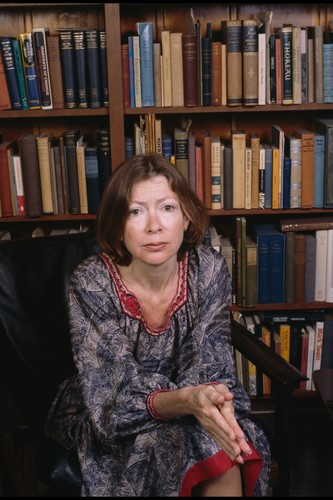
Joan Didion is an American author best known for her novels and her literary journalism. Her novels and essays explore the disintegration of American morals and cultural chaos, where the overriding theme is individual and social fragmentation. - Wikipedia
WHAT MAKES IAGO EVIL?
— from Play It as It Lays
Most acclaimed

Play It as It Lays
Set in a place beyond good and evil---literally in Hollywood, Las Vegas, and the barren wastes of the Mojave Desert, but figuratively in the landscape of an arid soul---it remains more than three decades after its original publication a profoundly disturbing novel, riveting in its exploration of a woman and a society in crisis and stunning in the still-startling intensity of its prose.
Political fictions
In 1988, Joan Didion began looking at the American political process for The New York Review of Books. What she found was not a mechanism that offered the nation's citizens a voice in its affairs but one designed by--and for--"that handful of insiders who invent, year in and year out, the narrative of public life." The eight pieces collected here from The New York Review build, one on the other, to a stunning whole, a portrait of the American political landscape that tells us, devastatingly, how we got where we are today.In Political Fictions, tracing the dreamwork that was already clear at the time of the first Bush ascendance in 1988, Didion covers the ways in which the continuing and polarizing nostalgia for an imagined America led to the entrenchment of a small percentage of the electorate as the nation's deciding political force, the ways in which the two major political parties have worked to narrow the electorate to this manageable element, the readiness with which the media collaborated in this process, and, finally and at length, how this mindset led inexorably over the past dozen years to the crisis that was the 2000 election. In this book Didion cuts to the core of the deceptions and deflections to explain and illuminate what came to be called "the disconnect"--and to reveal a political class increasingly intolerant of the nation that sustains it.Joan Didion's profound understanding of America's political and cultural terrain, her sense of historical irony, and the play of her imagination make Political Fictions a disturbing and brilliant tour de force.
Democracy
"From the former secretary of state and bestselling author -- a sweeping look at the global struggle for democracy and why America must continue to support the cause of human freedom. From the end of the Cold War and the collapse of the Soviet Union to the ongoing struggle for human rights in the Middle East, Condoleezza Rice has served on the front lines of history. As a child, she was an eyewitness to a third awakening of freedom, when her hometown of Birmingham, Alabama, became the epicenter of the civil rights movement for black Americans. In this book, Rice explains what these epochal events teach us about democracy. At a time when people around the world are wondering whether democracy is in decline, Rice shares insights from her experiences as a policymaker, scholar, and citizen, in order to put democracy's challenges into perspective. When the United States was founded, it was the only attempt at self-government in the world. Today more than half of all countries qualify as democracies, and in the long run that number will continue to grow. Yet nothing worthwhile ever comes easily. Using America's long struggle as a template, Rice draws lessons for democracy around the world -- from Russia, Poland, and Ukraine, to Kenya, Colombia, and the Middle East. She finds that no transitions to democracy are the same because every country starts in a different place. Pathways diverge and sometimes circle backward. Time frames for success vary dramatically, and countries often suffer false starts before getting it right. But, Rice argues, that does not mean they should not try. While the ideal conditions for democracy are well known in academia, they never exist in the real world. The question is not how to create perfect circumstances but how to move forward under difficult ones. These same insights apply in overcoming the challenges faced by governments today. The pursuit of democracy is a continuing struggle shared by people around the world, whether they are opposing authoritarian regimes, establishing new democratic institutions, or reforming mature democracies to better live up to their ideals. The work of securing it is never finished"--