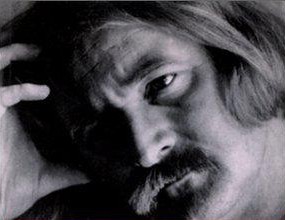
Richard Brautigan
Description
Richard Gary Brautigan (January 30, 1935 – ca. September 16, 1984) was an American novelist, poet, and short story writer. His work often clinically and surrealistically employs black comedy, parody, and satire, with emotionally blunt prose describing pastoral American life intertwining with technological progress. He is best known for his novels Trout Fishing in America (1967) and In Watermelon Sugar (1968). Brautigan began his career as a poet, with his first collection being published in 1957. He made his debut as a novelist with A Confederate General from Big Sur (1964), about a seemingly delusional man who believes himself to be the descendant of a Confederate general. Brautigan would go on to publish numerous prose and poetry collections until 1982. He committed suicide in 1984.
Books
Willard and his bowling trophies
Another sad, moving, funny slice of midwest american weirdness from Richard god rest his weary soul.. Think Coen Brothers meet Woody Allen over a couple of bongs. Basically it's about three brothers who go on the rampage looking for their stolen bowling trophies but it's not really about them at all - it's about Bob and Constance and "the Story of O Game". It's about love and loss. You must seek out this book and read it and then you will be a better person.
The Hawkline Monster
The Hawkline Monster: A Gothic Western is a novel by Richard Brautigan first published in 1974. The novel is his fifth published novel, and a parody of Western and Gothic novels.
Revenge of the Lawn Stories 1962-1970
Overview: Three unforgettable Brautigan masterpieces reissued in a one-volume omnibus edition : Revenge of the Lawn, The Abortion, So the Wind Won't Blow It All Away REVENGE OF THE LAWN: Originally published in 1971, these bizarre flashes of insight and humor cover everything from "A High Building in Singapore" to the "Perfect California Day." This is Brautigan's only collection of stories and includes "The Lost Chapters of TROUT FISHING IN AMERICA." THE ABORTION: AN HISTORICAL ROMANCE 1966: A public library in California where none of the books have ever been published is full of romantic possibilities. But when the librarian and his girlfriend must travel to Tijuana, they have a series of strange encounters in Brautigan's 1971 novel. SO THE WIND WON'T BLOW IT ALL AWAY: It is 1979, and a man is recalling the events of his twelfth summer, when he bought bullets for his gun instead of a hamburger. Written just before his death, and published in 1982, this novel foreshadowed Brautigan's suicide. Genre: Anthology | Literature & Fiction
The Abortion - An Historical Romance 1966
The Abortion: An Historical Romance 1966 is a novel by Richard Brautigan first published in 1971 by Simon & Schuster. In subsequent printings the title is often shortened to simply The Abortion. he Abortion is a genre novel parody concerning the librarian of a very unusual California library which accepts books in any form and from anyone who wishes to drop one off at the library—children submit tales told in crayon about their toys; teenagers tell tales of angst and old people drop by with their memoirs—described as "the unwanted, the lyrical and haunted volumes of American writing" in the novel.Summoned by a silver bell at all hours, submissions are catalogued at the librarian's discretion; not by the Dewey Decimal system, but by placement on whichever magically dust-free shelf would, in the author's judgment, serve best as the book's home.
In Watermelon Sugar
IN WATERMELON SUGAR is a story of love and betrayal that takes place in an extraordinary environment where the sun shines a different color every day.
Richard Brautigan's Trout fishing in America ; The pill versus the Springhill mine disaster, and In watermelon sugar
Science fact/fiction
Science fiction: before Christ and after 2001, an introduction / Ray Bradbury -- The gun without a bang / Robert Sheckley -- Crabs take over the island / Anatoly Dnieprov -- All watched over by machines of loving grace / Richard Brautigan -- EPICAC / Kurt Vonnegut, Jr. -- R.U.R. / Karel Capek -- The human factor / David Ely -- The thinking machine / Isaac Asimov -- Misbegotten missionary / Isaac Asimov -- Elegy / Charles Beaumont -- Aesthetics of the moon / Jack Anderson -- Constant reader / Robert Bloch -- Who's there? / Arthur C. Clarke -- We'll never conquer space / Arthur C. Clarke -- The sack / William Morrison -- Mariana / Fritz Leiber -- I always do what Teddy says / Harry Harrison -- The man who could work miracles / H.G. Wells -- Echoes of the mind / Arthur Koestler -- The reluctant orchid / Arthur C. Clarke -- Founding father / Isaac Asimov -- The wound / Howard Fast -- The [sound machine]( / Roald Dahl -- Love among the cabbages / Peter Tompkins and Christopher Bird -- Puppet show / Fredric Brown -- Random sample / T.P. Caravan -- On the wheel / Damon Knight -- Orbiter 5 shows how Earth looks from the moon / May Swenson -- The king of the beasts / Philip Jose Farmer -- UFO detective solves 'em all, well, almost / Philip J. Hilts -- The good provider / Marion Gross -- A sound of thunder / Ray Bradbury -- Who's cribbing? / Jack Lewis -- The third level / Jack Finney -- Speed / Josephine Miles -- The inn outside the world / Edmond Hamilton -- On the relativity of time / Wolfgang Pauli -- Relativity wins again -- A matter of overtime -- There will come soft rains / Ray Bradbury -- The forgotten enemy / Arthur C. Clarke -- Earthmen bearing gifts / Fredric Brown -- The lfth of Oofth / Walter Tevis -- Electronic tape found in a bottle / Olga Cabral -- Brace yourself for another ice age / Douglas Colligan -- The census takers / Frederik Pohl -- Disappearing act / Alfred Bester -- Bulletin / Shirley Jackson -- Autofac / Philip K. Dick -- Toward the space age / William Stafford -- Spaceship Earth / R. Buckminster Fuller -- Biographies of authors -- Science-fiction awards.
Experiencing Reading
Incident —Countee Cullen 5 Excerpt from The History of Art —H. W. Janson 11 Don't let that horse/eat that violin —Lawrence Ferlinghetti 11 The Upturned Face —Stephen Crane 14 How to Defuse the Population Bomb—Robert S. McNamara zz Population: The Uninvited Guest—Eugene Linden 30 Excerpt from My Lord, What a Morning —Marian Anderson 34 Parent and Child: What's behind spiked hair and pierced ears—Lawrence Kutner 37 Language and the Lunatic Fringe —Doris Lessing 40 Excerpt from Mr. Godolphin—Martha Sullivan Research in Brief: Flight of the Bumblebee —Mary Jones 48 How a New England Legend Came to Be —Alan Ferguson 50 Maintaining the Organic Lawn 51 Village of Snake Charmers Sees Hard Times —Barbara Crossette 52 Assault Weapons Aren't 'the Problem —Gary Kleck 54 Our Two-Sided Brain —John Chaffee 65 Stars —Sara Teasdale 80 Excerpt from Tarzan of the Apes—Edgar Rice Burroughs 91 The Waning Moon—Percy Bysshe Shelley 103 Hagar the Horrible—Dik Browne 103 The First Tastes of Vintage '93—Bryan Miller 104 '80s-Babble: Untidy Treasure —Stefan Kanfer 105 Dermatitis —Samuel M. Bluefarb, M.D. 117 A Brief History of Exercise—Victoria Roberts 143 [The Story of an Hour]( —Kate Chopin 177 I'm Your Horse in the Night—Luisa Valenzuela 183 Appointment in Samarra—W. Somerset Maugham 191 Excerpt from Elmira—Richard Brautigan 197 Excerpt from [Fahrenheit 451]( Bradbury 203 Chains 1942—Fanny Tillman Trueherz and Sandra Brown 209 Jack Luggage —William McGreevy 221 Girls of Summer —Marie Brenner 229 Death in the Orchard—Edward Brown 235 Excerpt from "No Name Woman" in The Woman Warrior—Maxine Hong Kingston 241 A Rough Ride—John Marchese 247 Marian Anderson Is Dead at 96; Singer Shattered Racial Barriers —Allan Kozinn 257 300 People of Letters Come To Pulitzer's Birthday Party—James Barron 265 How to Assay an Essay —Carmen Collins 283 Hand, Eye, Brain: Some "Basics" in the Writing Process—Janet Emig 289 Seeing and Imagining: Clues to the Workings Of the Mind's Eye—Sandra Blakeslee 295 Linguists Debate Study Classifying Language As Innate Human Skill —Gina Kolata 305 The Many Lives and Tricks of 9 —Pico Iyer 313 Cross Out a Landmark on the Chinatown Tour—Michael T. Kaufman 319 Dollie And Johnnie—William Safire 325 Into the Sunshine and Another Spring—John A. Gould 331 Language of Early Americans is Deciphered —John Noble Wilford 337 In Praise of the Humble Comma—Pico lyer 345 The 30•Second Spot Quiz —Hugh Rank 362 The Communication Collapse—Norman Cousins 371 Appearances Are Destructive—Mark Mathabane 377 Voters Assailed by Unfair Persuasion—Daniel Goleman 383 When Movies Ruled Our Lives—Theodore Roszak 399 Hue and Cry—Barbara Flanagan 407
Loading mercury with a pitchfork
" ... delicate, full of insight and the ability to see and describe the possibilities and complications of the world in a lucid and totally original way ..."
Prentice Hall literature
Prentice Hall Literature--Timeless Voices, Timeless Themes--Gold Level
Trout Fishing in America
Richard Brautigan's world is one of gentle magic and marvelous laughter, of the incredibly beautiful and the beautifully incredible. Trout Fishing in America is a pseudonym for the miraculous. A journey which begins at the foot of the Benjamin Franklin statue in San Francisco's Washington Square, which wanders through the wonders of America's rural waterways, and which ends, inevitably, with mayonnaise. Funny, wild, and sweet, Trout Fishing in America is an incomparable guidebook to the delights of exploration -- both of land and mind. Richard Brautigan was a literary idol of the 1960s and 1970s whose comic genius and iconoclastic vision of American life caught the imagination of young people everywhere. His early books became required reading for the hip generation, and on its publication, Trout Fishing in America, considered by many as his best novel, became an international bestseller.With it Brautigan caught the public's attention and became a cult hero. By 1970 Trout Fishing in America had become the namesake of a commune, a free school, an underground newspaper, and more.
A Confederate general from Big Sur, Dreaming of Babylon, and The Hawkline monster
An odd grouping of three novels, the classic Confederate General with the masterpiece Hawkline Monster and the pedestrian gumshoe spoof Dreaming Of Babylon. Two out of three ain't bad!
So the wind won't blow it all away
A beautiful, terse, and distilled account of one 12-year old boy's childhood in America during the 1940's. His family (he has a mother and two sisters) is on welfare and they live in a trailer and once in the extra apartment of a funeral home. The book builds through his childhood, recounting his experiences and how they slowly wove together into tragedy when, on February 17, 1948, he accidentally kills his friend while shooting rotten apples in an orchard with him. This event changes him for life and leaves him tortured about his decision to buy bullets for his gun and go shooting apples with David instead of purchasing a hamburger. He becomes obsessed with the choice he made and for a while believes that he can only achieve salvation for David's death by learning everything he possibly can about hamburgers. Finally, his family moves to a new place and he gives up all of his hamburger research, burning files and pages of it in a park grill in the rain outside of a zoo, where a sad coyote watches him from behind bars.
The Edna Webster Collection of Undiscovered Writings
"On the eve of his departure from Eugene, Oregon, to San Francisco and worldly success, a twenty-one-year-old unpublished writer named Richard Brautigan gave these funny, buoyant stories and poems as a gift to Edna Webster, the beloved mother of both his best friend and his first "real" girlfriend. The stories and poems show Brautigan as hopelessly lovestruck, cheerily goofy, and at his most disarmingly innocent. We see not only a young man and young artist about to bloom, but also the whole literary sensibility of the 1960s counterculture about to spread its wings and fly."--BOOK JACKET.