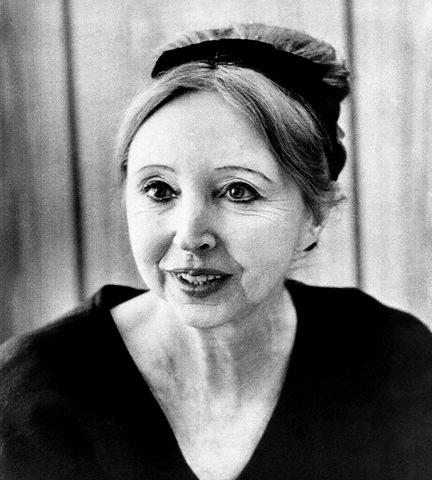
Anaïs Nin
Personal Information
Description
Anaïs Nin is known internationally for her diary, eleven volumes of which have been published. The 35,000 handwritten pages of her journals are currently located in the UCLA library. She was born in Paris to Cuban parents, and spent her early years in Cuba and Spain. Her young adulthood was spent in Paris and she and her husband, Hugo Guiler, moved to the United States in 1939 to avoid World War II. After meeting Rupert Pole in 1947 she engaged in a "bicoastal trapeze" living with him in Los Angeles as a married couple and maintaining her marriage with Guiler in New York. She died of cervical cancer in 1977.
Books
Little Birds
Thirteen explorations of sexual variants feature rivals for the same lover, husbands with exotic tastes and frustrated wives, a celebrated prostitute, a sixteen-year-old waif striving to surpass her mother, and other adventurers.
Arrows of longing
Arrows of Longing presents an Anais Nin radically different from the self-conscious persona of the diaries and fiction. The woman engaged in this long, private correspondence emerges as warm, self-effacing, empathetic, and ready to bear the burdens of others. Felix Pollak, the poet whose friendship with Nin is documented here, also struggled for personal and artistic fulfillment.
Seduction of the Minotaur
Seduction of the Minotaur is the fifth and final volume of Anaïs Nin's continuous novel known as Cities of the Interior. First published by Swallow Press in 1961, the story follows the travels of the protagonist Lillian through the tropics to a Mexican city loosely based on Acapulco, which Nin herself visited in 1947 and described in the fifth volume of her Diary. As Lillian seeks the warmth and sensuality of this lush and intriguing city, she travels inward as well, learning that to free herself she must free the "monster" that has been confined in a labyrinth of her subconscious."-- Provided by publisher
Nearer the moon
Anais Nin's diary was her "ultimate confidante," and to it she revealed her private self, her doubts and weaknesses, and the uncensored details about her physical relationships. This discipline of daily writing also helped Nin develop the skills to write her edited diaries and best-selling volumes of erotica. The fourth volume of "A Journal of Love," Nearer the Moon covers the years 1937 through 1939 and continues the story begun in Fire of Nin's "dismemberment by love.". She remains torn between three men: Henry Miller, whose detached self-immersion and artistic "impersonality" both attract and repel her; Gonzalo More, a sensitive and attentive but jealous lover who drives her to distraction; and Hugh Guiler, her faithful husband, who provides a calm center for Nin. In addition, a wide circle of family, friends, and admirers makes demands on Nin's time and emotional energy. She is constantly busy helping people - finding apartments and rent money, taking trips to the doctor, encouraging artistic pursuits. And yet, she cannot abandon her writing - the structured world of the writer is her refuge.
The mystic of sex and other writings
This book includes short essays spanning a period of forty years and illustrates the variety of styles and concerns which made Anais Nin one of the most influential writers of her century.
Conversations with Anaïs Nin
Largely ignored by mainstream audiences for the first thirty years of her career, Anais Nin (1903-1977) finally came into her own with the publication of the first part of her diary in 1966. Thereafter she was catapulted into fame. Throughout the late sixties and the seventies she attracted a host of devoted and admiring readers in the counter culture, who were magnetized by her personal liberation and openness. For a woman to make such probing exploration of the intimate recesses of her psyche made her a cult figure with a large and lasting readership. Born in France, Anais Nin lived much of her life in America. Her liaison with Henry Miller and his wife June, documented in her explicitly detailed diaries, became the subject of a major film of the nineties. Her forthright books, her diaries that continue to be published in a steady flow, and her charismatic charm made her the subject of many candid interviews, such as those collected here. Eight included in this volume are printed for the first time. Many others were originally published in magazines that are now defunct. Nin elaborates on subjects only touched upon in the diaries, and she speaks also of her role in the women's movement and of her philosophies on art, writing, and individual growth.
Incest
Few writings explore a woman's love life in such detail, with such subtlety, insight, and pain, as does Anais Nin's original, uncensored diary. It is a life record that deals openly with the physical aspects of relationships and unsparingly with the full spectrum of psychological ramifications. Here was a woman who sought the freedom to act out her sexual and emotional desires with the same guiltless, "amoral" abandon that men have always claimed for themselves. When Nin began publishing sections of her diary in 1966, this aspect of her life was excised, though clearly there was more than could be told at the time concerning her relationships with Henry Miller and his wife, June, with the writer and actor Antonin Artaud, with her analysts Rene Allendy and Otto Rank, and - most important - with her father. Here now is the previously missing portion of Nin's life in the crucial years from 1932 to 1934, the shattering psychological drama that drove her to seek absolution from her psychoanalysts for the ultimate transgression. In its raw exposure of a woman's struggle to come to terms with herself, to find salvation in the very act of writing, Incest unveils an Anais Nin without masks and secrets, yet in the end still mysterious, perhaps inexplicable.
Henry and June
Drawn from the original, uncensored journals of Anaïs Nin,Henry and June is an intimate account of a woman's sexual awakening. It covers a single momentous year - from late 1931 to the end of 1932 - during Nin's life in Paris, when she met Henry Miller and his wife, June. She fell in love with June's beauty and Henry's writing and, soon after June's departure for New York, began a fiery affair with Henry, which liberated her sexually and morally but undermined her marriage and let her into psychoanalysis. One question dominated her thoughts: what would happen when June returned to Paris? That event took place in October 1932, leaving Nin trapped between two loves - Henry and June.
The Early Diary of Anais Nin, Volume 4
A charming and amusing view of Nin's early life, from age eleven to seventeen; the self-portrait of an innocent girl who is transformed, through her own insights, into an enlightened young woman. "An enchanting portrait of a girl's constant search for herself" (Library Journal). Preface by Joaquin Nin-Culmell; Index; photographs and drawings. Translated by Jean L. Sherman.
A Spy in the House of Love
Beautiful, bored and bourgeoise, Sabina leads a double life inspired by her relentless desire for brief encounters with near-strangers. Fired into faithlessness by a desperate longing for sexual fulfilment, she weaves a sensual web of deceit across New York. But when the secrecy of her affairs becomes too much to bear, Sabina makes a late night phone-call to a stranger from a bar, and begins a confession that captivates the unknown man and soon inspires him to seek her out...
Delta of Venus
Conjuring up a cascade of sexual encounters, this book evokes the essence of female sexuality in a world where only love has meaning. Among these provocative stories, a Hungarian adventurer seduces wealthy women then vanishes with their money; a veiled woman selects strangers from a chic restaurant for private trysts; and a Parisian hatmaker named Mathilde leaves her husband for the opium dens of Peru.
