Discover

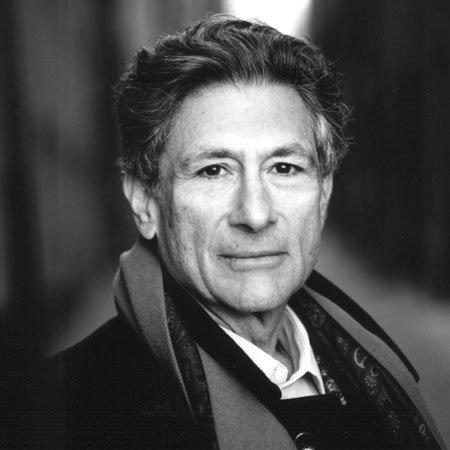
Edward W. Said

Personal Information

Born January 1, 1935
Died January 1, 2003 (68 years old)
Jerusalem, Mandatory Palestine
Also known as: EDWARD W. SAID, Edward Said
40 books
4.3 (10)
408 readers

Description

Edward Wadie Said (1 November 1935 – 24 September 2003) was a Palestinian and American academic, literary critic, and political activist. As a professor of literature at Columbia University, he was among the founders of post-colonial studies. As a cultural critic, Said is best known for his book Orientalism (1978), a foundational text which critiques the cultural representations that are the bases of Orientalism—how the Western world perceives the Orient. His model of textual analysis transformed the academic discourse of researchers in literary theory, literary criticism, and Middle Eastern studies.

Books

Newest First

On late style

0.0 (0)
6

In his fascinating last book, Edward Said looks at a selection of essays, poems, novels, films, and operas to determine what late style may explain about the evolution of the creative life. He discusses how the approaching death of an artist can make its way "with anachronism and anomaly" into his work, as was the case in the late work of Thomas Mann, Richard Strauss, Jean Genet, Giuseppe Tomasi di Lampedusa, and C. P. Cavafy. Said examines Beethoven's Missa Solemnis, Genet's Le captif amoureux and Les paravents, Mozart's Cosi fan tutte, Visconti's film of Lampedusa's The Leopard, Euripides' The Bacchae and Iphigenia at Aulis, and Thomas Mann's Death in Venice, among other works.He points out that one can also find an "unearthly serenity," in last works, for example, in Sophocles, Shakespeare, Rembrandt, Matisse, Bach, and Wagner, which, as Said puts it, "crown a lifetime of aesthetic endeavor." But in On Late Style he concentrates on artistic lateness as "intransigence, difficulty, and unresolved contradiction." He also writes about Theodor Adorno and about Glenn Gould, who chose to stop performing, thereby creating his own form of lateness. Said makes clear that most of the works discussed are rife with deep conflict and an almost impenetrable complexity. In fact, he feels that lateness is often "a form of exile." These works frequently stood in direct contrast to what was popular at the time, but they were forerunners of what was to come in each artist's particular discipline--works of true genius.Eloquent and impassioned, brilliantly reasoned and revelatory, On Late Style is Edward Said's own great last work.From the Hardcover edition.

From Oslo to Iraq and the roadmap

0.0 (0)
5

"In From Oslo to Iraq and the Road Map, Said writes about the second intifada and about the so-called peace process, which he terms a kind of "fast-food peace" underscored by "malevolent sloppiness." He discusses the breach of democracy in the last American presidential election and describes the Bush administration as hopeless in its allegiance to the Christian right and to the big oil companies. He writes passionately against the war in Iraq and condemns the "road map" as a plan not for peace but for pacification of the Palestinians. He makes clear the ways in which the U.S. response to 9/11 has further destabilized the Middle East, but finds as well reasons for hope: the Palestinian National Initiative, an organization of grassroots activists who share a burgeoning idea of democracy "undreamed of by the [Palestinian] Authority." What has always set Said apart is his ability to state the uncensored truth about the realities of the Palestinian experience, from land expropriation and dispossession, to assassinations, roadblocks, and house demolitions." "In this book, Said reveals information that never finds its way into the American media, thus providing a real context for our understanding of the Middle East."--BOOK JACKET.

Parallels and Paradoxes

0.0 (0)
4

These free-wheeling, often exhilarating dialogues--which grew out of the acclaimed Carnegie Hall Talks--are an exchange between two of the most prominent figures in contemporary culture: Daniel Barenboim, internationally renowned conductor and pianist, and Edward W. Said, eminent literary critic and impassioned commentator on the Middle East. Barenboim is an Argentinian-Israeli and Said a Palestinian-American; they are also close friends.As they range across music, literature, and society, they open up many fields of inquiry: the importance of a sense of place; music as a defiance of silence; the legacies of artists from Mozart and Beethoven to Dickens and Adorno; Wagner's anti-Semitism; and the need for "artistic solutions" to the predicament of the Middle East--something they both witnessed when they brought young Arab and Israeli musicians together. Erudite, intimate, thoughtful and spontaneous, Parallels and Paradoxes is a virtuosic collaboration.From the Trade Paperback edition.

Freud and the Non-European

3.0 (1)
10

"Using an array of material from literature, archaeology and social theory, Edward Said's essay is an exploration of the profound implications in Sigmund Freud's Moses and Monotheism for Middle-East politics today." "Demonstrating an abiding interest in Freud's work and its influence upon his own, Said proposes that Freud's assumption that Moses was an Egyptian undermines any simple ascription of a 'pure' identity, and further that identity itself cannot be thought or worked through without the recognition of the limits inherent in it. Said suggests that such an unresolved, nuanced sense of identity might, if embodied in political reality, have formed that basis for a new understanding between Jews and Palestinians. Instead, Israel's relentless march towards an exclusively Jewish state denies any sense of a more complex, inclusive past."--BOOK JACKET.

Reflections on exile and other essays

0.0 (0)
20

This Long-Awaited Collection of literary and cultural essays by Edward W. Said, the first since Harvard University Press published The World, the Text, and the Critic in 1983, reconfirms what no one can doubt -- that Said is the most impressive, consequential, and elegant critic of our time -- and offers further evidence of how much the fully engaged critical mind can contribute to the reservoir of value, thought, and action essential to our lives. As in the title essay, the widely admired "Reflections on Exile," the fact of his own exile and the fate of the Palestinians have given both form and the force of intimacy to the questions Said has pursued. Taken together, these essays -- from the famous to those that will surprise even Said's most assiduous followers -- afford rare insight into the formation of a critic and the development of an intellectual vocation. Said's topics are many and diverse, from the movie heroics of Tarzan to the machismo of Ernest Hemingway to the shades of difference that divide Alexandria and Cairo. He offers major reconsiderations of writers and artists such as George Orwell, Giambattista Vico, Georg Lukacs, R.P. Blackmur, E.M. Cioran, Naguib Mahfouz, Herman Melville, Joseph Conrad, Walter Lippmann, Samuel Huntington, Antonio Gramsci, and Raymond Williams. Said makes a strong and eloquent attack on what he calls "aestheticized powerlessness," a habitual stance of many in the academy. Most of the key debates in the humanities over the last thirty years are taken up in this book, and a number of them are given definitive treatment here.

I saw Ramallah

4.0 (2)
28

this book was mistakenly listed under Edward Said. Said only wrote the forward, which is 5 pages.

Out of Place

0.0 (0)
27

"Out of Place is an extraordinary story of exile, a narrative of many departures, a celebration of an irrecoverable past. A fatal medical diagnosis in 1991 convinced Edward Said that he should leave a record of where he was born and spent his childhood, and so with this memoir he rediscovers the Arab landscape of his early years - "the many places and people [who] no longer exist....Essentially a lost world." Vast changes occurred as Palestine became Israel, Lebanon was transformed by twenty years of civil war, and the colonial Egypt of King Farouk disappeared forever by 1952."--BOOK JACKET. "Underscoring all is the confusion of identity as Said had to come to terms with the dissonance of being an American citizen, a Christian and a Palestinian, and, ultimately, an outsider."--BOOK JACKET.

Peace and its discontents

0.0 (0)
1

Ever since Yasir Arafat and Yitzhak Rabin shook hands on the White House lawn, Israel and the Palestinian people have been engaged in what commentators persist in calling "the peace process." Yet Israel remains racked by violence and continuing land seizures, and Palestinians are more demoralized than ever before. Now in this probing and impassioned book, one of our foremost Palestinian-American intellectuals explains why the much-vaunted process has yet to produce peace - and is unlikely to as presently constituted. Whether Edward Said is addressing the fatal flaws in the PLO's bargain, denouncing fundamentalists on both sides of the religious divide, or calling our attention to the distortions in official coverage of the Arab world, he offers insights beyond the conventional wisdom and a sympathy that extends to both Israelis and Palestinians. He does so with an incisiveness, clarity, and fairness that make Peace and Its Discontents essential reading for anyone who cares about the future of the Middle East.

The politics of dispossession

0.0 (0)
5

In this brilliant collection of pieces on the question of Palestinian self-determination, Edward Said - the most celebrated, visible, and outspoken Arab writing in America today - looks at the issues behind the Palestinian struggle for statehood. An Arab born in Jerusalem, educated there and in Cairo, and an American who has lived in the United States since the age of fifteen, the product of an American boarding school, Princeton, and Harvard, Said writes from a unique point of view. An internationally renowned literary and cultural critic, he turned his attention to political writing in 1967 after the seizure of the West Bank. In these thirty-eight pieces - essays, book and film reviews, and a personal interview - which have appeared between 1969 and 1994 in a wide range of publications, Said provides the context for understanding the recent autonomy agreement between the PLO and Israel, as well as a critical assessment of United States policy toward the Palestinians. He evaluates the argument for a two-state solution, documents the cultural and historical background to the relationships between the Arab Islamic world and the West, and points up the repercussions of the Gulf War. In all these pieces, Said again and again proves his prescience and deep understanding of an overwhelmingly complex situation. In a candid and very personal introduction, Said eloquently explains how he came to hold his views. A highly effective mediator, who has been present at many of the major Middle East peace negotiations, Said has also been an outspoken critic of Saddam Hussein, the Arab Right Wing, and Islamic fundamentalism. In his introduction, Said discusses how he was, on several occasions, approached behind-the-scenes to try to bring together the United States and Yasir Arafat for substantive meetings and discussions. Robert Hughes has written that Edward Said has always spoken for the "secular, liberal, and human strand in Arab culture whose voices are silenced by Middle Eastern regimes and ignored in America." This is a major collection of writingtimely, impassioned, and controversial - from our most important Arab scholar.

Representations of the intellectual

5.0 (1)
15

Celebrated humanist, teacher, and scholar, Edward W. Said here examines the ever-changing role of the intellectual today. In these six stunning essays - delivered on the BBC as the prestigious Reith Lectures - Said addresses the ways in which the intellectual can best serve society in the light of a heavily compromised media and of special interest groups who are protected at the cost of larger community concerns. Said suggests a recasting of the intellectual's vision to resist the lures of power, money, and specialization. in these powerful pieces, Said eloquently illustrates his arguments by drawing on such writers as Antonio Gramsci, Jean-Paul Sartre, Regis Debray, Julien Benda, and Adorno, and by discussing current events and celebrated figures in the world of science and politics: Robert Oppenheimer, Henry Kissinger, Dan Quayle, Vietnam, and the Gulf War. Said sees the modern intellectual as an editor, journalist, academic, or political adviser - in other words, a highly specialized professional - who has moved from a position of independence to an alliance with powerful institutional organizations. He concludes that it is the exile-immigrant, the expatriate, and the amateur who must uphold the traditional role of the intellectual as the voice of integrity and courage, able to speak out against those in power.

Culture and imperialism

5.0 (1)
60

In a series of essays, Said argues the impact of mainstream culture (mainly British writers of the 19th and early 20th century, like Jane Austen and Rudyard Kipling) on colonialism and imperialism, and conversely how imperialism, resistance to it, and decolonization influenced the English and French novel. In the introduction to the work, Said explains his focus on the novel: he "consider[s] it the aesthetic object whose connection to the expanding societies of Britain and France is particularly interesting to study. The prototypical modern realistic novel is Robinson Crusoe, and certainly not accidentally it is about a European who creates a fiefdom for himself on a distant, non-European island." On the connection between culture and empire, Said observes that "The power to narrate, or to block other narratives from forming and emerging, is very important to culture and imperialism, and constitutes one of the main connections between them." Hence he analyzes cultural objects in large part to understand how empire works: "For the enterprise of empire depends upon the idea of having an empire... and all kinds of preparations are made for it within a culture; then in turn imperialism acquires a kind of coherence, a set of experiences, and a presence of ruler and ruled alike within the culture." Said defines "imperialism" as "the practice, the theory, and the attitudes of a dominating metropolitan center ruling a distant territory." His definition of "culture" is more complex, but he strongly suggests that we ought not to forget imperialism when discussing it. Of his overall motive, Said states: "The novels and other books I consider here I analyze because first of all I find them estimable and admirable works of art and learning, in which I and many other readers take pleasure and from which we derive profit. Second, the challenge is to connect them not only with that pleasure and profit but also with the imperial process of which they were manifestly and unconcealedly a part; rather than condemning or ignoring their participation in what was an unquestioned reality in their societies, I suggest that what we learn about this hitherto ignored aspect actually and truly enhances our reading and understanding of them." The title is thought to be a reference to two older works, Culture and Anarchy (1867–68) by Matthew Arnold and Culture and Society (1958) by Raymond Williams. Said argues that, although the "age of empire" largely ended after World War II, when most colonies gained independence, imperialism continues to exert considerable cultural influence in the present. To be aware of this fact, it is necessary, according to Said, to look at how colonialists and imperialists employed "culture" to control distant land and peoples.

Musical elaborations

0.0 (0)
3

Examines the performance of Western high-art music, the politicized theorizing of it, and the use of "melody, solitude, and affirmation" in it.

After the last sky

5.0 (2)
45

"A searing portrait in words and photographs of Palestinian life and identity that is at once an exploration of Edward Said's own dislocated past and a testimony to the lives of those living in exile."--BOOK JACKET.

Covering Islam

3.0 (1)
56

An unusually sharp look at the way in which the U.S. press and experts have dealt with the crisis in the Middle East and Iran.