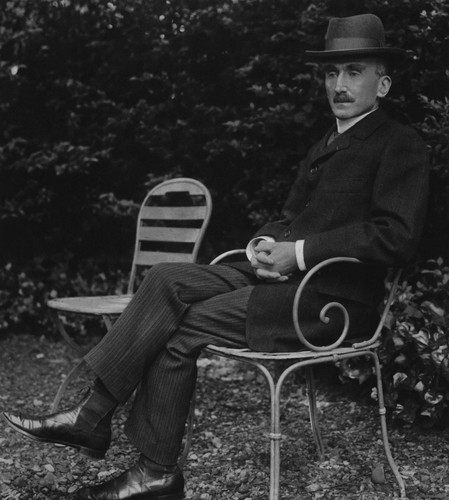
Henri Bergson
Personal Information
Description
French philosopher, influential especially in the first half of the 20th century.
Books
Œuvres
L'Évolution créatrice
French philosopher Henri Bergson's Creative Evolution was published in 1907 and translated into English in 1911. Very popular at the time, it gives an alternate mechanism for evolution - that it is motivated by an "elan vital" a vital impetus, also graspable as our natural creative urge. It also looks at Bergson's conception of time, a subjective "duration" (rather than the quantifiable time of a clock) that is best understood not through the intellect but through our creative intuition, an idea that influenced Marcel Proust and other modernist thinkers.
Time and free will
Bergson proposes a theory of time and freedom. Considered an influence on the French New Wave filmmakers, and a philosopher interested in humor and creativity, Bergson's works are generally a little awkward in translation (originals in French), but are well worth the effort. Bergson's basic argument here is that we (in literate Western cultures generally) use ideas and images associated with space to think about time, clocks and calendars as obvious examples. He says this tends to limit spontaneity and creativity in the present, because we are always using familiar images and expectations to confront the new, and we tend to think of moments in time as hardened rather than fluid as they are. This reviewer found this book to be life-changing, particularly to the degree it echoes some aspects of Eastern philosophies, psychologists interested in the experience of time, and even contemporary cultural critics like Marshal McLuhan.
Le rire; essai sur la signification du comique
En este ensayo Henri Bergson analiza las diversas cosas que provocan la risa con el fin de determinar los elementos humorísticos que nos hacen reí. Bergson describe la risa como un ser vivo que tiene un objetivo en gran parte social. Henri Bergson (1859-1941) fue el primer gran filósofo del siglo XX. Su originalísima obra, a menudo situada entre el análisis psicológico, la sociología, la filosofía y las ciencias naturales, sirvió para superar el positivismo y abrir al nuevo siglo muchas de las vías en adelante tan transitadas. Una ocasión idónea para probar la superioridad de esta nueva filosofía fue aplicarla al entonces popular problema de la comicidad, misterio «que se yergue en impertinente desafío a la especulación filosófica». Escrito en el estilo que le valdría el Premio Nobel de Literatura -entretenido pero de gran profundidad, extremadamente claro y nada abstruso, sin pretensiones pero muy lírico por momentos-, el texto de La risa" fue aclamado y se instituyó como gran matriz cultural del primer tercio del siglo pasado.
The Creative Mind
The Second edition of The Creative Mind has been updated to include recent developments in artificial intelligence, with a new preface, introduction and conclusion by the author.
Deux sources de la morale et de la religion
In Henri Bergson's view, the world includes two opposing tendencies--life and matter. Life is dynamic, has force and will, and struggles for richness and complexity through and beyond matter. Matter is the congealed residue of creation that has already taken place and, according to the laws of nature, is in a gradual state of erosion. Morality and religion, Bergson shows in the present book, may be regarded in similar terms. They partake, on the one hand, of a static principle, combining nature's heritage and the accrual of past forms, and a dynamic principle through which morality and religion remain always in crisis, always alive to contingency and growth. In the course of this study Bergson inquires into the nature of moral obligation, into the place of religion and the purpose it has served since primitive times, into static religion and its value in preserving man from the dangers of his own intelligence; into dynamic religion or mysticism as a manifestation of the life force and a means of producing man's forward leap beyond the limits of the closed society for which nature intended him and into the open society which is the brotherhood of man. --From publisher's description.
Laughter
'Laughter!', first performed in 1978 at the Royal Court Theatre, London, is a two act play that dramatises the screaming cruelty of Ivan the Terrible - the 16th century Russian Tsar - and the anaesthetized bureaucracy which administrated the Nazi concentration camps in the 20th century. With his daring treatment of concentration camps, involving a music-hall style routine, Peter Barnes probes the cavity between comedy and tragedy, examining the mechanisms - among them laughter - which dampen atrocity.
Dreams
Before the dawn of history mankind was engaged in the study of dreaming. The wise man among the ancients was preeminently the interpreter of dreams. The ability to interpret successfully or plausibly was the quickest road to royal favor, as Joseph and Daniel found it to be; failure to give satisfaction in this respect led to banishment from court or death. When a scholar laboriously translates a cuneiform tablet dug up from a Babylonian mound where it has lain buried for five thousand years or more, the chances are that it will turn out either an astrological treatise or a dream book. If the former, we look upon it with some indulgence; if the latter with pure contempt. For we know that the study of the stars, though undertaken for selfish reasons and pursued in the spirit of charlatanry, led at length to physical science, while the study of dreams has proved as unprofitable as the dreaming of them. Out of astrology grew astronomy. Out of oneiromancy has grown - nothing.That at least was substantially true up to the beginning of the present century. Dream books in all languages continued to sell in cheap editions and the interpreters of dreams made a decent or, at any rate, a comfortable living out of the poorer classes. But the psychologist rarely paid attention to dreams except incidentally in his study of imagery, association and the speed of thought. But now a change has come over the spirit of the times. The subject of the significance of dreams, so long ignored, has suddenly become a matter of energetic study and of fiery controversy the world over.The cause of this revival of interest is the new point of view brought forward by Professor Bergson in the paper which is here made accessible to the English-reading public. This is the idea that we can explore the unconscious substratum of our mentality, the storehouse of our memories, by means of dreams, for these memories are by no means inert, but have, as it were, a life and purpose of their own, and strive to rise into consciousness whenever they get a chance, even into the semi-consciousness of a dream. To use Professor Bergson's striking metaphor, our memories are packed away under pressure like steam in a boiler and the dream is their escape valve.That this is more than a mere metaphor has been proved by Professor Freud and others of the Vienna school, who cure cases of hysteria by inducing the patient to give expression to the secret anxieties and emotions which, unknown to him, have been preying upon his mind. The clue to these disturbing thoughts is generally obtained in dreams or similar states of relaxed consciousness. According to the Freudians a dream always means something, but never what it appears to mean. It is symbolic and expresses desires or fears which we refuse ordinarily to admit to consciousness, either because they are painful or because they are repugnant to our moral nature. A watchman is stationed at the gate of consciousness to keep them back, but sometimes these unwelcome intruders slip past him in disguise.
An Introduction to Metaphysics (Henri Bergson Centennial)
"This book is the key text for understanding the development of Bergson's thought from his early treatises on duration to the extension of this concept towards a general cosmology and an ethico-political ontology. In a new critical edition of this crucial work, the original authorised translation by T.E. Hulme has been restored and supplemented with new translations of Bergson's later amendments to the text, a guide to further reading and a new introduction."--Jacket.
