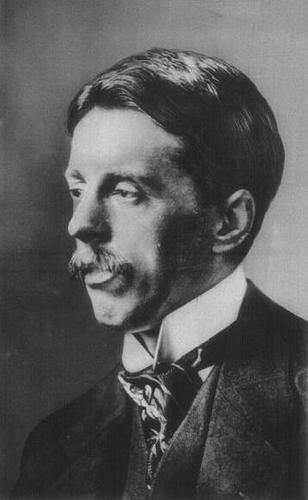
Arnold Bennett
Personal Information
Description
Enoch Arnold Bennett was an English novelist, playwright, and journalist, whose novels and plays generally reflected middle-class life in north Staffordshire. He was born in Hanley, Staffordshire (which is now Stoke-on-Trent), the son of a solicitor. He was educated in Newcastle-under-Lyme. After school, he worked for his father, and in his spare time he was a journalist. At age twenty-one, he moved to London to work as a solicitor's clerk. In 1889 he won a writing competition in Tit-Bits magazine and decided to become a full-time journalist. In 1894, he became assistant editor of the periodical Woman, for which he also began writing serial fiction. His first novel, A Man from the North, was published in 1898, the same year he became the editor of Woman. In 1900 he left the magazine and moved to Hockliffe, Bedfordshire, to become a full-time writer. In 1903 he moved to join the artist community in Paris, where he wrote several novels and plays. In 1908 he published The Old Wives' Tale, which was a best-seller. He visited to America in 1911 on a much-publicized trip. His excellent detective fiction includes The Loot of Cities (1905), six stories about Cecil Thorold, a rogue-detective millionaire "in search of joy' and not above blackmail and theft to corral his criminals. [Leslie S. Klinger, In the Shadow of Sherlock Holmes (2011)] During World War I he was Director of Propaganda for France at the Ministry of Information. He refused a knighthood in 1918. In 1922 he separated from his French wife and fell in love with the actress Dorothy Cheston, with whom he stayed for the rest of his life. He died of typhoid at his home in London in 1931.
Books
Romance
The night visitor and other stories
This book includes ten short stories. Three of them are long stories: The setting of "The Night Visitor" is a hacienda deep in the Mexican bush where a lonely American recreates in his imagination an eerie world of Indian folk legend. "The Cattle Drive" is a vivid description of a cowboy's trek with a thousand head of cattle across the Mexican plains; it has all the authenticity that Hollywood Westerns lack. "Macario, " which was made into a prize-winning motion picture, is a wry Mexican fable about an Indian woodcutter who makes a compact with the devil to save his family from starvation. Among seven shorter stories, some are based on incidents from contemporary Mexican life, others on ancient Indian folk legends.
Over there
A well-told narrative of US participation in the most godawful and useless of modern wars. In 1917, on the eve of its entry into WWI, the US was without a single army division. Nineteen months later, the nation’s armed and naval forces had grown to 4 million people, and their deployment had tipped the balance of war in Europe against the Central Powers. Farwell, a vivid chronicler of military forces, generals, and wars (Armies of the Raj: From Mutiny to Independence, 1989, etc.), here describes that extraordinary build-up of American armed might and what it wrought. It’s hard to imagine a better, and better-written, tale of the US’s first military venture on European soil. What the book lacks in fresh insights or perspective it makes up for in compactness, comprehensiveness, balance, and style. Perhaps never before have so many topics about this Great War been covered with such economy and to such effect. We learn of storied generals and unknown doughboys, preparedness and weaponry, trench warfare and African-Americans in battle, and campaigns and peace maneuvers—as well as the horrors of the battlefront. And we learn of them always with an apt story, a telling statistic, or a sharp portrait’such as of the fabled Sergeant Alvin York or the “Lost Battalion.” It’s regrettable, however, that little of the stupidity and absurdity of war (so brilliantly brought to life in the works of Paul Fussell) finds its place in Farwell’s account.Nevertheless, someone looking for an introduction to this part of American history will find the basics of what should be known in this book. A fine place to go for a narrative history of its subject.
The Great Adventure (A Play of Fancy)
"The Great Adventure: A Play of Fancy in Four Acts" by Arnold Bennett is a captivating drama that unfolds the story of renowned painter Ilam Carve and the series of events following his sudden illness and death. Set against the backdrop of family dynamics and personal relationships, the play delves into themes of secrets, desires, and human nature. As characters navigate unexpected twists and confront their motivations, the narrative explores the consequences of their actions in a dramatic and engaging manner.
Anna of the Five Towns
Set in the Potteries, the region in which Bennett spent much of his youth, this is the story of a miser's daughter who inherits a fortune. She stands out as a spirited, complex modern woman in a stifling and repressive society.
