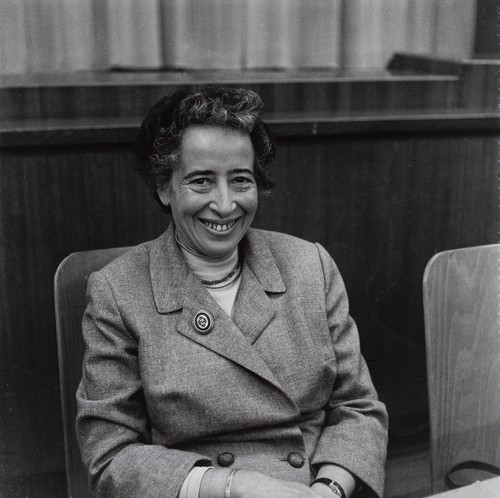
Hannah Arendt
Personal Information
Description
German-American philosopher and political theorist
Books
On violence
El término «violencia», en su sentido más elemental, refiere al daño ejercido sobre las personas por parte de otros seres humanos. Los experimentos totalitarios del siglo xx ampliaron este uso de la violencia, a una escala y una intensidad inéditas en la historia de la humanidad, y es en este contexto donde cabe encuadrar esta obra perenne de Hannah Arendt. Para la filosofía política, la violencia objeto de su estudio tiene dos caras: la violencia organizada del Estado o aquella que irrumpe frente al mismo. Esto ha hecho que muchos pensasen que la violencia es sobre todo una forma de ejercicio del poder. La posición de partida de la autora en "Sobre la violencia" consiste en el estudio minucioso de la violencia política en sus encarnaciones extremas dentro del mundo contemporáneo y en su cuidadosa separación entre violencia y poder político; este último es el resultado de la acción cooperativa, mientras que la violencia del siglo XX está ligada al alcance magnificador de la destrucción que proporciona la tecnología.
The Promise of Politics
"After the publication of The Origins of Totalitarianism in 1951, Hannah Arendt undertook an investigation of Marxism, a subject that she had deliberately left out of her earlier work. Her inquiry into Marx's philosophy led her to a critical examination of the entire tradition of Western political thought, from its origins in Plato and Aristotle to its culmination and conclusion in Marx. The Promise of Politics tells how Arendt came to understand the failure of that tradition to account for human action." "From the time that Socrates was condemned to death by his fellow citizens, Arendt finds that philosophers have followed Plato in constructing political theories at the expense of political experiences, including the pre-philosophic Greek experience of beginning, the Roman experience of founding, and the Christian experience of forgiving. It is a fascinating, subtle, and original story, which bridges Arendt's work from The Origins of Totalitarianism to The Human Condition, published in 1958. These writings, which deal with the conflict between philosophy and polities, have never before been gathered and published." "The final and longer section of The Promise of Politics, titled "Introduction into Polities," was written in German and is published here for the first time in English. This remarkable meditation on the modern prejudice against politics asks whether politics has any meaning at all anymore. Although written in the latter half of the 1950s, what Arendt says about the relation of politics to human freedom could hardly have greater relevance for our own time. When politics is considered as a means to an end that lies outside of itself, when force is used to "create" freedom, political principles vanish from the face of the earth. For Arendt, politics has no "end"; instead, it has at times been - and perhaps can be again - the never-ending endeavor of the great plurality of human beings to live together and share the earth in mutually guaranteed freedom. That is the promise of politics."--Jacket.
Within four walls
"When they met in the spring of 1936 in Paris, they were both exiles from Hitler's Germany. Hannah Arendt was twenty-nine, Heinrich Blucher thirty-seven. Following the German invasion of France early in 1941, they had to leave Paris. They arrived in New York in May, 1941. The correspondence starts in August, 1936, when Arendt traveled to Geneva to attend the founding conference of the World Jewish Congress, and ends in September, 1968, when she was in Basle for the celebration of Karl Jaspers' eightieth birthday.". "What emerges from this correspondence is the life story of two exceptional people, two Germans who fled their country for different reasons. It is the story of their life in exile in Paris and in New York, the hardships of that exile, their dependence on each other, their deepening love for each other, their continued exchange of ideas, Arendt's teaching and writing, her involvement with Jewish life and organizations in Europe and in Israel, and Blucher's years at The New School and at Bard College. It is also an important document of the 1930s in Germany and France, of World War II, and the post-war life in ravaged European cities. Meanwhile, there is love of food and drink, and of friendships, both intellectual and affectionate, with Karl Jaspers, Mary McCarthy, Alfred Kazin, and the complex relationship with Martin Heidegger and his wife."--BOOK JACKET.
Crises of the Republic
Un libro que llamara profundamente la atencion de cuantos se interesen por los problemas politicos actuales; inicia con una reflexion sobre los documentos del Pentagono, originario de una grave crisis de confianza de los norteamericanos respecto a sus gobernantes y, en general, enfoca aspectos y problemas trascendentes de esa republica y sus correlaciones con los problemas de todo el mundo.
Love and Saint Augustine
Hannah Arendt began her scholarly career with an exploration of Saint Augustine's concept of caritas, or neighborly love, written under the direction of Karl Jaspers and the influence of Martin Heidegger. After her German academic life came to a halt in 1933, Arendt carried her dissertation into exile in France, and years later took the same battered and stained copy to New York. During the late 1950s and early 1960s, as she was completing or reworking her most influential studies of political life, Arendt was simultaneously annotating and revising her dissertation on Augustine, amplifying its argument with terms and concepts she was using in her political works of the same period. The dissertation became a bridge over which Arendt traveled back and forth between 1929 Heidelberg and 1960s New York, carrying with her Augustine's question about the possibility of social life in an age of rapid political and moral change.
Between Friends
"Ariella, unhappy in love, confides in the woman whose husband she stole; Nahum, a devoted father, can't find the words to challenge his daughter's promiscuous lover; the old idealists deplore the apathy of the young, while the young are so used to kibbutz life that they can't work out if they're impassioned or indifferent. And amid this, Martin attempts to teach Esperanto."--Back cover.
Essays in understanding, 1930-1954
Few thinkers have tackled the political horrors and complexities of this century with the insight and passionate intellectual integrity of Hannah Arendt. A philosophic champion of human freedom, she was among the first to draw the now-evident parallel between Nazism and Bolshevism and to identify totalitarianism as a threat inherent to the modern world. Jerome Kohn, Arendt's longtime assistant, has compiled, edited, and annotated her manuscripts for publication, beginning with some of her earliest published work and including essays on Augustine, Rilke, Kierkegaard, and figures of the nineteenth-century "Berlin Salon"; the loyalties of immigrant groups within the United States; the unification or "federation" of Europe; "the German problem"; religion, politics, and intellectual life; the dangers of isolation and careerism in American society; the logical consequences of "scientific" theories of Nature and History; the terror that was the organizing principle of both the Nazi and the Communist states.
Hannah Arendt/Karl Jaspers correspondence, 1926-1969
"The correspondence between Hannah Arendt and Karl Jaspers begins in 1926, when the twenty-year-old Arendt studied philosophy with Jaspers in Heidelberg. It is interrupted by Arendt's emigration and Jaspers's "inner emigration," and it is resumed immediately after World War II. The initial teacher-student relationship develops into a close friendship, in which Jasper's wife, Gertrud, is soon included and then Arendt's husband, Heinrich Blucher." "These letters show not only the way both philosophers lived, thought, and worked but also how they experienced the postwar years. Since neither ever dreamed that this correspondence would be published, and each had absolute trust in the other, they reveal themselves here - for the first time - in a personal and spontaneous way." "Brilliant, vulnerable, forthright, Arendt speaks about America, her adopted country. About American universities, American politics from McCarthyism to Kennedy, American urban decay. She speaks about Germany, the country she left: its anti-Semitism, its guilt for the Holocaust, its politics. And about Israel, which she always supported as a Jew but also criticized, especially in her controversial book about the trial and execution of Adolf Eichmann in 1961." "In his dialogue with Arendt, the thoughtful, generous, concerned Jaspers considers the question of the German essence, and of the Jewish character. He speaks about philosophers past and present - Spinoza, Heidegger. About old age and retirement. Corrupt journalism. Suicide. Man's future on this planet." "Here is a fascinating dialogue between a woman and a man, a Jew and a German, a questioner and a visionary, both uncompromising in their examination of our troubled century."--BOOK JACKET.
