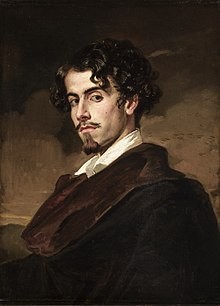
Gustavo Adolfo Bécquer
Personal Information
Description
Gustavo Adolfo Bécquer (February 17, 1836 – December 22, 1870) was a Spanish Romanticist poet and writer (mostly short stories), also a playwright, literary columnist, and talented in drawing. Today he is considered one of the most important figures in Spanish literature, and is considered by some as the most read writer after Cervantes. He adopted the alias of Bécquer as his brother Valeriano Bécquer, a painter, had done earlier. He was associated with the romanticism and post-romanticism movements and wrote while realism was enjoying success in Spain. He was moderately well known during his life, but it was after his death that most of his works were published. His best known works are the Rhymes and the Legends, usually published together as Rimas y leyendas. These poems and tales are essential to the study of Spanish literature and common reading for high-school students in Spanish-speaking countries. Source: [Gustavo Adolfo Bécquer]( on Wikipedia.
Books
Los mejores relatos fantasmagóricos
Una magnífica selección de relatos donde los fantasmas son los auténticos protagonistas: el de un anciana señora, el de un prodigioso músico que no puede dejar de deleitar a los feligreses ni tras su muerte, el fantasma de un hombre que cae en la desesperación y en la apatía tras trescientos años de irreprochable trabajo, o el de un guardavía que avisa de un terrible peligro. Siete relatos de los mejores escritores que nos trasladan al terror y que nos envuelven con el misterio de lo fantasmagórico.
Romantic legends of Spain
Romantic Legends of Spain"" is a collection of short stories and poems written by Gustavo Adolfo Becquer, a Spanish poet and writer of the Romantic era. The book features a series of legends and tales that are steeped in Spanish folklore and mythology, including stories of witches, ghosts, and enchanted castles. The tales are told in a lyrical and evocative style that captures the essence of Spain's rich cultural heritage. Becquer's writing is characterized by his use of vivid imagery and his ability to create a sense of mystery and wonder. The book is a classic of Spanish literature and is widely regarded as one of the most important works of the Romantic period in Spain.This scarce antiquarian book is a facsimile reprint of the old original and may contain some imperfections such as library marks and notations. Because we believe this work is culturally important, we have made it available as part of our commitment for protecting, preserving, and promoting the world's literature in affordable, high quality, modern editions, that are true to their original work.
Legends and letters
Legends and Letters is an English translation of one essay, fourteen legends, and the four "Literary Letters to a Woman" by Gustavo Adolfo Becquer, one of nineteenth-century Spain's greatest lyricists. Much of Becquer's fantasy and creative flow finds stimulation in the light, aura, and mystery of the moon, and in the essay "By the Light of the Moon" we are given a glimpse into the inspiration of numerous legends, especially "The White Doe," where in the moon's light "objects take on a fantastic hue," and "The Moonbeam," where moonlight "spreads a soft melancholy over all of nature.". The legends are a singular type of short story: brief journeys to a bygone time. They are a world of heroic architecture, exotic personages, haunted ruins, and majestic cathedrals; a world in which the protagonist pursues the ephemeral, the ethereal, the beautiful, and the mysterious; a world in which the protagonist - in search of love, which is to say in search of woman - frequently risks madness or death. They are grouped here into four categories. The first, Impossible Love, is comprised of "Green Eyes," "The Moonbeam," and "The White Doe," legends that reflect the poet's yearning for an ideal love and an ideal woman with sentiments that find an echo in his verse. The second, Divine Intervention in Seville and Toledo, contains "Master Perez the Organist," "The Gold Bracelet," "The Kiss," and "The Christ of the Skull," tales that evoke celestial music, retribution, and wrath. The third, The Devil's Disciples, includes "Believe in God," "The Devil's Cross," and "The Miserere," stories of satanic protagonists and satanic deeds. And the fourth, Visitors from the Hereafter, is made up of "Haunted Mountain," "The Cave of the Moorish Woman," "The Promise," and "The Gnome," legends that are replete with supernatural occurrences, dark nights of foreboding, illusory images, spirits, and genies. . In the four "Literary Letters to a Woman" Becquer considers the nature of inspiration and discusses woman as poetry, beauty, love, and religion. The views expressed in them amount to unifying themes because they are constants in both his verse and his prose fiction. From the letters the reader will see that the correlation is not only between the legends and letters, but between the letters and poems (Rimas) as well.