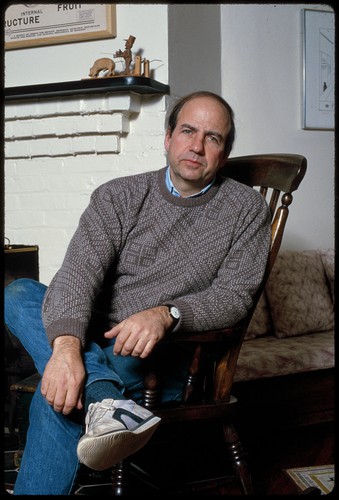
Calvin Trillin
Personal Information
Description
There is no description yet, we will add it soon.
Books
About Alice
In Calvin Trillin's antic tales of family life, she was portrayed as the wife who had "a weird predilection for limiting our family to three meals a day" and the mother who thought that if you didn't go to every performance of your child's school play, "the county would come and take the child." Now, five years after her death, her husband offers this loving portrait of Alice Trillin off the page--his loving portrait of Alice Trillin off the page--an educator who was equally at home teaching at a university or a drug treatment center, a gifted writer, a stunningly beautiful and thoroughly engaged woman who, in the words of a friend, "managed to navigate the tricky waters between living a life you could be proud of and still delighting in the many things there are to take pleasure in."Though it deals with devastating loss, About Alice is also a love story, chronicling a romance that began at a Manhattan party when Calvin Trillin desperately tried to impress a young woman who "seemed to glow.""You have never again been as funny as you were that night," Alice would say, twenty or thirty years later."You mean I peaked in December of 1963?""I'm afraid so."But he never quit trying to impress her. In his writing, she was sometimes his subject and always his muse. The dedication of the first book he published after her death read, "I wrote this for Alice. Actually, I wrote everything for Alice."In that spirit, Calvin Trillin has, with About Alice, created a gift to the wife he adored and to his readers.From the Hardcover edition.
Feeding a Yen
In a compilation of eating adventures around the United States and the world, the author chronicles his search for great meals in different locales, from posole in northern New Mexico and boudin in Louisiana to pan bagnat in Nice.
Tepper Isn't Going Out
"Murray Tepper would say that he is an ordinary New Yorker who is simply trying to read the newspaper in peace. But he reads while sitting behind the wheel of his parked car, and his car always seems to be in a particularly desirable parking spot. Not surprisingly, he is regularly interrupted by drivers who want to know if he is going out." "Tepper isn't going out. Why not? His explanations tend to be rather literal: the indisputable fact, for instance, that he has twenty minutes left on the meter.". "Tepper's behavior sometimes irritates the people who want his spot. ("Is that where you live? Is that car rent-controlled?") It also irritates the mayor - Frank Ducavelli, known in tabloid headlines as Il Duce - who sees Murray Tepper as a harbinger of what His Honor always calls "the forces of disorder."". "But once New Yorkers become aware of Tepper, some of them begin to suspect that he knows something they don't know. And an ever-increasing number of them are willing to line up for the opportunity to sit in his car with him and find out."--BOOK JACKET.
Family man
A decade of working for the Gilchrist empire has made Katy Wade tough as nails. Now she's got the deal of her career to close: persuading Luke Gilchrist, estranged heir, to save the floundering family business. Luke, a talented business man, has sworn he'll never go home. All his life, the Gilchrists have alienated him, the product of his father's affair. But when Luke meets Katy, he thinks he might become a family man. It's not in her job description, but with one look into Luke's sexy green eyes she knows love is the bottom line.
Messages from my father
"The man was stubborn," writes Calvin Trillin - the second most stubborn member of the Trillin family - to begin his fond, wry, and affecting memoir of his father. Abe Trillin had the western Missouri accent of someone who had grown up in St. Joseph and the dreams of America of someone who had been born is Russia. In Kansas City, he was a grocer, at least until he swore off the grocery business. He was given to swearing off things - coffee, tobacco, alcohol, all neckties that were not yellow in color. Presumably he had also sworn off swearing, although he was a collector of curses like "May you have an injury that is not covered by workman's compensation." Although he had a strong vision of the sort of person he wanted his son to be, his explicit advice about how to behave didn't go beyond an almost lackadaisical "You might as well be a mensch." Somehow, though, Abe Trillin's messages got through clearly. Fathers, sons, and admirers of Trillin's unerring sense of the American character will be entertained and touched by this quietly powerful memoir.
Too soon to tell
The topical essays of Too Soon to Tell reveal Calvin Trillin at his barbed and irrepressible best. Dealing with matters of the family, he tells the tale of a couple who were at first pleased that their twenty-six-year-old son had finally moved out ("If Jeffrey's going to find himself, it would probably help for him to look somewhere other than his own room") and then realized that they had lost the ability to videotape. Grappling with educational issues, he discusses whether the presence of Michael Milken as a lecturer at the UCLA business school means that its religion department will get around to employing Jim Bakker ("Church Management 101: Imaginative Ideas in Religious Fund-Raising"). In the field of world affairs, he deals with the role of astrologers ("The planets are perfect for trading arms for hostages and saying you didn't") and whether the language laws in Quebec really require the hiring of a mime who doesn't speak French rather than a mime who doesn't speak English. Trillin's short takes send us back to life refreshed and delighted.
Deadline poet, or, My life as a doggerelist
"Could there be anyone else who was inspired to write poetry by the presence of John Sununu?" Maybe so, but only Calvin Trillin came up with a piece of verse called "If You Knew What Sununu." Ever since it appeared in print, in 1990, he has been a weekly gadfly in verse for The Nation, delighting readers with his rhyming observations on the news of the day. As his deadline approached every week, his inspiration came from, among many others, George Bush ("You did your best in your own way, / The way of Greenwich Country Day") and H. Norman Schwarzkopf and Saddam Hussein and Jerry Brown and Clarence Thomas and Ross Perot and Princess Diana and Zoe Baird ("She'd done this deed to get au paired") and Robert Dole and someone called Wanderin' Willie Clinton, who sings the "I got the movin' to the middle 'cause it's slip'ry on the edges blues." Here, in prose as sparkling as the verse that accompanies it, Trillin describes his evolution from a "special-occasions poet" into a deadline poet, and comments on the events that inspired his weekly verse. The result is an irresistible entertainment that also turns out to be an antic history of three years of American life that were particularly rich in material for someone who describes his job this way: "The news presents a motley little band / That I observe, tomato in my hand."
Enough's enough (and other rules of life)
A collection of the author's columns, 1987-1990.
Alice, let's eat
"Trillin is our funniest food writer. He writes with charm, freedom, and a rare respect for language."--New York magazineIn this delightful and delicious book, Calvin Trillin, guided by an insatiable appetite, embarks on a hilarious odyssey in search of "something decent to eat." Across time zones and cultures, and often with his wife, Alice, at his side, Trillin shares his triumphs in the art of culinary discovery, including Dungeness crabs in California, barbecued mutton in Kentucky, potato latkes in London, blaff d'oursins in Martinique, and a $33 picnic on a no-frills flight to Miami. His eating companions include Fats Goldberg, the New York pizza baron and reformed blimp; William Edgett Smith, the man with the Naughahyde palate; and his six-year-old daughter, Sarah, who refuses to enter a Chinese restaurant unless she is carrying a bagel ("just in case"). And though Alice "has a weird predilection for limiting our family to three meals a day," on the road she proves to be a serious eater--despite "seemingly uncontrollable attacks of moderation." Alice, Let Eat amply demonstrates why The New Republic called Calvin Trillin "a classic American humorist.""One of the most brilliant humorists of our times . . . Trillin is guaranteed good reading."--Charleston Post and Courier"Read Trillin and laugh out loud."--TimeFrom the Trade Paperback edition.
American fried; adventures of a happy eater
"The New Yorker's Calvin Trillin loves food while despising the tres haut Francophile gourmet -- the kind who can produce a dissertation on the proper consistency of sauce Bearnaise. Trillin knows that the search for good food requires constant vigilance particularly when outside the Big Apple. Not that Cincinnati and Houston and Kansas City (his hometown) lack magnificent places to eat -- if one can resist the importunities of those well meaning ignoramuses who insist on hauling you off to La Maison de la Casa House, the pride of local epicures too dumb to realize that the noblest culinary creations of the American heartland are barbecued ribs, fried chicken, hash browns and hamburgers. Trillin is ready to do battle for K.C.'s Winstead's as the home of the greatest burger in the USA. Generally, he advises, you will do fine if you avoid "any restaurant the executive secretary of the chamber of commerce is particularly proud of." Also, any restaurant with (ply)wood paneling and "atmosphere," where the food is likely to taste "something like a medium-rare sponge." This then is not a celebration of multi-star "restaurants" but of diners, roadhouses, eateries -- the kind that serve food on wax paper or plastic plates and to hell with Craig Claiborne. With tongue in stuffed cheek Trillin gives the finger to the food snobs, confessing his secret vices with fiendish glee and high good humor"--Kirkusreviews.com.
Prentice Hall Literature -- Platinum
10th grade