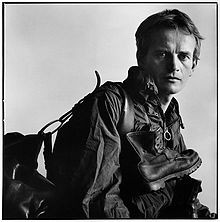
Bruce Chatwin
Personal Information
Description
Charles Bruce Chatwin (13 May 1940 – 18 January 1989) was an English travel writer, novelist and journalist. His first book, In Patagonia (1977), established Chatwin as a travel writer, although he considered himself instead a storyteller, interested in bringing to light unusual tales. He won the James Tait Black Memorial Prize for his novel On the Black Hill (1982), while his novel Utz (1988) was shortlisted for the Booker Prize. In 2008 The Times ranked Chatwin as number 46 on their list of "50 Greatest British Writers Since 1945". (Source: [Wikipedia](
Books
The Songlines
Follow Chatwin on his journey into the 'Red Centre' of Australia. Part autobiography, part story, part history, part anthropology. Teaches us how Aboriginal Australians perceive their landscapes, and negotiate with each other in that vast, nomadic environment.
On the Black Hill
Dans la lignée de Thomas Hardy et du roman campagnard anglais de la fin du 19e siècle. Thème central : la gémellité. Pour P. Thevenon il s'agit d'un "exploit parodique."
Utz
Bruce Chatwin's bestselling novel traces the fortunes of Kaspar Utz, an enigmatic collector of Meissen porcelain living in Cold War Czechoslovakia. Although Utz is allowed to leave the country each year, and considers defecting each time, he always returns to his Czech home, a prisoner of the Communist state and of his precious collection.
Under the Sun
"Edward McAllister, wedding planner extraordinaire arrives at Sapphire Cay for a wedding. He has four days to go until the big day and his plans are smashed when he spots the stage he was setting is destroyed. Doesn't matter that the guy pulling down the old gazebo and digging trenches is hot -- he is messing with Edward's OCD and Edward isn't afraid to let the other man know exactly how he feels. Jamie Durand is and ex marine and son of the former owners of Sapphire Cay. He is on the island to get his head around his new life after leaving the forces due to injury. When Edward arrives in his space he is bemused at the instant dislike the uptight man is showing towards him. Not an auspicious start. But just you wait when Edward relaxes and Jamie opens up. Fireworks."--Back cover.
What Am I Doing Here?
"What Am I Doing Here? is a startling masterwork by one of the forgotten innovators of American comics. In 1945, after more than a decade as a commercial illustrator--drawing advertisements and cartoons for Life, Time, Esquire, Newsweek, and many others--Abner Dean invented a genre all his own: One might call it the Existential Gag Cartoon. He used the elegant draftsmanship and single-panel format of the standard cartoons of the day, but turned them into more than just one-off jokes. With an inimitable mixture of wit, earnestness, and enigmatic surrealism, Dean uses this most ephemeral of forms to explore the deepest mysteries of human existence. What Am I Doing Here? depicts a world at once alien and familiar, in which everyone is naked but act like they're clothed--a world of club-wielding commuters and byzantine inventions, secret fears, and perverse satisfactions. Through it all strolls (or crawls, or floats, or stumbles) Dean's unclad Everyman, searching for love, happiness, and the answers to life's biggest questions"--
The Best of Granta Travel
These selections have been taken from Granta's Travel Writing and include memoir, reportage and old-fashioned stories.
Anatomy of Restlessness
Although he is best known for his luminous reports from the farthest-flung corners of the earth, Bruce Chatwin possessed a literary sensibility that reached beyond the travel narrative to span a world of topics—from art and antiques to archaeology and architecture. This spirited collection of previously neglected or unpublished essays, articles, short stories, travel sketches, and criticism represents every aspect and period of Chatwin’s career as it reveals an abiding theme in his work: his fascination with, and hunger for, the peripatetic existence. While Chatwin’s poignant search for a suitable place to “hang his hat,” his compelling arguments for the nomadic “alternative,” his revealing fictional accounts of exile and the exotic, and his wickedly en pointe social history of Capri prove him to be an excellent observer of social and cultural mores, Chatwin’s own restlessness, his yearning to be on the move, glimmers beneath every surface of this dazzling body of work.
The Viceroy of Ouidah
In this vivid, powerful novel, Chatwin tells of Francisco Manoel de Silva, a poor Brazilian adventurer who sails to Dahomey in West Africa to trade for slaves and amass his fortune. His plans exceed his dreams, and soon he is the Viceroy of Ouidah, master of all slave trading in Dahomey. But the ghastly business of slave trading and the open savagery of life in Dahomey slowly consume Manoel's wealth and sanity.
Prentice Hall Literature -- Gold
High School level
