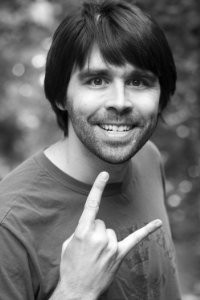

UNITED STATES AUTHOR · FICTION · HORROR
Joe Hill
Also known as: Joe King, Joseph King
Hill is the second child of authors Stephen and Tabitha King. He grew up in Bangor, Maine. His younger brother Owen is also a writer. Hill has three sons. Hill chose to use an abbreviated form of his given name (a reference to executed labor leader Joe Hill, for whom he was named) in 1997, out of a desire to succeed based solely on his own merits instead of as the son of Stephen King. After achieving a degree of independent success, Hill publicly confirmed his identity in 2007 after an article the previous year in Variety broke his cover (although online speculation about Hill's family background had been appearing since 2005). Joe Hill is a past recipient of the Ray Bradbury Fellowship. He has also received the William L. Crawford award for best new fantasy writer in 2006, the A. E. Coppard Long Fiction Prize in 1999 for "Better Than Home" and the 2006 World Fantasy Award for Best Novella for "Voluntary Committal". His stories have appeared in a variety of magazines, such as Subterranean Magazine, Postscripts and The High Plains Literary Review, and in many anthologies, including The Mammoth Book of Best New Horror (ed. Stephen Jones) and The Year's Best Fantasy and Horror (ed. Ellen Datlow, Kelly Link & Gavin Grant). Hill's first book, the limited edition collection 20th Century Ghosts published in 2005 by PS Publishing), showcases fourteen of his short stories and won the Bram Stoker Award for Best Fiction Collection, together with the British Fantasy Award for Best Collection and Best Short Story for "Best New Horror". In October 2007, Hill's mainstream US and UK publishers reprinted 20th Century Ghosts, without the extras published in the 2005 slipcased versions, but including one new story. Hill's first novel, Heart-Shaped Box, was published by William Morrow/HarperCollins on February 13, 2007 and by Victor Gollancz Ltd in UK in March 2007. Simultaneous to these two editions, a limited edition of Heart-Shaped Box was also released by Subterranean Press; it sold out several months prior to publication. The novel reached number 8 on the New York Times bestseller list on April 1, 2007. On September 23, 2007, at the thirty-first Fantasycon, the British Fantasy Society awarded Hill the first ever Sydney J. Bounds Best Newcomer Award. Hill's first professional sale was in 1997. Among unpublished works is one partly completed with his father, "But Only Darkness Loves Me", which is held with the Stephen King papers at the Special Collections Unit of the Raymond H Fogler Library at the University of Maine in Orono, Maine. Hill is also the author of Locke & Key, a new comic book series published by IDW Publishing. The first issue, released on February 20, 2008, sold out of its initial publication run in one day. A forthcoming collection of the series in limited form from Subterranean Press sold out within 24 hours of being announced. His only screen appearance so far was aged 10 in the film Creepshow (1982) (dir. George Romero), which co-starred and was co-written by his father.
THE FACE WAS THIRTY FEET HIGH.
— from Smoke and mirrors, 1994
Most acclaimed

Darkness
"New York Times bestselling author Karen Robards continues her penchant for "fantastic storytelling" (RT Book Reviews) with this next heart-pumping romantic suspense novel, the tale of a brilliant ornithologist trapped on the remote Attu Island in Alaska, fighting for her life--and that of a handsome stranger--before they're swallowed up in darkness forever. BOOM. That's the sound that changes everything for Dr. Gina Sullivan, a renowned ornithologist on a group research grant trip on the remote island of Attu, Alaska. When an everyday outing turns sinister at the onset of one of Attu's infamous storms, Gina expects thunder and lightning--but what she doesn't see coming is the small jet plane that drops out of the sky and into the water mere feet from her boat. Even more unprecedented: there's a sole survivor from the crash, and he needs Gina's help. But it turns out that rescuing the stranger and getting them both out of the oncoming storm is just the beginning. Because the more Gina learns about James "Cal" Callahan, he of brooding eyes and muscled frame, the more she fears--for herself, and for him. Cal has made a career of trading on government secrets and emerging unscathed--until a routine pickup goes horribly wrong and lands him in ice-cold water. Literally. He knows the plane crash was no accident and that there could very well be an enemy force currently combing the Alaskan island ensuring there were no survivors. Now if only the arrestingly beautiful bird-watcher with the clear-blue gaze would stop watching him, well, like a hawk. Cal convinces Gina to return to base camp and help him covertly get off the island. But when Gina makes it safely back to camp and finds her entire team murdered, all bets are off, and as darkness envelops the island, she must decide: trust a man she barely knows, or go it alone and risk running straight into the arms of a killer?"--
Horns
Joe Hill has been hailed as "a major player in 21st-century fantastic fiction" (Washington Post); "a new master in the field of suspense" (James Rollins); "one of the most confident and assured new voices in horror and dark fantasy to emerge in recent years (Publishers Weekly); a writer who "builds character invitingly and plants an otherworldly surprise around every corner" (New York Times).This gifted and brilliantly imaginative author catapulted to bestsellerdom with the chilling Heart-Shaped Box and cemented his reputation with the prizewinning volume of short fiction 20th Century Ghosts. At last, the New York Times bestselling author returns with a relentless supernatural thriller that runs like Hell on wheels. . . .Ignatius Perrish spent the night drunk and doing terrible things. He woke up the next morning with a thunderous hangover, a raging headache . . . and a pair of horns growing from his temples.At first Ig thought the horns were a hallucination, the product of a mind damaged by rage and grief. He had spent the last year in a lonely, private purgatory, following the death of his beloved, Merrin Williams, who was raped and murdered under inexplicable circumstances. A mental breakdown would have been the most natural thing in the world. But there was nothing natural about the horns, which were all too real.Once the righteous Ig had enjoyed the life of the blessed: born into privilege, the second son of a renowned musician and younger brother of a rising late-night TV star, he had security, wealth, and a place in his community. Ig had it all, and more—he had Merrin and a love founded on shared daydreams, mutual daring, and unlikely midsummer magic.But Merrin's death damned all that. The only suspect in the crime, Ig was never charged or tried. And he was never cleared. In the court of public opinion in Gideon, New Hampshire, Ig is and always will be guilty because his rich and connected parents pulled strings to make the investigation go away. Nothing Ig can do, nothing he can say, matters. Everyone, it seems, including God, has abandoned him. Everyone, that is, but the devil inside. . . .Now Ig is possessed of a terrible new power to go with his terrible new look—a macabre talent he intends to use to find the monster who killed Merrin and destroyed his life. Being good and praying for the best got him nowhere. It's time for a little revenge. . . . It's time the devil had his due. . . .
Strange case of Dr Jekyll and Mr Hyde
"First published in 1886 as a "shilling shocker," Dr. Jekyll and Mr. Hyde takes the basic struggle between good and evil and adds to the mix bourgeois respectability, urban violence, and class conflict. The result is a tale that has taken on the force of myth in the popular imagination. This Broadview edition provides a selection of contextual material, including contemporary reviews of the novel, Stevenson's essay "A Chapter on Dreams," and excerpts from the 1887 stage version of Dr. Jekyll and Mr. Hyde. Also included are historical documents on criminality and degeneracy, the "Jack the Ripper" murders, and London in the 1880s." "New to this second edition are an updated critical introduction and, in the appendices, writings on Victorian psychology by Thomas Carlyle, Richard Krafft-Ebing, and Henry Maudsley, among others."--Jacket.