
CLASSICAL ATHENS AUTHOR · DRAMA · TRANSLATIONS INTO ENGLISH
Euripides
Also known as: EURIPIDES., Euripides.
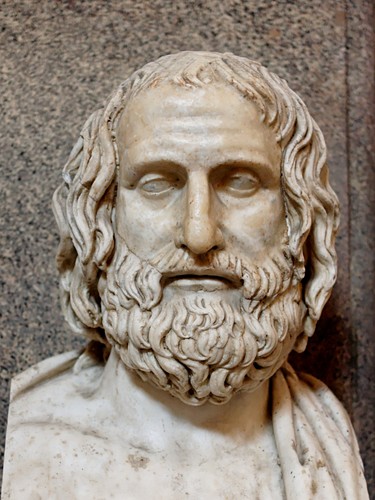
Euripides was the last of the three great tragedians of classical Athens (the other two being Aeschylus and Sophocles). Ancient scholars thought that Euripides had written ninety-five plays, although four of those were probably written by Critias. Eighteen or nineteen of Euripides' plays have survived complete. There has been debate about his authorship of Rhesus, largely on stylistic grounds and ignoring classical evidence that the play was his.Fragments, some substantial, of most of the other plays also survive. More of his plays have survived than those of Aeschylus and Sophocles together, because of the unique nature of the Euripidean manuscript tradition.
Lo! These are the fair virgin streams of Nile, the river that waters Egypt's tilth, fed by pure melting snow instead of rain from heaven.
— from HELEN
Most acclaimed

Fragments
The eleven plays by Aristophanes that have come down to us intact brilliantly illuminate the eventful period spanned by his forty-year career, beginning with the first production in 427 BCE. But the Athenians knew much more of his work: over forty plays by Aristophanes were read in antiquity, of which nearly a thousand fragments survive. These provide a fuller picture of the poet's ever astonishing comic vitality and a wealth of information and insights about his world. Jeffrey Henderson's new widely acclaimed Loeb edition of Aristophanes is completed by this volume containing what survives from, and about, his lost plays, hitherto inaccessible to the non-specialist, and incorporating the enormous scholarly advances that have been achieved in recent years. Each fragmentary play is prefaced by a summary of what can be inferred about its plot, characters, themes, theatricality, and topical significance. Also included in this edition are the ancient reports about Aristophanes' life, works, and influence on the later comic tradition. Jeffrey Henderson is William Goodwin Aurelio Professor of Greek Language and Literature at Boston University. He is General Editor of the Loeb Classical Library. -- Jacket.
Grief Lessons
"Euripides, the last of the three great tragedians of ancient Athens, reached the height of his renown during the disastrous Peloponnesian War, when democratic Athens was brought down by its own outsized ambitions. His plays were shockers: he unmasked heroes, revealing them as foolish and savage, and he wrote about the powerless - women and children, slaves and barbarians - for whom tragedy was not so much exceptional as unending. Euripides' plays rarely won first prize in the great dramatic competitions of ancient Athens, but their combustible mixture of realism and extremism fascinated audiences throughout the Greek world." "Four of those tragedies are here presented in new translations by the contemporary poet and classicist Anne Carson. They are Herakles, in which the hero swaggers home to destroy his own family; Hekabe, set after the Trojan War, in which Hektor's widow takes vengeance on her Greek captors; Hippelytes, about love and the horror of love; and the strange tragicomic fable Alkestis, which tells of a husband who arranges for his wife to die in his place. The volume also contains brief introductions by Carson to each of the plays along with two remarkable framing essays: "Tragedy: A Curious Art Form" and "Why I Wrote Two Plays About Phaidra.""--Jacket.