Discover

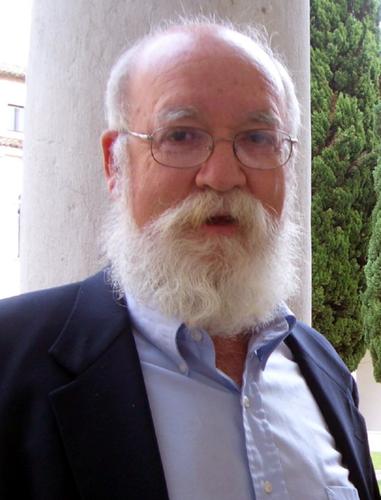
Daniel C. Dennett

Personal Information

Born March 28, 1942
Died April 19, 2024 (82 years old)
Boston, United States
Also known as: Daniel Clement Dennett, Daniel C. Dennett III
21 books
3.8 (47)
398 readers

Description

Daniel Clement Dennett III was an American philosopher, writer, and cognitive scientist whose research centered on the philosophy of mind, philosophy of science, and philosophy of biology, particularly as those fields relate to evolutionary biology and cognitive science. Dennett was the co-director of the Center for Cognitive Studies and the Austin B. Fletcher Professor of Philosophy at Tufts University in Massachusetts. Dennett was a vocal atheist and secularist, a member of the Secular Coalition for America advisory board, and a member of the Committee for Skeptical Inquiry, as well as an outspoken supporter of the Brights movement. Dennett was referred to as one of the "Four Horsemen of New Atheism", along with Richard Dawkins, Sam Harris, and the late Christopher Hitchens. In 1962, Dennett married Susan Bell. They lived in North Andover, Massachusetts, and had a daughter, a son, and six grandchildren. He was an avid sailor. Dennett died of interstitial lung disease at Maine Medical Center on April 19, 2024, at the age of 82. [source: Wikipedia]

Books

Newest First

What Are You Optimistic About?

2.0 (1)
20

The nightly news and conventional wisdom tell us that things are bad and getting worse. Yet despite dire predictions, scientists see many good things on the horizon. John Brockman, publisher of Edge (www.edge.org), the influential online salon, recently asked more than 150 high-powered scientific thinkers to answer a vital question for our frequently pessimistic times: "What are you optimistic about?"Spanning a wide range of topics—from string theory to education, from population growth to medicine, and even from global warming to the end of world—What Are You Optimistic About? is an impressive array of what world-class minds (including Nobel Laureates, Pulitzer Prize winners, New York Times bestselling authors, and Harvard professors, among others) have weighed in to offer carefully considered optimistic visions of tomorrow. Their provocative and controversial ideas may rouse skepticism, but they might possibly change our perceptions of humanity's future.

Breaking the spell

3.7 (7)
40

For all the thousands of books that have been written about religion, few until this one have attempted to examine it scientifically: to ask why—and how—it has shaped so many lives so strongly. Is religion a product of blind evolutionary instinct or rational choice? Is it truly the best way to live a moral life? Ranging through biology, history, and psychology, Daniel C. Dennett charts religion's evolution from "wild" folk belief to "domesticated" dogma. Not an antireligious screed but an unblinking look beneath the veil of orthodoxy, Breaking the Spell will be read and debated by believers and skeptics alike.

Freedom evolves

5.0 (1)
16

"Four billion years ago, there was no freedom on our planet, because there was no life. What kinds of freedom have evolved since the origin of life? Can there be freedom and free will in a deterministic world? If you are free, are you responsible for being free, or just lucky?". "In Freedom Evolves, Daniel C. Dennett, the author of Darwin's Dangerous Idea and Consciousness Explained, sets out to answer these questions, showing how we, alone among the animals, have evolved minds that give us free will and morality. In a series of strikingly original arguments drawing on evolutionary biology, cognitive neuroscience, economics, and philosophy, he demonstrates that if we accept Darwin's reasoning, we can build from the simplest life forms all the way up to the best and deepest human thoughts on questions of morality and meaning, ethics and freedom."--BOOK JACKET.

Brainchildren

0.0 (0)
7

Minds are complex artifacts, partly biological and partly social, and only a unified, multidisciplinary approach will yield a realistic theory of how minds came into existence and how they work. One of the foremost thinkers in this multidisciplinary field is Daniel Dennett. This book brings together his essays on philosophy of mind, artificial intelligence, and cognitive ethology that appeared in relatively inaccessible journals from 1984 to 1996.

Kinds of minds

4.0 (2)
12

In Kinds of Minds, Dennett asks the ultimate metaphysical questions: What is a mind and who else (besides the questioner) has one? Combining ideas from philosophy, artificial intelligence, and neurobiology, Dennett leads the reader on a fascinating journey of inquiry, exploring such intriguing possibilities as: Can any of us really know what is going on in someone else's mind? What distinguishes the human mind from the minds of animals, especially those capable of complex behavior? If such animals, for instance, were magically given the power of language, would their communities evolve an intelligence as subtly discriminating as ours? Would they be capable of developing the uniquely human ability to theorize about the world they inhabit? Will robots, once they have been endowed with sensory systems like those that provide us with experience, ever exhibit the particular traits long thought to distinguish the human mind, including the ability to think about thinking? . Dennett address these questions from an evolutionary perspective. Beginning with the macromolecules of DNA and RNA, whose evolution was determined by Darwinian natural selection, Dennett shows how, step by step, animal life moved from a simple ability to respond to frequently recurring environmental conditions to much more powerful ways of beating the odds, ways of using patterns of past experience to predict the future in never-before-encountered situations. He argues that a series of small but revolutionary steps moved us from there to the unique human capability to frame and execute specific long-range intentions. These changes included first the emergence of speech, then, because of situations in which the ability to keep secrets conferred an evolutionary advantage, a skill in conversing with ourselves, and finally, the creation of artifacts that permit us to expand our minds into the surrounding environment.

Darwin's dangerous idea

3.8 (11)
46

In this groundbreaking and very accessible book, Daniel C. Dennett, the acclaimed author of Consciousness Explained, demonstrates the power of the theory of natural selection and shows how Darwin's great idea transforms and illuminates our traditional view of our place in the universe. Following Darwinian thinking to its logical conclusions is a risky business, with pitfalls for everybody. Creationists and others who reject evolution are not the only ones to fall into the traps. Many who accept the validity of Darwin's conclusions hesitate before their implications and distort his theory, fearful that it is politically incorrect or antireligious, or that it robs life of all spirituality. Dennett explains the scientific theory of natural selection in vivid terms, and shows how it extends far beyond biology.

Consciousness explained

3.6 (12)
96

This book revises the traditional view of consciousness by claiming that Cartesianism and Descartes' dualism of mind and body should be replaced with theories from the realms of neuroscience, psychology and artificial intelligence. What people think of as the stream of consciousness is not a single, unified sequence, the author argues, but "multiple drafts" of reality composed by a computer-like "virtual machine". Dennett considers how consciousness could have evolved in human beings and confronts the classic mysteries of consciousness: the nature of introspection, the self or ego and its relation to thoughts and sensations, and the level of consciousness of non-human creatures.

Elbow room

0.0 (0)
7

In Elbow Room, Dennett shows how the classical formulation of the problem in philosophy depend on misuses of imagination, and he disentangles the philosophical problems of real interest from the "family of anxieties" they get enmeshed in-imaginary agents, bogeymen, and dire prospects that seem to threaten our freedom.

Intuition pumps and other tools for thinking

5.0 (1)
17

Daniel Dennett, one of the world's most original and provocative thinkers, takes readers on a profound, illuminating and highly entertaining philosophical journey as he reveals a collection of his favorite thinking tools, or "intuition pumps", that he and others have developed for addressing life's most fundamental questions.

From Bacteria to Bach and Back: The Evolution of Minds

2.7 (3)
27

xviii, 476 pages, 2 unnumbered pages of plates : 25 cm

The Mind's I

4.7 (6)
82

With contributions from Jorge Luis Borges, Richard Dawkins, John Searle, and Robert Nozick, The Mind's I explores the meaning of self and consciousness through the perspectives of literature, artificial intelligence, psychology, and other disciplines. In selections that range from fiction to scientific speculations about thinking machines, artificial intelligence, and the nature of the brain, Hofstadter and Dennett present a variety of conflicting visions of the self and the soul as explored through the writings of some of the twentieth century's most renowned thinkers.

Sweet Dreams

0.0 (0)
0

"In Consciousness Explained, Dennet proposed to replace the ubiquitous but bankrupt Cartesian Theater model with the Multiple Drafts Model. Drawing on psychology, cognitive neuroscience, and artificial intelligence, he asserted that human consciousness is essentially the mental software that reorganizes the functional architecture of the brain. In Sweet Dreams, he recasts the Multiple Drafts Model as the "fame in the brain" model, as a background against which to examine the philosophical issues that "continue to bedevil the field.""--Jacket.
