
ITALY AUTHOR · COSMOLOGY · PHYSICS
Carlo Rovelli
Also known as: Carlo ROVELLI, Rovelli Carlo
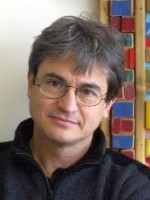
Carlo Rovelli (born 3 May 1956) is an Italian theoretical physicist and writer who has worked in Italy, the United States, France, and Canada. He is currently Emeritus Professor at the Centre de Physique Théorique of Marseille in France, a Distinguished Visiting Research Chair at the Perimeter Institute, core member of the Rotman Institute of Philosophy of Western University in Canada, and Fractal Faculty of the Santa Fe Institute in The United States. Rovelli works mainly in the field of quantum gravity and is a founder of the theory of loop quantum gravity. He has also worked in the history and philosophy of science, formulating the relational quantum mechanics and the notion of thermal time. He collaborates with several Italian newspapers, including the cultural supplements of the Corriere della Sera, Il Sole 24 Ore, and La Repubblica.
Human civilizations have always believed that the world consisted of the Heavens above and the Earth below (figure 1a).
— from The first scientist
Most acclaimed

Siete breves lecciones de física
An introduction to modern physics by a founder of the loop quantum gravity theory shares seven succinct lessons on topics ranging from general relativity and quantum mechanics to elementary particles and black holes.
General Relativity
Based on a course given at Oxford over many years, this book is a short and concise exposition of the central ideas of general relativity. Although the original audience was made up of mathematics students, the focus is on the chain of reasoning that leads to the relativistic theory from the analysis of distance and time measurements in the presence of gravity, rather than on the underlying mathematical structure. The geometric ideas - which are central to the understanding of the nature of gravity - are introduced in parallel with the development of the theory, the emphasis being on laying bare how one is led to pseudo-Riemannian geometry through a natural process of reconciliation of special relativity with the equivalence principle. At centre stage are the "local inertial coordinates" set up by an observer in free fall, in which special relativity is valid over short times and distances. In more practical terms, the book is a sequel to the author's Special Relativity in the same series, with some overlap in the treatment of tensors. The basic theory is presented using techniques, such as phase-plane analysis, that will already be familiar to mathematics undergraduates, and numerous problems, of varying levels of difficulty, are provided to test understanding. The latter chapters include the theoretical background to contemporary observational tests - in particular the detection of gravitational waves and the verification of the Lens-Thirring precession - and some introductory cosmology, to tempt the reader to further study. While primarily designed as an introduction for final-year undergraduates and first-year postgraduates in mathematics, the book is also accessible to physicists who would like to see a more mathematical approach to the ideas.
Reality Is Not What It Seems
Traces how the human image of the world has changed throughout history, demonstrating the evolution of the idea of reality while touching on subjects ranging from the Higgs boson to quantum gravity.