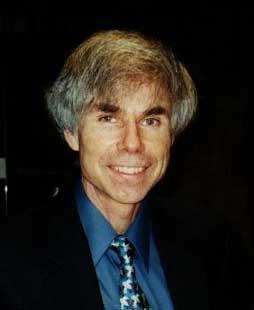
Douglas R. Hofstadter
Personal Information
Description
Douglas Hofstadter is an American scholar of cognitive science, physics, and comparative literature whose research includes concepts such as the sense of self in relation to the external world, consciousness, analogy-making, artistic creation, literary translation, and discovery in mathematics and physics. His 1979 book Gödel, Escher, Bach: An Eternal Golden Braid won both the Pulitzer Prize for general nonfiction and a National Book Award for Science. His 2007 book I Am a Strange Loop won the Los Angeles Times Book Prize for Science and Technology.—Wikipedia 2021-03-03
Books
Metamagical Themas
Toen 'Godel, Escher, Bach' verscheen in 1979 was Hofstadter in een klap wereldberoemd. Het is maar weinigen gegeven zo met taal en kennis te spelen: briljant, erudiet, creatief, humoristisch, en didaktisch van zeer hoog niveau. Dezelfde kwaliteiten bepalen het gezicht van 'Metamagische thema's'. Het is een bundeling van artikelen die in de jaren 1981-1983 in de Scientific American verschenen en die nu met behulp van uitvoerige naschriften tot een geheel verweven zijn. De onderwerpen bestrijken ruwweg hetzelfde brede gebied dat we kennen uit 'Godel, Escher, Bach': kunstmatige intelligentie, creativiteit, muziek, zelfverwijzing, en ook Achilles en de schildpad zijn van de partij. Een intellectuele delicatesse. Bevat register en een uitvoerige bibliografie met toelichting. (NBD|Biblion recensie, Drs. D.G. van der Steen.)
Gödel, Escher, Bach
Winner of the Pulitzer Prize A metaphorical fugue on minds and machines in the spirit of Lewis Carroll Douglas Hofstadter's book is concerned directly with the nature of "maps" or links between formal systems. However, according to Hofstadter, the formal system that underlies all mental activity transcends the system that supports it. If life can grow out of the formal chemical substrate of the cell, if consciousness can emerge out of a formal system of firing neurons, then so too will computers attain human intelligence. Gödel, Escher, Bach is a wonderful exploration of fascinating ideas at the heart of cognitive science: meaning, reduction, recursion, and much more.
The Mind's I
With contributions from Jorge Luis Borges, Richard Dawkins, John Searle, and Robert Nozick, The Mind's I explores the meaning of self and consciousness through the perspectives of literature, artificial intelligence, psychology, and other disciplines. In selections that range from fiction to scientific speculations about thinking machines, artificial intelligence, and the nature of the brain, Hofstadter and Dennett present a variety of conflicting visions of the self and the soul as explored through the writings of some of the twentieth century's most renowned thinkers.
I Am a Strange Loop
Hofstadter's long-awaited return to the themes of Gödel, Escher, Bach--an original and controversial view of the nature of consciousness and identity. What do we mean when we say "I"? Can a self, a soul, a consciousness, an "I" arise out of mere matter? If it cannot, then how can you or I be here? This book argues that the key to understanding selves and consciousness is a special kind of abstract feedback loop inhabiting our brains. Deep down, a human brain is a chaotic soup of particles, on a higher level it is a jungle of neurons, and on a yet higher level it is a network of abstractions that we call "symbols." The most central and complex symbol in your brain or mine is the one we both call "I." But how can such a mysterious abstraction be real--or is our "I" merely a convenient fiction?--From publisher description.
Le Ton beau de Marot
Not Merely a set of translations of one poem, Le Ton beau de Marot is an autobiographical essay, a love letter to the French language, a series of musings on life, loss, and death, a sweet bouquet of stirring poetry - but most of all, it celebrates the limitless creativity fired by a passion for the music of words. Dozens of literary themes and creations are woven into the picture, including Pushkin's Eugene Onegin, Dante's Inferno, Salinger's Catcher in the Rye, Villon's ballades, Nabokov's essays, Georges Perec's La disparition, Vikram Seth's Golden Gate. Horace's odes, and more. Rife with stunning form-content interplay, crammed with creative linguistic experiments yet always crystal-clear, this book is meant not only for lovers of literature, but also for people who wish to be brought into contact with current ideas about how creativity works, and who wish to see how today's computational models of language and thought stack up next to the human mind.
Fluid Concepts and Creative Analogies
Readers of earlier works by Douglas Hofstadter will find this book a natural extension of his style and his ideas about creativity and analogy; in addition, psychologists, philosophers, and artificial-intelligence researchers will find in this elaborate web of ingenious ideas a deep and challenging new view of mind.