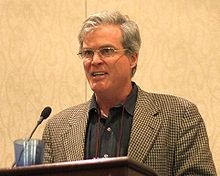
John Horgan
Personal Information
Description
John Horgan is an American science journalist best known for his 1996 book The End of Science. He has written for many publications, including National Geographic, Scientific American, The New York Times, Time, Newsweek, and IEEE Spectrum. - Wikipedia
Books
What Are You Optimistic About?
The nightly news and conventional wisdom tell us that things are bad and getting worse. Yet despite dire predictions, scientists see many good things on the horizon. John Brockman, publisher of Edge (www.edge.org), the influential online salon, recently asked more than 150 high-powered scientific thinkers to answer a vital question for our frequently pessimistic times: "What are you optimistic about?"Spanning a wide range of topics—from string theory to education, from population growth to medicine, and even from global warming to the end of world—What Are You Optimistic About? is an impressive array of what world-class minds (including Nobel Laureates, Pulitzer Prize winners, New York Times bestselling authors, and Harvard professors, among others) have weighed in to offer carefully considered optimistic visions of tomorrow. Their provocative and controversial ideas may rouse skepticism, but they might possibly change our perceptions of humanity's future.
The Undiscovered Mind
My obsession with sciences limits culminated in "The End of Science", which was published in 1996. In it I examined major fields of pure science, including particle physics, cosmology, and evolutionary biology. These disciplines, I argued, were becoming victims of their own phenomenal success. Physicists would never transcend the powerful theories of quantum mechanics and relativity, which together describe all the forces and particles of nature; cosmologists would never achieve anything as profound as the unifying narrative ofthe big bang theory; biologists could not hope to top Darwin's theory of evolution and DNA-mediated genetics. But in the chapters titled "The End of Social Science" and "The End of Neuroscience," I presented a somewhat different argument: that scientists attempting to explain the human mind might be overwhelmed by its sheer complexity. [...] I decided to write another book, one that would examine mind-related science in much greater detail than "The End of Science" did. The book would address not only scientists' efforts to explain the properties of the mind, including consciousness; it would also examine attempts to medicate or otherwise treat minds afflicted with mental illness and to replicate the mind's properties in machines. [excerpted from author's Introduction]
Terrorism Studies
"In an age when there is more written about terrorism than anyone can possibly read in a lifetime, it has become increasingly difficult for students and scholars to navigate the literature. At the same time, courses and modules on terrorism studies are developing at a rapid rate. To meet this challenge, this comprehensive new Reader in Terrorism Studies seeks to equip the aspiring student, based anywhere in the world, with a comprehensive introduction to the study of terrorism. Containing many of the most influential and groundbreaking studies from the worlds leading authorities on terrorism, drawn from several disciplines, and edited by one of the worlds leading experts, John Horgan, this book is the essential companion for the student of terrorism and political violence. Terrorism Studies, which starts with a detailed Introduction on 'Studying Terrorism', is divided into nine sub-sections, each of which has an introduction and guide to further reading. It will be essential reading for undergraduate students of terrorism and political violence, and recommended reading for students of security studies, international relations and political science in general"-- Provided by publisher