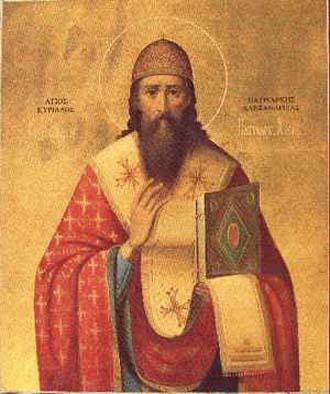
Cyril Saint, Patriarch of Alexandria
Personal Information
Description
There is no description yet, we will add it soon.
Books
Five tomes against Nestorius ; Scholia on the incarnation ; Christ is one ; Fragments against Diodore of Tarsus, Theodore of Mopsuestia, the Synoustias
Three Christological Treatises
"Cyril, bishop of Alexandria from 412 to 444, is renowned both as one of the most authoritative of all the fathers of the church, and at the same time as one of the most controversial of all church politicians. He oversaw the final extinguishing of pagan religion from Alexandria, and also spent the height of his career as a statesman and an author fighting the doctrines of Nestorius, whose excommunication he brought about at the Council of Ephesus (431). Having spent the first fifteen years of his episcopate writing extensive commentaries on Scripture, from 429 onwards Cyril turned his enormous learning and talent for penning and distributing polemic tracts to the development of doctrinal orthodoxy after he sensed that the new ideas coming out of Constantinople threatened the very core of the Christian doctrines of Incarnation and salvation. The three treatises here translated into English for the first time all belong to the period around the ecumenical council. On Orthodoxy to Theodosius was written for the emperor, a year before the council met, with the aim of persuading him that Nestorius's sermons were heretical and that his task as leader of both church and state was to ensure right religious observance. The Defense against the Bishops of Oriens and the Defense against Theodoret were written in the months leading up to the council when Cyril found himself required to defend his notorious 'Twelve Chapters (or Anathemas),' which many bishops in other parts of the empire felt had gone too far in an anti-Nestorian direction. All three works were key parts of Cyril's battle for orthodoxy and mark key moments in the church's progress towards the definition of Christological orthodoxy that was made at Chalcedon."--
On the unity of Christ
In the early fifth century the Christian world was racked by one of the most fierce theological disputes it had known since the Arian crisis of the previous century. The center of debate turned on the nature of the personhood of Christ, and how divine and human characteristics could combine in Jesus without rendering his subjectivity hopelessly divided, or without reducing his authentic humanness to an insubstantiality. These arguments soon polarized in the conflict between two great churches, Alexandria and Constantinople, and their powerful archbishops, St Cyril (d. 444) and Nestorius (d.c. 452) respectively. Cyril is, arguably, the most important patristic theologian ever to deal with the issues of Christology. The text here translated is one of his most important and approachable writings, composed in the aftermath of the Council of Ephesus (431) to explain his doctrine to an international audience. He argues here for the single divine subjectivity of Christ, and describes how it encompasses a full and authentic humanity in Jesus - a human experience that is not overwhelmed by the divine presence but fostered and enhanced by it. Accordingly, for St Cyril, Christology becomes a paradigm for the transfigured and redeemed life of the Christian. . This book is essential reading for all those interested in the theology and spirituality of the fathers, in the ancient church's use of scripture, and the way in which the church once creatively expressed its thinking through the media of philosophy and the natural sciences.
[Opera]
Festal letters 1-12
"St. Cyril of Alexandria is best known for his role in the Christological disputes of the fifth century. In recent years, however, scholars have turned their attention to Cyril the exegete. Cyril wrote extensive commentaries on nearly every book of the Bible; in fact, two-thirds of his extant corpus is devoted to biblical interpretation. Yet, despite this strong interest in Cyril as theologian and biblical interpreter, his activity as the Patriarch of Alexandria remains obscure. Doctrinal treatises and biblical commentary reveal little of the daily pastoral duties that occupied Cyril during his years as leader of one of ancient Christianity's most important sees. This new translation of Cyril's festal letters will help fill these gaps. Twenty-nine in all, these letters cover all but three of Cyril's years as bishop. In Alexandria, festal letters functioned primarily as a vehicle for announcing the beginning of Lent and the proper date for the celebration of Easter. They also served an important catechetical purpose by providing the patriarch with an annual opportunity to present his flock with a pastoral version of the theological issues that found more formal and complex expression elsewhere. Thus, Cyril's Festal Letters offer the modern reader a glimpse into the issues that Cyril himself considered important enough to proclaim to the entire diocese and a sample of how he prepared these ideas for reception by a less sophisticated audience. These letters illuminate other aspects of the ancient church in Alexandria, including that church's complex relationship with the Jews and other religious groups, as well as the ways in which the ascetical movement wound its way into the patriarch's pastoral program. In short, Cyril of Alexandria's Festal Letters provides modern readers with a rare opportunity to enter the daily reality of the church in ancient Alexandria."--