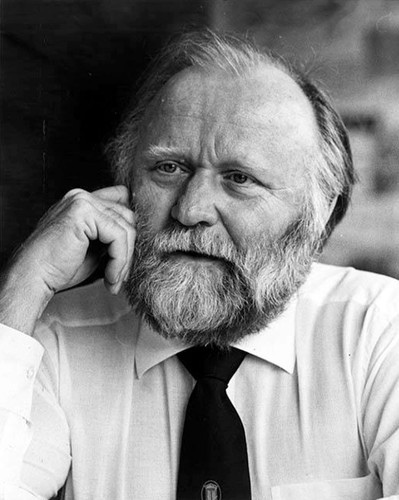

UNITED STATES AUTHOR · SCIENCE FICTION · FICTION
Frank Herbert
Also known as: Herbert, Frank, herbert-frank
Franklin Patrick Herbert Jr. (October 8, 1920 – February 11, 1986) was an American science-fiction author, best known for his 1965 novel Dune and its five sequels. He also wrote short stories and worked as a newspaper journalist, photographer, book reviewer, ecological consultant, and lecturer. Dune is the best-selling science fiction novel of all time, and the series is a classic of the science-fiction genre. The series has been adapted numerous times, including the feature film David Lynch's Dune (1984), the miniseries Frank Herbert's Dune (2000) and Children of Dune (2003), and a motion picture trilogy currently in production, with Denis Villeneuve's Dune (2021) and Dune: Part Two (2024) having been released.
Muad'dib's Imperial reign generated more historians than any other era in human history.
— from Dune Messiah
Most acclaimed

The Jesus Incident
From the back cover: Frank Herbert, author of the world-famous Dune, is one of today's leading futurist thinkers. Bill Ransom is a poet, a Pulitzer and National Book Award nominee. Together, in a bold and unprecedented collaboration, they have crafted a book that combines the outward sweep of SF at its farseeing best with the intense inward laser of the poet's eye. As demanding and spectacular as the vision it serves. The Jesus Incident is as much a voyage as a novel: a breakthrough work of speculative fiction that leaps to the end of evolution, to the surface of a poisoned planet as profoundly realized as Dune's Arrakis... to witness mankind and his creations trading places in a ceremony that illuminates the shimmering connections between free will and destiny that will determine the ultimate course of our future.
Dune Messiah
Book Two in the Magnificent Dune Chronicles—the Bestselling Science Fiction Adventure of All Time Dune Messiah continues the story of Paul Atreides, better known—and feared—as the man christened Muad’Dib. As Emperor of the known universe, he possesses more power than a single man was ever meant to wield. Worshipped as a religious icon by the fanatical Fremen, Paul faces the enmity of the political houses he displaced when he assumed the throne—and a conspiracy conducted within his own sphere of influence. And even as House Atreides begins to crumble around him from the machinations of his enemies, the true threat to Paul comes to his lover, Chani, and the unborn heir to his family’s dynasty...
Dune
The breathtaking vision and incomparable storytelling of Brian Herbert and Kevin Anderson's Dune: The Butlerian Jihad, a prequel to Frank Herbert's classic Dune, propelled it to the ranks of speculative fiction's classics in its own right. Now, with all the color, scope, and fascination of the prior novel, comes Dune: The Machine Crusade. . More than two decades have passed since the events chronicled in The Butlerian Jihad. The crusade against thinking robots has ground on for years, but the forces led by Serena Butler and Irbis Ginjo have made only slight gains; the human worlds grow weary of war, of the bloody, inconclusive swing from victory to defeat. The fearsome cymeks, led by Agamemnon, hatch new plots to regain their lost power from Omnius--as their numbers dwindle and time begins to run out. The fighters of Ginaz, led by Jool Noret, forge themselves into an elite warrior class, a weapon against the machine-dominated worlds. Aurelius Venport and Norma Cenva are on the verge of the most important discovery in human history-a way to "fold" space and travel instantaneously to any place in the galaxy. And on the faraway, nearly worthless planet of Arrakis, Selim Wormrider and his band of outlaws take the first steps to making themselves the feared fighters who will change the course of history: the Fremen. Here is the unrivaled imaginative power that has put Brian Herbert and Kevin Anderson on bestseller lists everywhere and earned them the high regard of readers around the globe. The fantastic saga of Dune continues in Dune: The Machine Crusade.