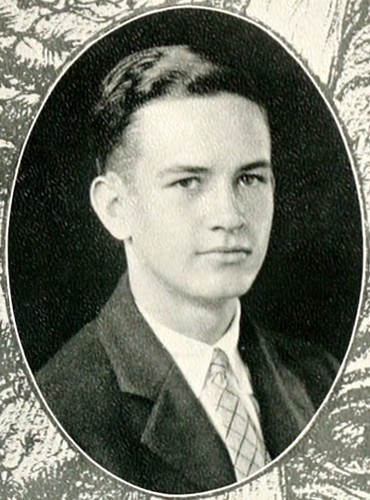

UNITED STATES AUTHOR · FICTION · GENERAL
Frank G. Slaughter
Also known as: C. V. Terry, G. Arnold Haygood
Frank Gill Slaughter was born in Washington DC, and was moved with his family to a farm near Oxford, North Carolina. In 1925 he received a degree from Trinity College and went on to study medicine at Johns Hopkins University. In 1935, while working as a physician in Jacksonville FL, he began writing fiction. In 1941 his first novel, That None Should Die, was published. He went on to write almost 30 novels, drawing on his experience as a doctor and his interest in history and the Bible. Frank Gill Slaughter , pen-name Frank G. Slaughter, pseudonym C.V. Terry, was an American novelist and physician whose books sold more than 60 million copies. His novels drew on his own experience as a doctor and his interest in history and the Bible. Through his novels, he often introduced readers to new findings in medical research and new medical technologies.
IT WAS NOON on a bright-blue autumn day in early October of the war year 1942.
— from Countdown, 2009
Most acclaimed

Epidemic!
That double threat, rats and lice (or rather fleas) make history- this time in New York City, as ship's captain Mike Dollard, after a port of call in the Cameroons, dies on arrival in his girl's apartment, and a dock strike gives the disease-bearing rats shore leave. Dr. Eric Stowe, immunologist and public health officer of the World Health Organization, temporarily stationed at a Manhattan city hospital, makes an early identification of the plague, but not before the young doctor who has performed the autopsy is a victim. An all out alert is sounded: finally the city is quarantined; the caseload climbs, and organized violence, arson and sabotage make an even greater disaster area of the city, before the epidemic can be controlled.... A strong but strident situation toboggans from emergency to catastrophe and leaves little time for romance (Drs. Eric Stowe and Trent, and the nurse they both love) but the subject and the author are within a sure sphere of contagion.
Constantine
"Constantine: Unconquered Emperor, Christian Victor is a survey of the life and legacy of the greatest of the later Roman emperors. In 312, Constantine - one of four Roman emperors ruling a divided empire - marched on Rome to establish his sole control of its western half. According to Constantine's first biographer, the bishop Eusebius, on the eve of the decisive battle, at Rome's Milvian Bridge, he had a vision. 'A cross-shaped trophy of light' appeared to him in the sky with an exhortation, generally translated as 'By this sign conquer'. Inscribing the sign on the shields of his soldiers, Constantine drove the followers of his rival Maxentius into the Tiber and claimed the imperial capital for himself. He converted to Christianity and ended persecution of his co-religionists with the defeat in 324 of his last rival, Licinius." "Under Constantine, Christianity emerged from the shadows, its adherents no longer persecuted. Constantine united the western and eastern halves of the Roman Empire, and presided over the first ecumenical council of the Christian Church, at Nicaea in 325. He founded a new capital city nearby on the Bosphorus, where Europe meets Asia. This site, the ancient trading colony of Byzantium, became the city of Constantine, Constantinople, a new Christian capital set apart from Rome's pagan past." "Paul Stephenson offers an account of a man whose cultural and spiritual renewal of the Roman Empire gave birth to the historically crucial idea of a unified Christian Europe underpinned by a commitment to religious tolerance."--Jacket.
Countdown
2009
A powerful investigation into the chances for humanity's future from the author of the bestseller The World Without Us. In his bestselling book The World Without Us, Alan Weisman considered how the Earth could heal and even refill empty niches if relieved of humanity's constant pressures. Behind that groundbreaking thought experiment was his hope that we would be inspired to find a way to add humans back to this vision of a restored, healthy planet-only in harmony, not mortal combat, with the rest of nature. But with a million more of us every 4 1/2 days on a planet that's not getting any bigger, and with our exhaust overheating the atmosphere and altering the chemistry of the oceans, prospects for a sustainable human future seem ever more in doubt. For this long awaited follow-up book, Weisman traveled to more than 20 countries to ask what experts agreed were probably the most important questions on Earth--and also the hardest: How many humans can the planet hold without capsizing? How robust must the Earth's ecosystem be to assure our continued existence? Can we know which other species are essential to our survival? And, how might we actually arrive at a stable, optimum population, and design an economy to allow genuine prosperity without endless growth? Weisman visits an extraordinary range of the world's cultures, religions, nationalities, tribes, and political systems to learn what in their beliefs, histories, liturgies, or current circumstances might suggest that sometimes it's in their own best interest to limit their growth. The result is a landmark work of reporting: devastating, urgent, and, ultimately, deeply hopeful. By vividly detailing the burgeoning effects of our cumulative presence, Countdown reveals what may be the fastest, most acceptable, practical, and affordable way of returning our planet and our presence on it to balance. Weisman again shows that he is one of the most provocative journalists at work today, with a book whose message is so compelling that it will change how we see our lives and our destiny.