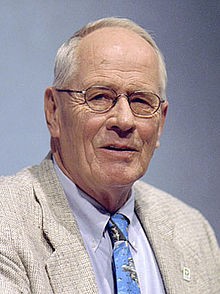
Stephen E. Ambrose
Description
Stephen Edward Ambrose was an American historian and biographer of U.S. Presidents Dwight D. Eisenhower and Richard Nixon. He was a longtime professor of history at the University of New Orleans and the author of many best selling volumes of American popular history. Source: [Stephen E. Ambrose]( on Wikipedia.
Books
The Cold War
Uses contemporary documents to explore the development of the Cold War struggle, the consequences in the 1950s and 1960s, and the lasting effects on American social and cultural patterns.
The Wild Blue
The very young men who flew the B-24s over Germany in World War II against terrible odds were yet another exceptional band of brothers, and, in The Wild Blue, Ambrose recounts their extraordinary brand of heroism, skill, daring, and comradeship with vivid detail and affection. Ambrose describes how the Army Air Forces recruited, trained, and then chose those few who would undertake the most demanding and dangerous jobs in the war. These are the boys -- turned pilots, bombardiers, navigators, and gunners of the B-24s -- who suffered over 50 percent casualties. With his remarkable gift for bringing alive the action and tension of combat, Ambrose carries us along in the crowded, uncomfortable, and dangerous B-24s as their crews fought to the death through thick black smoke and deadly flak to reach their targets and destroy the German war machine. The Wild Blue makes clear the contribution these young men of the Army Air Forces stationed in Italy made to the Allied victory. - Jacket flap.
Comrades
The author explores male friendships, including those between brothers, fathers and sons, soldiers and more.
Eisenhower and the German POWs
In 1989, a Canadian publisher released a book that has since become the subject of enormous international controversy. James Bacque's Other Losses: An Investigation into the Mass Deaths of German Prisoners of War at the Hands of the French and Americans After World War II asserts that General Dwight D. Eisenhower, as head of the American occupation of Germany in 1945, deliberately starved to death German prisoners of war in staggering numbers. Bacque charges that quite likely up to a million prisoners died, their deaths knowingly caused by army officers who had sufficient resources to keep them alive. In 1990, the Eisenhower Center at the University of New Orleans sponsored an international conference to examine Bacque's allegations. Participants included the six historians whose essays, along with those of Stephen E. Ambrose and Gunter Bischof, make up this volume, which systematically dismantles Bacque's argument. Eisenhower and the German POWs demonstrates numerous glaring errors in Bacque's research and conclusions. The authors show that Bacque misinterpreted documents accounting for the disposition of German POWs; neglected important evidence to the contrary of his theories; failed to take account of the acute disruption of Europe's economy and distribution networks; and ignored the competing needs of millions of refugees, displaced persons, and hungry civilians, as well as the deployment of Allied resources to the Pacific, where the war continued unabated. In addition to exposing Bacque's flawed methodology and illogical conclusions, these essays offer an extremely detailed and broad-ranging examination of European conditions immediately after the cessation of hostilities and of the difficult business of administering the newborn peace and the millions of newly disarmed military personnel.
Crazy Horse and Custer
On the sparkling morning of June 25, 1876, 611 U.S. Army soldiers rode toward the banks of the Little Bighorn in the Montana Territory, where 3,000 Indians stood waiting to battle.The lives of two great warriors would soon be forever linked throughout history: Crazy Horse, leader of the Oglala Sioux, and General George Armstrong Custer of the Seventh Cavalry. Both were men of aggression and supreme courage. Both had become leaders in their societies at very early ages; both had been stripped of power, and in disgrace had worked to earn back the respect of their people. And to both of them, the unspoiled grandeur of the Great Plains of North America was an irresistible challenge. Their parallel lives would pave the way, in a manner unknown to either, for an inevitable clash between the two nations fighting for possession of the open prairie. - Back cover.
Eisenhower
V. 1. Soldier, general of the army, President-elect, 1890-1952--v. 2. The President. A portrait of the man, both decent and complex, who is increasingly regarded as one of the twentieth century's greatest Presidents.
Ike: Abilene to Berlin
Covers Eisenhower's life from childhood to Allied Commander in WWII.
Witness to America
"A classic collection of primary source accounts covering the history of the United States, now in a new format, abridged, and brought up to the present day"--
Ike's spies
An account of the transformation of the wartime Office of Strategic Services into the Central Intelligence Agency and the growth of America's intelligence community.
Lewis & Clark
Tells the story of the most important expedition in American history, led by Captains Meriwether Lewis and William Clark. Includes the stories of the young army men, French-Canadian boatmen, Clark's African-American slave, and the Shoshone woman named Sacagawea who went with them.
This vast land, a young man's journal of the Lewis and Clark Expedition
A fictional journal recounting the travels--from 1803 to 1806--of eighteen-year-old George Shannon, the youngest member of Lewis and Clark's Corps of Discovery as they explored the west and sought a water route to the Pacific Ocean.
Pegasus Bridge
In the early morning hours of June 6, 1944, a small detachment of British airborne troops stormed the German defense forces and paved the way for the Allied invasion of Europe. Pegasus Bridge was the first engagement of D-Day, the turning point of World War II. This gripping account of it by acclaimed author Stephen Ambrose brings to life a daring mission so crucial that, had it been unsuccessful, the entire Normandy invasion might have failed. Ambrose traces each step of the preparations over many months to the minute-by-minute excitement of the hand-to-hand confrontations on the bridge. This is a story of heroism and cowardice, kindness and brutality—the stuff of all great adventures.