
UNITED KINGDOM AUTHOR · HISTORY · CAMPAIGNS
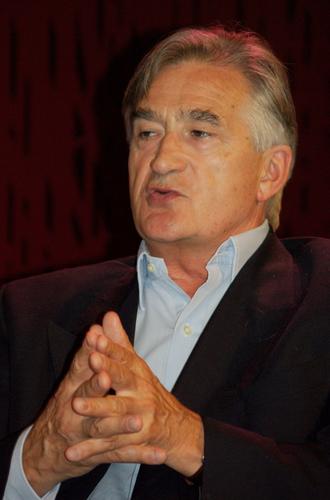
Antony Beevor
Also known as: Antony James Beevor
Antony James Beevor (born 14 December 1946) is a British military historian. He has published several popular historical works on the Second World War and other wars during the 20th century.
Bosch backed down while all those on the edge of joining hurried to cover their tracks Lt-Colonel Tejero's daughter then rang her father in the Cortes and the revolt was over in under eight hours
— from The Spanish Civil War, 1997
Most acclaimed

D-Day
The definitive account of the Normandy invasion by the bestselling author of Stalingrad and The Fall of Berlin 1945From critically acclaimed world historian, Antony Beevor, this is the first major account in more than twenty years to cover the whole invasion from June 6, 1944, right up to the liberation of Paris on August 25. It is the first book to describe not only the experiences of the American, British, Canadian, and German soldiers, but also the terrible suffering of the French caught up in the fighting. More French civilians were killed by Allied bombing and shelling than British civilians were by the Luftwaffe.The Allied fleet attempted by far the largest amphibious assault ever, and what followed was a battle as savage as anything seen on the Eastern Front. Casualties mounted on both sides, as did the tensions between the principal commanders. Even the joys of liberation had their darker side. The war in northern France marked not just a generation, but the whole of the postwar world, profoundly influencing relations between America and Europe. Beevor draws upon his research in more than thirty archives in six countries, going back to original accounts, interviews conducted by combat historians just after the action, and many diaries and letters donated to museums and archives in recent years.D-Day will surely be hailed as the consummate account of the Normandy invasion and the ferocious offensive that led to the liberation of Paris.
The Spanish Civil War
1997
"This book presents a new history of the most important conflict in European affairs during the 1930s, the Spanish Civil War. It describes the complex origins of the conflict, the collapse of the Spanish Republic and the outbreak of the only mass worker revolution in the history of Western Europe. Stanley Payne explains the character of the Spanish revolution and the complex web of republican politics, while also examining the development of Franco's counter-revolutionary dictatorship. Payne gives attention to the multiple meanings and interpretations of war and examines why the conflict provoked such strong reactions at the time, and long after. The book also explains the military history of the war and its place in the history of military development, the non-intervention policy of the democracies and the role of German, Italian and Soviet intervention, concluding with an analysis of the place of the war in European affairs, in the context of twentieth-century revolutionary civil wars"-- "The Spanish Civil War was the most important political and military struggle in Europe during the decade prior to World War II. It not only polarized Spain, but produced an intense reaction among millions all over Europe and the Americas. The war was given many names. Leftists, as well as many liberals, termed it varyingly "fascism versus democracy," "the people versus the oligarchy" (or "against the army"), "revolution versus counterrevolution," and even "the future versus the past." Rightists and conservatives at different times called it a struggle of "Christianity versus atheism," "Western civilization against communism," "Spain versus anti-Spain," and "law and order against subversion." These labels were antithetical, but nonetheless not always mutually exclusive, for the war was extremely complicated and contradictory, and there were greater or lesser amounts of truth in most of these appellations, though some were more accurate than others. The war began over internal issues in Spain, but once all three major European dictatorships initiated limited intervention, many people began to see it as an international conflict by proxy. In other countries, attitudes were sometimes colored more by opinion about the intervening states than about the Spanish conflict itself, for the outcome was perceived by many as potentially changing the balance of power in Western Europe"--
Russia
The Soviet Union crumbles and Russia rises from the rubble, once again the great nation - a perfect scenario, but for one point: Russia was never a nation. And this, says the eminent historian Geoffrey Hosking, is at the heart of the Russians' dilemma today, as they grapple with the rudiments of nationhood. His book is about the Russia that never was, a three-hundred-year history of empire building at the expense of national identity. Russia begins in the sixteenth century, with the inception of one of the most extensive and diverse empires in history. Hosking shows how this undertaking, the effort of conquering, defending, and administering such a huge mixture of territories and peoples, exhausted the productive powers of the common people and enfeebled their civic institutions. Neither church nor state was able to project an image of "Russian-ness" that could unite elites and masses in a consciousness of belonging to the same nation. Hosking depicts two Russias, that of the gentry and of the peasantry, and reveals how the gap between them, widened by the Tsarist state's repudiation of the Orthodox messianic myth, continued to grow throughout the eighteenth and nineteenth centuries. Here we see how this myth, on which the empire was originally based, returned centuries later in the form of the revolutionary movement, which eventually swept away the Tsarist Empire but replaced it with an even more universalist one. Hosking concludes his story in 1917, but shows how the conflict he describes continues to affect Russia right up to the present day.