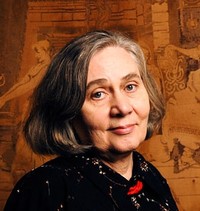

UNITED STATES AUTHOR · FICTION · PHILOSOPHY
Marilynne Robinson
Marilynne Summers Robinson (born November 26, 1943) is an American novelist and essayist. Across her writing career, Robinson has received numerous awards, including the Pulitzer Prize for Fiction in 2005, National Humanities Medal in 2012, and the 2016 Library of Congress Prize for American Fiction. In 2016, Robinson was named in Time magazine's list of 100 most influential people. Robinson began teaching at the Iowa Writers' Workshop in 1991 and retired in the spring of 2016. Robinson is best known for her novels Housekeeping (1980) and Gilead (2004).
I told you last night that I might be gone sometime, and you said, Where, and I said, To be with the Good Lord, and you said, Why, and I said, Because I'm old, and you said, I don't think you're old.
— from Gilead, 2004
Most acclaimed

Lila
Neglected as a toddler, Lila was rescued by a canny young drifter and together they crafted a life on the run. Despite some petty violence and moments of desperation, their life was laced with moments of joy and love. When Lila arrives in Gilead, she struggles to reconcile the life of her makeshift family and their days of hardship with the gentle Christian worldview of her husband which paradoxically judges those she loves. Lila, homeless and alone after years of roaming the countryside, steps inside a small-town Iowa church -- the only available shelter from the rain -- and ignites a romance and a debate that will reshape her life. She becomes the wife of a minister, John Ames, and begins a new existence while trying to make sense of the days of suffering that preceded her newfound security. Neglected as a toddler, Lila was rescued by Doll, a canny young drifter, and brought up by her in a hardscrabble childhood. Together they crafted a life on the run, living hand-to-mouth with nothing but their sisterly bond and a ragged blade to protect them. But despite bouts of petty violence and moments of desperation, their shared life is laced with moments of joy and love. When Lila arrives in Gilead, she struggles to harmonize the life of her makeshift family and their days of hardship with the gentle Christian worldview of her husband that paradoxically judges those she loves.
Gilead
2004
WINNER OF THE 2005 PULITZER PRIZE FOR FICTION In 1956, toward the end of Reverend John Ames’s life, he begins a letter to his young son, an account of himself and his forebears. Ames is the son of an Iowan preacher and the grandson of a minister who, as a young man in Maine, saw a vision of Christ bound in chains and came west to Kansas to fight for abolition: He “preached men into the Civil War,” then, at age fifty, became a chaplain in the Union Army, losing his right eye in battle. Reverend Ames writes to his son about the tension between his father—an ardent pacifist—and his grandfather, whose pistol and bloody shirts, concealed in an army blanket, may be relics from the fight between the abolitionists and those settlers who wanted to vote Kansas into the union as a slave state. And he tells a story of the sacred bonds between fathers and sons, which are tested in his tender and strained relationship with his namesake, John Ames Boughton, his best friend’s wayward son. Gilead is the long-hoped-for second novel by one of our finest writers, a hymn of praise and lamentation to the God-haunted existence that Reverend Ames loves passionately, and from which he will soon part.
Home
We all know Julie Andrews from The Sound of Music and Mary Poppins, but few people know the story of her road to fame. In this memoir, Julie Andrews takes us from her early years with an aspiring Vaudeville mom and a loving dad, to her parents’ divorce and mother’s remarriage to a difficult stepfather. Julie has kept diaries her whole life, so every anecdote in her memoir is very fresh and immediate. There are incredible scenes of the London Blitz during WWII; at age nine, she was the only kid on the street who was able to identify the sound of the German bombers, and it was her job to warn the whole neighborhood when they were coming. She performed for the Queen at age 12, and by the time she was a young teen, she was supporting her entire family because her stepdad was an alcoholic. A few of her roles were more glamorous during this time, but she was always the performer with holes in her socks because she never had any money. At age 19, Julie tried out for the role in The Boy Friend, which was opening on Broadway in New York. She got the part, was a smash in the play, and then starred in My Fair Lady with Rex Harrison. The book carries through her role in Camelot with Richard Burton, after which her daughter was born. There are great anecdotes about the actors and actresses of her day and her voice is humorous, warm, and lively, adding up to an incredible memoir.