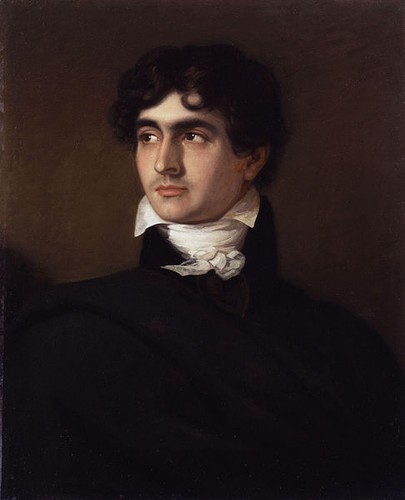
John William Polidori
Personal Information
Description
Dr. Polidori was Lord Byron's personal physician. Upon accompanying Byron on holiday to Switzerland, he participated in a "ghost story" writing exercise. His own story was met with scorn, but, inspired by the fragment that Byron wrote, Polidori used this base to write was would become the first modern vampire story in the English language. His character, Lord Ruthven, an aristocratic bloodsucker based on Byron, would be used in English, French and German novels, operas and plays until the character was eclipsed by Stoker's Count Dracula. Polidori became depressed and indebted due to gambling. His death at the age of 25 was officially classed as natural causes, but it was likely that Polidori committed suicide. There is strong evidence indicating poisoning with cyanide. Through his sister, Polidori was the uncle to Dante Gabriel Rossetti, co-founder of the Pre-Raphaelite Brotherhood.
Books
The Vampyre / Ernestus Berchtold
In 1816, John William Polidori travelled to Geneva as Lord Byron’s personal physician. There they met Mary Godwin (later Shelley) and her lover Percy Shelley and decided to while away a wet summer by writing ghost stories. The only two to complete their stories were Mary Shelley, who published Frankenstein in 1818, and Polidori, whose The Vampyre and Ernestus Berchtold were both published in 1819. The Vampyre, based on a discarded idea of Byron’s, is the first portrayal of the alluring vampire figure familiar to readers of Bram Stoker and Anne Rice. Ernestus Berchtold scandalously draws on the rumours of Byron’s affair with his half-sister for a Faustian updating of the myth of Oedipus, which it combines with an account of the struggle of Swiss patriots against the Napoleonic invasion. Along with Polidori’s work, this edition also includes stories read and written by the travellers in the Genevan summer of 1816 and contemporary responses to The Vampyre and Ernestus Berchtold.
Diary, 1816, relating to Byron, Shelley, etc
The Vampyre
The Vampyre*, a short gothic novel by John William Polidori, was first published in 1819 and is considered the first modern vampire story. The story features Lord Ruthven, a seductive aristocrat with unnatural powers over men and women, and an insatiable thirst for blood. Polidori's innovative portrayal of the vampire as a Byronic figure is said to have set the template for the modern vampire.
The Best Vampire Stories 1800-1849: A Classic Vampire Anthology
Contes de vampires
Comment échappe-t-on à un vampire ? C'est cette angoissante question que sont contraints de se poser tous les personnages de ces nouvelles. Aubrey peut-il empêcher lord Ruthven de s'en prendre à sa jeune soeur ? Romuald peut-il résister à la belle Clarimonde qui, chaque nuit, l'entraîne dans une existence de plaisirs et de débauche contraire à ses voeux pieux ? Luigi peut-il sauver sa femme et son enfant des griffes d'un revenant furieux ?
The Evil Image
xi • General Introduction (The Evil Image: Two Centuries of Gothic Short Fiction and Poetry) • essay by Patricia L. Skarda and Nora Crow Jaffe xxv • Critical Studies of the Gothic • essay by uncredited 2 • The Apparition of Mrs. Veal • (1919) • short story by Daniel Defoe (variant of A True Relation of the Apparition of One Mrs. Veal the Next Day After Her Death to One Mrs. Bargrave at Canterbury the 8th of September 1705 1706) 11 • On the Pleasures Derived from Objects of Terror; with Sir Bertrand, a Fragment • (1773) • short story by Anna Letitia Barbauld and John Aikin (variant of On the Pleasure Derived from Objects of Terror; with Sir Bertrand, A Fragment) [as by Dr. John Aikin and Anna Laetitia Aikin Barbauld] 18 • The Snow-Fiend • (1826) • poem by Ann Radcliffe 20 • December's Eve, Abroad • (1826) • poem by Ann Radcliffe 21 • December's Eve, At Home • (1826) • poem by Ann Radcliffe 23 • A Receipt for Writing a Novel • (1799) • poem by Mary Alcock 27 • Alonzo the Brave and Fair Imogine • (1796) • poem by Matthew Gregory Lewis 29 • Giles Jollup the Grave, and Brown Sally Green • (1801) • poem by Matthew Gregory Lewis 35 • "Christabel" • (1797) • poem by Samuel Taylor Coleridge (variant of Christabel 1816) 55 • Manfred: A Dramatic Poem • (1817) • poem by Lord George Gordon Byron 94 • The Vampyre: A Tale • [Lord Ruthven] • (1819) • novelette by Dr. John William Polidori 110 • A Fragment of a Novel • (1819) • short story by Lord George Gordon Byron (variant of Fragment of a Novel) 117 • Transformation • (1830) • short story by Mary Shelley (variant of The Transformation) 133 • Isabella, or The Pot of Basil • (1820) • poem by John Keats 153 • Wandering Willie's Tale • [Redgauntlet Excerpts] • (1824) • short story by Sir Walter Scott 169 • The Spectre Bridegroom • (1819) • short story by Washington Irving 182 • [Fall of the House of Usher]( (1839) • novelette by Edgar Allan Poe 199 • [Young Goodman Brown]( • (1835) • short story by Nathaniel Hawthorne 212 • Rochester's Song to Jane Eyre • (unknown) • poem by Charlotte Brontë 214 • R. Alcona to J. Brenzaida • (1846) • poem by Emily Brontë 214 • Retrospection • (1835) • poem by Charlotte Brontë 215 • No Coward Soul Is Mine • (1846) • poem by Emily Brontë 218 • The Signalman • (1866) • short story by Charles Dickens 231 • Sister Helen • (1853) • poem by Dante Gabriel Rossetti 240 • Goblin Market • (1859) • poem by Christina Rossetti [as by Christina Georgina Rossetti] 256 • Green Tea • [Martin Hesselius] • (1869) • novelette by Joseph Sheridan Le Fanu 285 • Perilous Play • (1869) • short story by Louisa May Alcott 298 • The Ghostly Rental • (1876) • novelette by Henry James 326 • The Stolen Child • (1886) • poem by William Butler Yeats 331 • Markheim • (1885) • short story by Robert Louis Stevenson 346 • The Darkling Thrush • (1900) • poem by Thomas Hardy (variant of By the Century's Deathbed) 347 • A Wasted Illness • (1901) • poem by Thomas Hardy 350 • The Monster • non-genre • (1898) • novella by Stephen Crane 400 • The Mezzotint • (1904) • short story by M. R. James 411 • Arabesque: The Mouse • (1920) • short story by A. E. Coppard 419 • [A Rose for Emily]( • (1930) • short story by William Faulkner 429 • Clytie • (1941) • short story by Eudora Welty 442 • The River • non-genre • (1953) • short story by Flannery O'Connor 458 • Briar Rose (Sleeping Beauty) • (1971) • poem by Anne Sexton 465 • Suffer the Little Children • (1972) • short story by Stephen King 476 • Suggestions for Further Reading in the Gothic Tradition • essay by uncredited