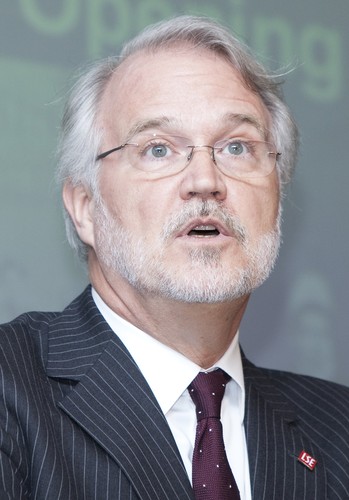
Craig J. Calhoun
Personal Information
Description
American sociologist
Books
Lessons of empire
>In the shadow of America’s recent military involvement in Iraq and Afghanistan, distinguished historians of empires and noted international relations specialists consider the dirty word “empire” in the face of contemporary political reality. Is “empire” a useful way to talk about America’s economic, cultural, political, and military power? > >This final volume in the Social Science Research Council “After September 11” series examines what the experience of past empires tells us about the nature and consequences of global power. How do the goals and circumstances of the United States today compare to classical imperialist projects of rule over others, whether for economic exploitation or in pursuit of a “civilizing mission”? > >Reviewing the much contested history of domination by Western colonizing powers, Lessons of Empire asks what lessons the history of these empires can teach us about the world today. - [publisher](
Business as usual
"Business As Usual by Jane Oliver and Ann Stafford was first published in 1933. It's a delightful illustrated novel in letters from Hilary Fane, an Edinburgh girl fresh out of university who is determined to support herself by her own earnings in London for a year, despite the mutterings of her surgeon fiancee. After a nervous beginning looking for a job while her savings rapidly diminish, she finds work as a typist in the London department store of Everyman's (a very thin disguise for Selfridges), and rises rapidly through the ranks to work in the library, where she has to enforce modernising systems on her entrenched and frosty colleagues. Business as Usual is charming: light, intelligent, heart-warming, funny, and entertaining. It's deeply interesting as a record of the history of shopping in the 1930s, and also fascinating for its unflinching descriptions of social conditions, poverty and illegitimacy. 'Jane Oliver' was the pen-name of Helen Evans (1903-1970). Formerly Clemence Dane's secretary, she developed a writing career, and wrote many successful novels with Ann Stafford (the pen-name of Ann Pedlar, also known as Joan Blair). Business as Usual was their first joint novel. Jane became a pilot and married the author John Llewellyn Rhys, who was killed in the war. She founded the Llewellyn Rhys Prize in his memory. She later lived in Hampshire near Ann Pedlar, and cared for her in illness until her death."
Practicing culture
Practicing Culture seeks to revitalize the field of cultural sociology with an emphasis not on abstract theoretical debates but on showing how to put theoretical sources to work in empirical research. Culture is not just products and representations but practices. It is made and remade in countless small ways and occasional bursts of innovation. It is something people do – and do in rich variety and distinctive contexts as engaging case studies from the book reveal. For example; in Russia’s most Western city, Kaliningrad, residents dig for artifacts symbolizing a German past – even though their parents only migrated to what was once Konigsberg after WWII in the USA, fans of professional wrestling pride themselves on being smart enough to know how much is trickery and how the tricks work yet still believe in the contest. Practicing Culture will reshape and invigorate the sociology of culture not only through internal development but through enhanced connections to the interdisciplinary social theory and to related fields like the sociology of knowledge and ethnography. It will prove an essential tool for students and researchers of cultural theory, contemporary social theory and cultural sociology.
Aftermath
In 2003, Rachel Cusk published A Life's Work, a provocative and often startlingly funny memoir about the cataclysm of motherhood. Widely acclaimed, the book started hundreds of arguments that continue to this day. Now, in her most personal and relevant book to date, Cusk explores divorce's tremendous impact on the lives of women. An unflinching chronicle of Cusk's own recent separation and the upheaval that followed―"a jigsaw dismantled"―it is also a vivid study of divorce's complex place in our society. "Aftermath" originally signified a second harvest, and in this book, unlike any other written on the subject, Cusk discovers opportunity as well as pain. With candor as fearless as it is affecting, Rachel Cusk maps a transformative chapter of her life with an acuity and wit that will help us understand our own.
Dictionary of the social sciences
"A rich and multifaceted web of disciplines, the social sciences are, by nature, in perpetual evolution. From their seventeenth- and eighteenth-century roots, they have grown to accommodate the major forces that have affected nearly every aspect of the way human beings live - from education, life expectancy, and the family model to urbanization, international relations, governmental models, and new technology and media. In their endeavor to understand and explain the implications of such dramatic flux, political scientists, anthropologists, economists, and other social scientists have spawned complex lexicons that can be daunting to the lay reader - indeed, even to the specialist working outside his or her field." "Oxford's unprecedented new Dictionary of the Social Sciences is designed to break down the barriers between social science disciplines, as well as to make social scientific language comprehensible to general readers. Collecting anthropology, sociology, political science, economics, human geography, cultural studies, and Marxism in one volume, the Dictionary presents concise, clearly written definitions of more than 1,500 important terms. Entries are true definitions, not extended essays or summaries. Ranging from 50 to 500 words, they succinctly define terms within each specific discipline and acquaint readers with the intellectual issues at stake when the terms are used. The entries draw on classic and contemporary scholarship, and include basic terms, concepts, theories, schools of thought, methodologies, techniques, topics, issues, and controversies. In addition to terminology, the Dictionary includes nearly 275 biographies of major figures - from Franz Boas to John Maynard Keynes to Max Weber, whose work has had a profound impact on the various fields." "The Dictionary of the Social Sciences is an invaluable tool for anyone in the social science disciplines. Experts crossing disciplines will find it as useful as nonspecialists interested in gaining a broader perspective on the social sciences."--BOOK JACKET.
Structures of power and constraint
Are social structures products of human action, expressions of individual or group power? Or are they essentially external constraints on human action, necessarily analyzed at a different level? How are themes of power and constraint to be joined in a common analytic approach? These have long been central questions for sociologists. since the collapse of functionalism as a unifying paradigm, however they have often appeared as the basis for sharp divisions between competing analytic paradigms. The divide between structuralism and rational-choice theory has been one of the most prominent such splits. Yet each approach has undergone a revival in past years. The editors of this book, in honour of Peter Blau, brought together a wide range of distinguished sociologists who have taken positions on different sides of this issue and brings them into focus as parts of a common discourse on the place of social structure and concepts of strategic action in sociological explanation.
Nationalism
Rethinking secularism
"This collection of essays presents groundbreaking work from an interdisciplinary group of leading theorists and scholars representing the fields of history, philosophy, political science, sociology, and anthropology. The volume will introduce readers to some of the most compelling new conceptual and theoretical understandings of secularism and the secular, while also examining socio-political trends involving the relationship between the religious and the secular from a variety of locations across the globe. In recent decades, the public has become increasingly aware of the important role religious commitments play in the cultural, social, and political dynamics of domestic and world affairs. This so called ''resurgence'' of religion in the public sphere has elicited a wide array of responses, including vehement opposition to the very idea that religious reasons should ever have a right to expression in public political debate. The current global landscape forces scholars to reconsider not only once predominant understandings of secularization, but also the definition and implications of secular assumptions and secularist positions. The notion that there is no singular secularism, but rather a range of multiple secularisms, is one of many emerging efforts to reconceptualize the meanings of religion and the secular. Rethinking Secularism surveys these efforts and helps to reframe discussions of religion in the social sciences by drawing attention to the central issue of how ''the secular'' is constituted and understood. It provides valuable insight into how new understandings of secularism and religion shape analytic perspectives in the social sciences, politics, and international affairs."--Provided by publisher.