
UNITED KINGDOM AUTHOR · POLICE · FICTION
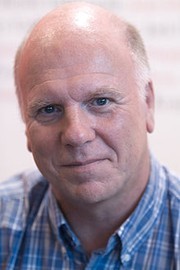
Peter Robinson
Peter Robinson (17 March 1950 – 4 October 2022) was a British-born Canadian crime writer who was best known for his crime novels set in Yorkshire featuring Inspector Alan Banks. He also published a number of other novels and short stories, as well as some poems and two articles on writing.
The night it all began, a thick of fog rolled down the dale and enfolded the town of Eastvale in the shroud.
— from Innocent Graves, 1996
Most acclaimed

Innocent Graves
1996
The worst that can possibly happen . . . has. A beautiful child is dead -- defiled and murdered in a lonely graveyard on a fog-shrouded evening. It is the sort of horrific crime Chief Inspector Alan Banks fled the city to escape. But the slaying of a bright and lovely teenager from a wealthy, respected family is not the end of a nightmare. Lies, dark secrets, unholy accusations, and hints of sexual depravity swirl around this abomination like leaves in an autumn wind, leading to a shattering travesty of justice that will brutally divide a devastated community with suspicion and hatred. But Banks must remain vigilant in his hunt -- because when the devil is left free to pursue his terrible calling, more blood will surely flow.
Bad boy
At thirteen Jim Thompson was learning how to smoke cigars and ogle burlesque girls under the tutelage of his profane grandfather. A few years later, he was bellhopping at a hotel in Fort Worth, where he supplemented his income peddling bootleg out of the package room. He shuddered out the DTs as a watchman on a West Texas oil pipeline. He outraged teachers, cheated mobsters, and almost got himself beaten to death by a homicidal sheriff's deputy. And somewhere along the way, Thompson became one of the greatest crime writers America has ever known. In this uproarious autobiographical tale, the author of After Dark, My Sweet and Pop. 1280 tells the story of his chaotic coming of age and reveals just where he acquired his encyclopedic knowledge of human misbehavior. Bad Boy is a bawdy, brawling book of reprobates--and an unfettered portrait of a writer growing up in the Southwest of the Roaring Twenties.
Aftermath
"After the destruction of the World Trade Center in New York on September 11th 2001, the world-renowned photographer Joel Meyerowitz felt compelled to visit the site. In his own words, he was 'overcome by a deep impulse to help, to save, to soothe, but, being far away, there was nothing I could do'. On his return Meyerowitz soon made his way to the scene where, upon raising his camera, he was reminded by a police officer that this was a crime scene and that no photographs were allowed. Meyerowitz duly left the scene but within a few blocks the officer's reminder had turned into consciousness. To Meyerowitz, 'no photographs meant no history' and he decided at that moment to find a way in and make an archive for the City of New York. Within days he had established strong links with many of the firefighters, policemen and construction workers contributing to the clean up. With their assistance he became the only photographer to be granted unimpeded access to Ground Zero.^ Once there he systematically began to document the wreckage followed by the necessary demolition, excavation and removal of tens of thousands of tonnes of debris that would transform the site from one of total devastation to level ground. Soon after the Museum of the City of New York officially engaged Meyerowitz to create an archive of the destruction and recovery at Ground Zero. The 9/11 Photographic Archive numbers in excess of 5,000 images and will become part of the permanent collections of the Museum of the City of New York. Meyerowitz takes a meditative stance toward the work and workers at Ground Zero, methodically recording the painful work of rescue, recovery, demolition and excavation. His pictures succinctly convey the magnitude of the destruction and loss and the heroic nature of the response.^ The images included here are a combination of prints from a large format camera, which allows for the greater detail, and standard 35mm, a format which provided Meyerowitz with the freedom to move easily around the site and capture each moment as it happened. The remarkable pictures in the archive visually relate the catastrophic destruction of the 9/11 attacks and the physical and human dimensions of the recovery effort. The aim of this book is to provide a record of the extraordinary extent of the World Trade Center attacks and to document the recovery efforts. The book will serve as both a poignant elegy to those who lost their lives and as a celebration of the tireless determination of those left behind to reclaim and rebuild the area known as 'Ground Zero'. Twenty-eight of the images from the archive were displayed in New York and then in over fifty cities around the world in a travelling exhibition entitled After September 11: Images from Ground Zero."--Publisher's website. Joel Meyerowitz, the only photographer allowed access inside the "forbidden city" of Ground Zero, documents the nine-month cleanup process after the September 11 attacks on the World Trade Center.