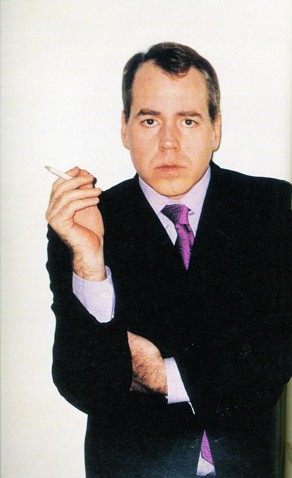
Bret Easton Ellis
Description
American novelist
Books
Lunar Park
Bret Ellis, the narrator of Lunar Park, is a writer whose first novel Less Than Zero catapulted him to international stardom while he was still in college. In the years that followed he found himself adrift in a world of wealth, drugs, and fame, as well as dealing with the unexpected death of his abusive father. After a decade of decadence a chance for salvation arrives; the chance to reconnect with an actress he was once involved with, and their son. But almost immediately his new life is threatened by a freak sequence of events and a bizarre series of murders that all seem to connect to Ellis's past. His attempts to save his new world from his own demons makes Lunar Park Ellis's most suspenseful novel. In this chilling tale reality, memoir, and fantasy combine to create not only a fascinating version of this most controversial writer but also a deeply moving novel about love and loss, parents and children, and ultimately forgiveness.From the Trade Paperback edition.
Glamorama
In Glamorama, a young man in what is recognizably fashion- and celebrity-obsessed Manhattan is gradually, imperceptibly drawn into a shadowy looking-glass of that society, there and in London and Paris, and then finds himself trapped on the other side, in a much darker place where fame and terrorism and family and politics are inextricably linked and sometimes indistinguishable. At once implicated and horror-stricken, his ways of escape blocked at every turn, he ultimately discovers - back on the other, familiar side - that there was no mirror, no escape, no world but this one in which hotels implode and planes fall from the sky.
White
The Informers
Los Angeles, 1980s. Centers on an array of characters who represent both the top of the heap - a Hollywood dream merchant, a dissolute rock star, an aging newscaster - and the very bottom (a voyeuristic doorman, an amoral ex-con). Connecting the intertwining strands are a group of beautiful, blonde young men and women who sleep all day and party all night, doing drugs and one another with total abandon. They don't realize that they are dancing on the edge of a volcano.
Less than Zero
Set in Los Angeles in the early 1980's, this coolly mesmerizing novel is a raw, powerful portrait of a lost generation who have experienced sex, drugs, and disaffection at too early an age, in a world shaped by casual nihilism, passivity, and too much money a place devoid of feeling or hope. Clay comes home for Christmas vacation from his Eastern college and re-enters a landscape of limitless privilege and absolute moral entropy, where everyone drives Porches, dines at Spago, and snorts mountains of cocaine. He tries to renew feelings for his girlfriend, Blair, and for his best friend from high school, Julian, who is careering into hustling and heroin. Clay's holiday turns into a dizzying spiral of desperation that takes him through the relentless parties in glitzy mansions, seedy bars, and underground rock clubs and also into the seamy world of L.A. after dark.
American Psycho
American Psycho is a novel by Bret Easton Ellis, published in 1991. The story is told in the first person by Patrick Bateman, a serial killer and Manhattan investment banker. Alison Kelly of The Observer notes that while "some countries [deem it] so potentially disturbing that it can only be sold shrink-wrapped", "critics rave about it" and "academics revel in its transgressive and postmodern qualities".
The rules of attraction
First Sentence: “And it’s a story that might bore you, but you don’t have to listen, she told me, because she always knew it was going to be like that, and it was, she thinks, her first year, or actually weekend, really a Friday, in September, and Camden, and this was three or four years ago, and she got so drunk that she ended up in bed, lost her virginity (late, she was eighteen) in Lorna Slavin’s room, because she was a Freshman and had a roommate and Lorna was, she remembers, a Senior or a Junior and usually sometimes at her boyfriend’s place off-campus, to who she thought was a Sophomore Ceramics major but who was actually either some guy from N.Y.U., a film student, and up in New Hampshire just for The Dressed To Get Screwed party, or a townie.” This is the second novel from Ellis, of American Psycho fame. It doesn’t depart much from the style (run-on sentences, sex, drugs, 80’s MTV music videos, more drugs, more sex, some violence thrown in there) of his other works, except that here it works throughout the whole book. Here he gives us a little more to work with, like allusions (Howard Roark!), different narrators, a setting that’s not L.A, and a semi-coherent plot. His talent is endless and the sentences run on seamlessly until you’re almost disappointed when a sentence actually ends. Nobody in the world can write like Ellis, though many have tried, and failed miserably. Yes, Ellis is a deranged person (has to be), but he’s also a prolific, talented writer whose put his time in. And here he shines. It’s about sex and drugs and horrible, self-absorbed, incomplete people, trying to get laid and quit smoking in a fictional University in New England. The things they do are despicable and immoral. There’s nothing redeeming about any of the characters in the entire book, no hope, and yet this book stings because nobody could write this well about people like this if they did not, in fact, exist in real life. When’s the last time you went to college? What do you think happens in Universities around America? What do you think most people are really like? This is a documentary of lost, attractive young people falling into the void. And nobody cares and nobody cares and nobody cares.
Imperial Bedrooms
Clay, a successful screenwriter, has returned from New York to Los Angeles to help cast his new movie, and he's soon drifting through a long-familiar circle that will leave him no choice but to plumb the darkest recesses of his character and come to terms with his proclivity for betrayal.
Ein literarischer Gang an die Börse
Im Gegensatz zu seinen Romanen und Erzählungen hat A.N. Herbst diesen Band zusammen mit Sabine Tost herausgegeben. Börse, Going Public, Aktienmärkte – beherrschende Themen seit dem Bau des ersten Börsengebäudes. Einige besonders spannende Aspekte des Börsengeschehens haben die Autoren der Weltliteratur in ihren Romanen und Erzählungen eingefangen und lebhaft geschildert. Dabei beleuchten sie Hausse und Baisse in ihren psychologischen und menschlichen Hintergründen und rücken die heftigen Ausschläge jenseits der bloßen Zahlen in den Blickpunkt.
30 unter 40
30 amerikanische und europaische Erzähler auf einen Blick: Generationenvertreter, deren Haltungen zu literarischen Traditionen genauso widersprüchlich und interessant sind wie ihr Erfahrungshunger und ihre Themen es sind. Erzählungen und Romanauszüge von Lisa Alther, Martin Amis, Paul Auster, René Belletto, William Boyd, Françoise Bouillot, Peter Carey, Jean-Claude Charles, Liane Dirks, Jean Echenoz, Deborah Eisenberg, Bret Easton Ellis, Louise Erdrich, Martin Groß, Hervé Guibert, Lisbet Hiide, Christoph Klimke, David Leavitt, Adam Mars-Jones, Susan Minot, Christa Moog, Lorrie Moore, Craig Nova, Marcelo Rubens Paiva, Alina Reyes, Christa Schmidt, Irini Spanidou, Pier Vittorio Tondelli, Christof Wackernagel un Tobias Wolff, die beeindrucken und dem Leser im Kopf bleiben. 30 Autoren unter 40, deren Texte zeigen, daß es sie überall auf der Welt gibt: die Besten von morgen.
Paradise Is Now
Seit über zweitausend Jahren erfreut sich die Palme im Morgen- und Abendland einer außergewöhnlichen Beliebtheit. Über Kontinente, Religionen und Kulturen hinweg erzählt sie Geschichten von Wohlstand, Frieden und Seelenheil. Kein anderes Motiv transportiert diese Glücksversprechen überzeugender als die Palme. Allgegenwärtig in der Werbung und den sozialen Medien beschwört sie in der säkularen Welt Vorstellungen von Luxus, Jetset und ewigen Sonnenschein herauf und repräsentiert ein modernes Paradies. Auch die bildende Kunst kann ihrem visuellen Reiz und ihrer metaphorischen Kraft nicht widerstehen. Vor diesem reichen kulturellen Hintergrund wird in der begleitenden Publikation zur Ausstellung 'Paradise is Now' die vielseitige Darstellung von Palmen in der zeitgenössischen Kunst aufgezeigt: Was steht hinter der Popularität dieses Emblems und welche Bedeutungsebenen und Widersprüche offenbaren sich im Zuge der künstlerischen Auseinandersetzung? Neben Texten von Bret Easton Ellis, Leif Randt und Norman Rosenthal versammelt die Publikation u.a. Werke von John Baldessari, Marcel Broodthaers, Rodney Graham, Secundino Hernández, David Hockney, Alicja Kwade, Sigmar Polke, Ed Ruscha und Rirkrit Tiravanija. Exhibition: Robert Grunenberg & Salon Dahlmann, Berlin, Germany (26.04.-30.06.2018).