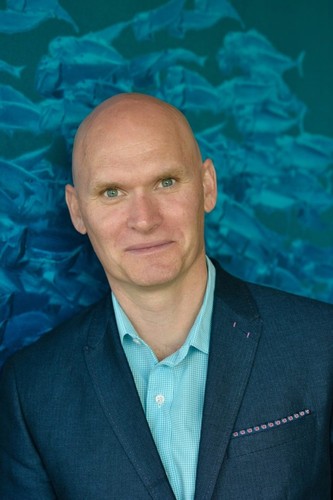
Anthony Doerr
Personal Information
Description
Anthony Doerr was born and raised in Cleveland, Ohio. He is the author of the story collections The Shell Collector and Memory Wall, the memoir Four Seasons in Rome, and the novels About Grace and All the Light We Cannot See, which was awarded the 2015 Pulitzer Prize for fiction and the 2015 Andrew Carnegie Medal for Excellence in Fiction. Doerr’s short stories and essays have won four O. Henry Prizes and been anthologized in The Best American Short Stories, New American Stories, The Best American Essays, The Scribner Anthology of Contemporary Fiction, and lots of other places. His work has been translated into over forty languages and won the Barnes & Noble Discover Prize, the Rome Prize, the New York Public Library’s Young Lions Award, a Guggenheim Fellowship, an NEA Fellowship, an Alex Award from the American Library Association, the National Magazine Award for Fiction, four Pushcart Prizes, two Pacific Northwest Book Awards, four Ohioana Book Awards, the 2010 Story Prize, which is considered the most prestigious prize in the U.S. for a collection of short stories, and the Sunday Times EFG Short Story Award, which is the largest prize in the world for a single short story. All the Light We Cannot See was a #1 New York Times bestseller, and remained on the hardcover fiction bestseller list for 134 consecutive weeks. Doerr lives in Boise, Idaho with his wife and two sons. A number of media interviews with him are collected here. Though he is often asked, as far as he knows he is not related to the late writer Harriet Doerr.
Books
The Artists' and Writers' Cookbook
The Artists’ and Writers’ Cookbook is a collection of personal, food-related stories with recipes from 76 contemporary artists and writers inspired by a book from 1961, The (original) Artists' & Writers' Cookbook In The Artists’ and Writers’ Cookbook, Anthony Doerr lures us out into the wild to find huckleberries and happiness. Neil Gaiman makes a perfectly eerie cheese omelet while Ed Ruscha associates his cactus omelet with “a time of doom.” Yiyun Li eats rations in Beijing while Edwidge Danticat prepares a soup to celebrate freedom. Nelson DeMille reminisces about a meal he ate 40 years ago when serving in Vietnam; Kamrooz Aram recalls childhood “picnics” in his basement in Tehran during air raids. Sanford Biggers updates a soul food classic—“something tasty to lessen the bitter taste of consistent, systematic oppression.” Paul Muldoon and Aimee Bender conjure food-related apocalyptic visions. Marina Abramović shares a dish best consumed on top of a volcano, Elissa Schappell dreams of playing Serge Gainsbourg records to snails, and Padgett Powell tastes a dish that reverses time and space. Daniel Wallace woos with an eggplant sandwich. Francesca Lia Block tells us how to fall in love. The essays are at turns comedic and heart-wrenching, personal and apocalyptic, with recipes that are enchanting to read and recreate. One part cookbook and one part intimate self-portrait, The Artists’ and Writers’ Cookbook is a portal into the kitchens and personal lives of an unmatched collection of contemporary artists and writers.
Cloud Cuckoo Land
"From the Pulitzer Prize-winning author of perhaps the most bestselling and beloved literary fiction of our time comes a triumph of imagination and compassion, a soaring novel about children on the cusp of adulthood in a broken world, who find resilience, hope, and story. The heroes of Cloud Cuckoo Land are children trying to figure out the world around them, and to survive. In the besieged city of Constantinople in 1453, in a public library in Lakeport, Idaho, today, and on a spaceship bound for a distant exoplanet decades from now, an ancient text provides solace and the most profound human connection to characters in peril. They all learn the story of Aethon, who longs to be turned into a bird so that he can fly to the paradise of Cloud Cuckoo Land, a better world. Twelve-year-old Anna lives in a convent where women toil all day embroidering the robes of priests. She learns to read from an old Greek tutor she encounters on her errands in the city. In an abandoned priory, she finds a stash of old books. One is Aethon's story, which she reads to her sister as the walls of Constantinople are bombarded by armies of Saracens. Anna escapes, carrying only a small sack with bread, salt fish-and the book. Outside the city walls, Anna meets Omeir, a village boy who was conscripted, along with his beloved pair of oxen, to fight in the Sultan's conquest. His oxen have died; he has deserted. In Lakeport, Idaho, in 2020, Seymour, a young activist bent on saving the earth, sits in the public library with two homemade bombs in pressure cookers-another siege. Upstairs, eighty-five-year old Zeno, a former prisoner-of-war, and an amateur translator, rehearses five children in a play adaptation of Aethon's adventures. On an interstellar ark called The Argos, Konstance is alone in a vault with sacks of Nourish powder and access to all the information in the world-or so she is told. She knows Aethon's story through her father, who has sequestered her to protect her. Konstance, encased on a spaceship decades from now, has never lived on our beloved Earth. Alone in a vault with sacks of Nourish powder and access to "all the information in the world," she knows Aethon's storythrough her father. Like Marie-Laure and Werner in All the Light We Cannot See, Konstance, Anna, Omeir, Seymour, the young Zeno, the children in the library are dreamers and misfits on the cusp of adulthood in a world the grown-ups have broken. They through their own resilience and resourcefulness, and through story. Dedicated to "the librarians then, now, and in the years to come," Anthony Doerr's Cloud Cuckoo Land is about the power of story and the astonishing survival of the physical book when for thousands of years they were so rare and so feared, dying, as one character says, "in fires or floods or in the mouths of worms or at the whims of tyrants." It is a hauntingly beautiful and redemptive novel about stewardship-of the book, of the Earth, of the human heart"--
The Shell Collector
Mystery horror novella. A lobsterman sees something uncanny in the water.
When I first held you
Becoming a father can be one of the most profoundly terrifying, exhilarating, life-changing occasions in a man's life. Now 22 of today's masterful writers get straight to the heart of modern fatherhood in this incomparable collection of thought-provoking essays. From making that ultimate decision to have a kid to making it through the birth to tangling with a toddler mid-tantrum, and eventually letting a teen loose in the world, these fathers explore every facet of fatherhood and show how being a father changed the way they saw the world--and themselves.
Fiction Gallery
Introducing Exceptional Short Stories Selected by New York’s Acclaimed Writing School Fiction Gallery features works by 25 authors, including such acknowledged masters of short fiction as Anton Chekhov, Dorothy Parker, John Cheever, Raymond Carver, and such acclaimed contemporary writers as Edwidge Danticat, Pam Houston, Ethan Canin, T. C. Boyle, Jhumpa Lahiri, and ZZ Packer. The stories in Fiction Gallery have been chosen to appeal to all readers, not just the fiction connoisseur. Every work will hold the reader spellbound from first to last page, while also exemplifying the very best in literary fiction. Aspiring writers who enjoyed Gotham Writers' Workshop's [Writing Fiction] will find this anthology an invaluable source of inspiration and insight. This gallery of stories presents diverse examples of all the elements of fiction craft and demonstrates how writers seamlessly sew these elements into unforgettable tales. As a bonus, the anthology includes original interviews with T. C. Boyle, Jhumpa Lahiri, and Hannah Tinti, in which they illuminate the process of creating a short story. : "Writing Fiction"
Four Seasons in Rome
The author describes the year he spent in Rome after winning the Rome Prize, including his adventures around the city, life in a foreign but welcoming country, and parenthood as it applies to his newborn twins.
American wild
American Wild: it can kill you, or exhilarate you. It's always there, a character in its own right in the great unfolding narrative of American writing. This issue of Granta is dedicated to stories of the wild, from MELINDA MOUSTAKIS on gutting fish in Alaska to CLAIRE VAYE WATKINS on a lost child in a dystopian California. Also: ANTHONY DOERR on a family of pioneers in Idaho, ADAM NICOLSON on tracking wolves in New Mexico and DAVID TREUER on cage fighting and his Ojibwe heritage.
All the Light We Cannot See
From the highly acclaimed, multiple award-winning Anthony Doerr, a stunningly ambitious and beautiful novel about a blind French girl and a German boy whose paths collide in occupied France as both try to survive the devastation of World War II. Marie Laure lives with her father in Paris within walking distance of the Museum of Natural History where he works as the master of the locks (there are thousands of locks in the museum). When she is six, she goes blind, and her father builds her a model of their neighborhood, every house, every manhole, so she can memorize it with her fingers and navigate the real streets with her feet and cane. When the Germans occupy Paris, father and daughter flee to Saint-Malo on the Brittany coast, where Marie-Laure's agoraphobic great uncle lives in a tall, narrow house by the sea wall. In another world in Germany, an orphan boy, Werner, grows up with his younger sister, Jutta, both enchanted by a crude radio Werner finds. He becomes a master at building and fixing radios, a talent that wins him a place at an elite and brutal military academy and, ultimately, makes him a highly specialized tracker of the Resistance. Werner travels through the heart of Hitler Youth to the far-flung outskirts of Russia, and finally into Saint-Malo, where his path converges with Marie-Laure. Doerr's gorgeous combination of soaring imagination with observation is electric. Deftly interweaving the lives of Marie-Laure and Werner, Doerr illuminates the ways, against all odds, people try to be good to one another. Ten years in the writing, All the Light We Cannot See is his most ambitious and dazzling work
Memory Wall
– A Notable Book of 2010 in the New York Times. – Top 10 Fiction and Literature at Amazon. – Winner of 2010 The Story Prize. – Winner of a 2011 Pacific Northwest Book Award. – A Top 12 Book of 2010 at the Boston Globe. – A San Francisco Chronicle Book of the Year. Featuring four new short stories and two big novellas, Anthony’s second story collection takes place on four continents and addresses issues from Alzheimer’s in South Africa to infertility in Wyoming to fishing for endangered sturgeon in Lithuania. The title novella won the National Magazine Award for Fiction, the second story has been called “a masterpiece of observed detail and intuitive poetic sense, like DeLillo at his best,” the fourth story won an O. Henry Prize, and the fifth story won a 2011 Pushcart Prize. Can a short story collection take you to more places and introduce you to more people than a novel?
The Pen/O. Henry Prize Stories 2009
An ordinary soldier of the queen / Graham Joyce The nursery / Kirsten Sundberg Lunstrum Purple bamboo park / E.V. Slate The bell ringer / John Burnside Uncle Musto takes a mistress / Mohan Sikka Kind / L.E. Miller Icebergs / Alistair Morgan The camera and the cobra / Roger Nash Tell him about Brother John / Manuel Muñoz This is not your city / Caitlin Horrocks The house behind a weeping cherry / Ha Jin Twenty-two stories / Paul Theroux The order of things / Judy Troy A beneficiary / Nadine Gordimer Substitutes / Viet Dinh Isabel's daughter / Karen Brown The visitor / Marisa Silver And we will be here / Paul Yoon Darkness / Andrew Sean Greer Wildwood / Junot Díaz Reading the PEN/O. Henry Prize stories 2009: A.S. Byatt on "An ordinary soldier of the Queen" by Graham Joyce ; Anthony Doerr on " Wildwood" by Junot Díaz ; Tim O'Brien on "An ordinary soldier of the Queen" by Graham Joyce
The Story Prize
The Book of Miracles (from The Dew Breaker) / Edwidge Danticat -- The Postman's Cottage (from The Hill Road) / Patrick O'Keeffe -- My Podiatrist Tells Me a Story About a Boy and a Dog (from The Stories of Mary Gordon) / Mary Gordon -- The Zero Meter Diving Team (from Like You'd Understand, Anyway) / Jim Shepard -- Bullet in the Brain (from Our Story Begins) / Tobias Wolff -- Saleema (from In Other Rooms, Other Wonders) / Daniyal Mueenuddin -- Memory Wall (from Memory Wall) / Anthony Doerr -- Snowmen (from In the Penny Arcade) / Steven Millhauser -- Ghosts, Cowboys (from Battleborn) / Claire Vaye Watkins -- Tenth of December (from Tenth of December) / George Saunders -- Something Amazing (from Thunderstruck & Other Stories) / Elizabeth McCracken -- Nirvana (from Fortune Smiles) / Adam Johnson -- How She Remembers It (from For a Little While) / Rick Bass -- The Sign (from Anything Is Possible) / Elizabeth Strout.
About Grace
David Winkler begins life in Anchorage, Alaska, a quiet boy drawn to the volatility of weather and obsessed with snow. Sometimes he sees things before they happen—a man carrying a hatbox will be hit by a bus; Winkler will fall in love with a woman in a supermarket. When David dreams that his infant daughter will drown in a flood as he tries to save her, he comes undone. He travels thousands of miles, fleeing family, home, and the future itself, to deny the dream. On a Caribbean island, destitute, alone, and unsure if his child has survived or his wife can forgive him, David is sheltered by a couple with a daughter of their own. Ultimately it is she who will pull him back into the world, to search for the people he left behind.
