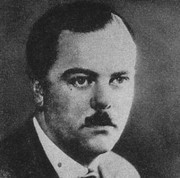
Anthony Berkeley
Personal Information
Description
Anthony Berkeley Cox was an English crime writer who wrote as Anthony Berkeley, Frances Iles, and A. Monmouth Platts.
Books
The Poisoned Chocolates Case
Sir Eustace is a cad of the first water, with a specialty in other men's wives, and the list of people who might want to do him in could fill a London phone book. But which of them actually sent the chocolates with their nasty hidden payload? Scotland Yard is baffled. Enter the Crime Circle, a group of society intellectuals with a shared conviction in their ability to succeed where the police have failed. Eventually, each member will produce a tightly reasoned solution to the Case of the Poisoned Chocolates, but each of those solutions will identify a different murderer. First published in 1929, this is both a classic of the golden age of mystery fiction, and one of the great puzzle-mysteries of all time.
The Piccadilly Murder
Stopping in at the Piccadilly Palace Hotel for a bit of afternoon refreshment, Mr. Ambrose Chitterwick witnesses a chilling scene: an elderly lady dies of poisoning in the midst of a crowded lounge. An empty vial in her hand and a residue of prussic acid in her coffee cup suggest the means of death; but was it suicide or murder? Scotland Yard contends she was poisoned by Major Sinclair, her nephew and putative heir who had been sitting with her at her table. Moreover, Inspector Moresby of Scotland Yard has tapped Chitterwick as chief witness for the prosecution. But after a chorus of friends and relatives claim the accused is incapable of such a crime, Chitterwick's interest -and involvement - in the case deepen. Mystery lovers will need their ratiocinative skills in top working order to keep up with the twists and turns of the plot as the timorous sleuth (he recites "The Wreck of the Hesperus" to calm himself in tense situations) threads his way through a thicket of contradictory clues.
The Scoop / Behind the Screen
"The Scoop" first appeared as a serial in the Listener in 1931. "Behind the Screen" first appeared as a serial in the Listener in 1930. The two serials were first published in book form in the UK by Victor Gollancz Ltd in 1983 and in the US by Harper & Row in 1984. It was another foggy night in London when the members of the world-renowned Detection Club gathered to repeat the success of their jointly authored book, The Floating Admiral. Each writer worked on the mysteries without knowing the solutions the others had planned. When the creators of Miss Marple, Lord Peter Wimsey and other sleuths get together, you can be sure the mysteries will be monumental, the detection delightful, and the results exciting!
Trial and error
Mr. Todhunter lived an ordinary life in an ordinary bachelor's flat in London. He took tea at the same time every day and his habits were totally predictable. Until he learned he had only months to live—and decided to make one dramatic last gesture...to rid the world of the worst person he could find. But once the deed was done, something quite unpredictable happened. An innocent man was convicted of the crime, and it was up to Mr. Todhunter to prove himself guilty of murder.
Jumping Jenny
Original UK title Jumping Jenny At a costume party with the dubious theme of ‘famous murderers and their victims’, the know-it-all amateur criminologist Roger Sheringham is settled in for an evening of beer, small talk and analysing his companions. One guest in particular has caught his attention for her theatrics, and his theory that she might have several enemies among the partygoers proves true when she is found hanging from the ‘decorative’ gallows on the roof terrace. Noticing a key detail which could implicate a friend in the crime, Sheringham decides to meddle with the scene and unwittingly casts himself into jeopardy as the uncommonly thorough police investigation circles closer and closer to the truth.
The Layton Court mystery
In a typical English country house, a murder is committed. The wealthy Victor Stanworth, who'd been playing host to a party of friends, is found dead in the library. At first it appears to be suicide, for the room was undoubtedly locked. But could there be more to the case? As one of the guests at Layton Court, gentleman sleuth Roger Sheringham begins to investigate. Many come under suspicion, but how could anyone have killed the man and gotten out of the room, leaving it all locked behind?
The second shot
Detective writer John Hillyard is entertaining a small house party at Minton Deeps Farm when a shocking accident takes place. Shortly after enacting a murder drama for their own amusement, the guests are returning to the house when Eric Scott Davies, the man who played victim, is found dead after two gunshots go off. The police suspect murder, but when Roger Sheringham is summoned from London it is not by Superintendent Hancock but by one of the guests. In a web of scandal, opportunity and multiple motives, the case turns out to be more complex than even Sheringham could have expected.
Not to Be Taken
The medical certificate stated that John Waterhouse died of gastric ulcers, but when his estranged brother demanded an exhumation, the real cause of death – arsenic poisoning. Someone with extreme care and amazing cleverness planned and executed the murder, the solution to which lay not in the what, when, where and how – but rather in the why.
Six Against the Yard
A unique anthology for crime aficionados - six 'perfect murder' stories written by the most accomplished crime writers of the 1930s, designed to fox real-life Scotland Yard Superintendent Cornish, who comments on whether or not these crimes could have genuinely been solved. Is the 'perfect murder' possible? Can that crime be committed with such consummate care, with such exacting skill, that it is unsolvable - even to the most astute investigator? In this unique collection, legendary crime writers Margery Allingham, Anthony Berkeley, Freeman Wills Crofts, Ronald Knox, Dorothy L. Sayers and Russell Thorndike each attempt to create the unsolvable murder, which Superintendent Cornish of the CID then attempts to unravel. This clever literary battle of wits from the archives of the Detection Club joins The Floating Admiral and Ask a Policeman in showing some of the experts from the Golden Age of detective fiction at their most ingenious.
Ask A Policeman
Lord Comstock is a barbarous newspaper tycoon with enemies in high places. His murder in the study of his country house poses a dilemma for the Home Secretary. In the hours before his death, Lord Comstock’s visitors included the government Chief Whip, an Archbishop, and the Assistant Commissioner for Scotland Yard. Suspicion falls upon them all and threatens the impartiality of any police investigation. Abandoning protocol, the Home Secretary invites four famous detectives to solve the case: Mrs Adela Bradley, Sir John Saumarez, Lord Peter Wimsey, and Mr Roger Sheringham. All are different, all are plausible, all are on their own – and none of them can ask a policeman... To produce this classic whodunit, the Detection Club adopted a completely new approach: Milward Kennedy proposed the title, John Rhode plotted the murder and provided the suspects, and four of their contemporaries were asked to lend their well-known detectives to the task of providing solutions to the crime. But there was to be another twist: the authors would swap detectives and use the characters in their sections of the book. Thus Gladys Mitchell and Helen Simpson swapped Mrs Bradley and Sir John Saumarez, and Dorothy Sayers and Anthony Berkeley swapped Lord Peter Wimsey and Roger Sheringham, enabling the authors to indulge in skilful and sly parodies of each other. The contributors are: John Rhode, Helen Simpson, Gladys Mitchell, Anthony Berkeley, Dorothy L. Sayers, and Milward Kennedy.
Malice aforethought
On a balmy summer's day in 1930 the great and the good of the county are out in force for the annual, much-anticipated tennis party at the Bickleighs, although not everyone has much enthusiasm for the game. The tennis party exists for other reasons—and charmingly mannered infidelity is now the most popular pastime in the small but exclusive Devonshire hamlet of Wyvern's Cross. Which is why, in his own garden, the host, Dr Edmund Bickleigh, is desperately fighting to conceal the two things on his mind: a mounting passion for Gwynfryd Rattery—and the certain conviction that he is going to kill his wife ...
Murder in the Basement
When young Mr. and Mrs. Dane return from their honeymoon they find, buried under the cellar floor of the suburban villa they have taken, the body of an unknown girl. Scotland Yard is called in, and finds itself confronted first of all by an almost impossible problem in identification. By an ingenious idea, Chief Inspector Moresby solves the preliminary puzzle, and calls upon his friend Roger Sheringham, to say that the girl was last heard of at a preparatory school where Roger had been deputising, just before her death, as a master. Roger had noticed that there were some strange undercurrents among the staff of the school, and on leaving it had begun a book about the members of it. This manuscript he now hands over to Moresby, and it is given to the reader, who at this stage has not been told the identity of the murdered girl. The action is thus switched back to a fortnight or so before the girl's death, with the result that the reader is given a puzzle new to detective fiction: not, spot the criminal, but, spot the future victim.
Top Storey Murder
From mysteryfile dot com: " Novelist and part-time criminologist Roger Sheringham follows along, as Scotland Yard puts together a case against a burglar who added murder to his last job. These were the leisurely days when the professional criminals were all known and readily identifiable by their characteristic methods of operation. But Roger finds flaws in their· theories and strikes off on his own investigations, which increasingly point to an inside job. He also adds a secretary — the murdered woman’s niece — who mysteriously disclaims her rightful inheritance, and whom Roger finds secretly provoking in other ways as well."
Before the fact
"Some women give birth to murderers, some go to bed with them. Lina Aysgarth had lived with her husband for nearly eight years before she realized that she was married to a murderer." Johnny was delightful—and Lina loved him desperately. But his devastating charm was combined with a complete lack of both morals and income. Slowly Lina discovered what such a combination led to. The first indications seemed trivial, especially since, in his childish way, Johnny loved her. Not for along time did she realize that he had killed, and was planning to kill again. Made into the famous Cary Grant-Joan Fontaine motion picture Suspicion, this story has seldom been surpassed for sheer, blood-curdling suspense. As one reviewer said, "it induces such a There-butfor-the-Grace-of-God sensation that one remains shivering for hours."
The Wychford poisoning case
Mrs Bentley has been arrested for murder. The evidence is overwhelming: arsenic she extracted from fly papers was in her husband's medicine, his food and his lemonade, and her crimes are being plastered across the newspapers. Even her lawyers believe she is guilty. But Roger Sheringham, the brilliant but outspoken young novelist, is convinced that there is 'too much evidence' against Mrs Bentley and sets out to prove her innocence.
The silk stocking murders
Gentleman sleuth and novelist Roger Sheringham would not have ordinarily been curious about the suicide of chorus girl Miss Unity Ransome. However when he receives a cry for help from a country parson attempting to trace his missing daughter, Sheringham finds himself involved. And when three other young women are found hanged dead, by silk stockings, Sheringham realizes that what he is investigating is actually murder.
