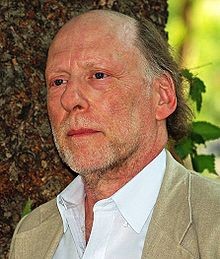
Todd Gitlin
Personal Information
Description
Todd Gitlin is an American sociologist, political writer, novelist, and cultural commentator. He has written widely on the mass media, politics, intellectual life and the arts, for both popular and scholarly publications. - Wikipedia
Books
The chosen peoples
Outlines a new approach to understanding the relationship between the United States and Israel, explaining that both nations embrace a philosophy that they were divinely chosen to influence the world for the better.
Media Unlimited
"Everyone knows that the media surround us, but no one quite understands how this happened and what it has done to our lives. Critics and analysts focus on this show or that star, the latest Superbowl ad or twenty-four-hour news binge, but they miss the true import of our total immersion in a fast-moving torrent of sounds and images. As he did with television in Inside Prime Time and with the culture wars in The Twilight of Common Dreams, Todd Gitlin once again recasts the world we think we know. In Media Unlimited, a remarkable and original look at our media-glutted, speed-addicted world, he makes us stare, as if for the first time, at the biggest picture of all."--BOOK JACKET.
The bulldozer and the big tent
A social critic presents an analysis of the American political system, addressing such issues as why baby boomers have produced few impressive politicians, why Barack Obama has become popular so quickly, and who has won the culture war.
Watching television
7 essays by leading media critics explore the politics and social implications of television. "...An important step into the past wasteland era of writing about the tube." - NYT Book Review.
The Whole World Is Watching
"The whole world is watching!" chanted the demonstrators in the Chicago streets in 1968, as the TV cameras beamed images of police cracking heads into homes everywhere. Acclaimed media critic Todd Gitlin first scrutinizes major news coverage in the early days of the antiwar movement. Drawing on his own experiences (he was president of the Students for a Democratic Society in 1963-64) and on interviews with key activists and news reporters, he shows in detail how the media first ignore new political developments, then select and emphasize aspects of the story that treat movements as oddities. He then demonstrates how the media glare made leaders into celebrities and estranged them from their movement base how it inflated the importance of revolutionary rhetoric, destabilizing the movement, then promoted "moderate" alternatives--all the while spreading the antiwar message. Finally, Gitlin draws together a theory of news coverage as a form of anti-democratic social management--which he sees at work also in media treatment of the anti-nuclear and other later movements [Publisher description]
Letters to a young activist
"In Letters to a Young Activist, Todd Gitlin looks back at his eventful life, recalling his experience as president of the formidable Students for a Democratic Society contemplating the spirit of activism, and arriving at principles of action to guide the passion and energy of those wishing to do good. He considers the three complementary motives of duty, love, and adventure, reflects on the changing nature of idealism, and shows how righteous action requires realistic as well as idealistic thinking. And he looks forward to an uncertain future that is nevertheless full of possibility, a future where patriotism and intelligent skepticism are not mutually exclusive."--Jacket.
Inside prime time
A behind-the-scenes view of prime-time television reveals how shows get and stay on the air, explains how television is shaped by the political and cultural climate of the era, and offers anecdotes about "Charlie's Angels," "Hill Street Blues," and other series.
The sixties
The 1960s was the decade America transformed from a country of conformity to a land of political, cultural, and social liberation. Looking through the lens of television, this production weaves together the events and personalities that influenced and dominated the 1960s in America, sketching a portrait of this remarkable decade that is both entertaining and illuminating.
The twilight of common dreams
In The Twilight of Common Dreams, Todd Gitlin places the debates of the moment in a sweeping historical context and - sparing no sides - he argues that these highly charged conflicts are a sideshow, obscuring a seismic transformation in American political life. The Left, which once stood for universal values, has come to be identified with the special needs of distinct "cultures" and select "identities." The Right, long associated with privileged interests, now claims to defend the needs of all. The consequences are clear: since the late 1960s, while the Right has been busy taking the White House, the Left has been marching on the English department. With dazzling range and acuteness, Gitlin's analysis moves through American history and modern thought, from academic squabbles to the crisis in the Democratic party, from embattled school boards to the right-wing exploitation of those scarlet letters, "PC." In the end, he maintains, the culture wars are evasions of America's deepest trauma - inequality - and he eloquently contends that America is lost unless its obsession with cultural differences can be transcended in the name of the common good.
Occupy nation
Provides a better understanding of the Occupy Wall Street movement by exploring its origins, spirit, uniqueness, predecessors, and inner tensions, while discussing the role it's likely to play in future political culture.