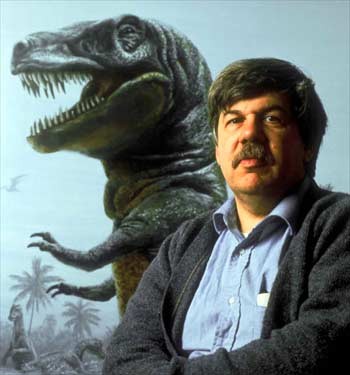
Stephen Jay Gould
Personal Information
Description
Stephen Jay Gould was an American paleontologist, evolutionary biologist, and historian of science. He was also one of the most influential and widely read writers of popular science of his generation. - Wikipedia
Books
The hedgehog, the fox, and the magister's pox
Stephen Jay Gould offers a surprising and nuanced study of the complex relationship between our two great ways of knowing: science and the humanities, twin realms of knowledge that have been divided against each other for far too long. To establish his two protagonists, Gould draws from a seventh century b.c. proverb attributed to the Greek soldier-poet Archilochus that said roughly, "The fox devises many strategies; the hedgehog knows one great and effective strategy." While emphatically rejecting any simplistic attempt to assign either science or the humanities to one or the other of these approaches to knowledge, Gould uses this ancient concept to demonstrate that neither strategy can work alone, but that these seeming opposites can be conjoined into a common enterprise of tremendous unity and power. In building his case, Gould shows why the common assumption of an inescapable conflict between science and the humanities (in which he includes religion) is false, mounts a spirited rebuttal to the ideas that his intellectual rival E.O. Wilson set forth in his book Consilience, and explains why the pursuit of knowledge must always operate upon the bedrock of nature's randomness. The hedgehog, the fox, and the magister's pox is a controversial discourse, rich with facts and observations gathered by one of the most erudite minds of our time.
Infinite tropics
This collection comprises Wallace's best and most important writing, much of which has been out of print for over a century. Ranging from the scientific to the social, from the political to the spiritual, the selection captures the essence of a great thinker.
Finders Keepers
At the height of summer a dark shadow falls across Exmoor. Children are being stolen. Each disappearance is marked only by a terse note - a brutal accusation. There are no explanations, no ransom demands ... and no hope. Policeman Jonas Holly faces a precarious journey into the warped mind of the kidnapper if he's to stand any chance of catching him. But - still reeling from a personal tragedy - is Jonas really up to the task? Because there's at least one person on Exmoor who thinks that, when it comes to being the first line of defence, Jonas Holly may be the last man to trust ..."--Back cover.
Urchin in the Storm
Reviews books about pandas, scientific research, evolution, culture, geology, the origin of the mind, testing bias, genetics, and scientific frauds.
Hen's teeth and horse's toes
Une compilation de trente essais parus pour la plupart dans ##Natural history magazine## et articulés autour de la théorie de l'évolution. Sept parties : Des bizarreries raisonnables - Personnalités - Adaptation et évolution - Teilhard et Piltdown - Science et politique - L'extinction - Une trilogie du zèbre. L'auteur, professeur à l'Université de Harvard, a précédemment publié deux autres recueils : ##Darwin et les grandes énigmes de la vie## (1979) et ##Le pouce du panda## (1982). [SDM].
Leonardo's mountain of clams and the Diet of Worms
Sobre Leonardo da Vinchi
Bully for Brontosaurus
Essays from the author's column This view of life, published in Natural history.
Hidden Histories of Science
Essays by Oliver Sacks, Jonathan Miller, Stephen Jay Gould, Daniel J. Kevles, & R.C. Lewontin explore forgotten and neglected aspects of the history of science.
Punctuated Equilibrium
"In 1972 Stephen Jay Gould took the scientific world by storm with his paper on punctuated equilibrium, written with Niles Eldredge. Challenging a core assumption of Darwin's theory of evolution, it launched the career of one of the most influential evolutionary biologists of our time - perhaps the best known since Darwin." "Now, thirty-five years later, and five years after his untimely death, Punctuated Equilibrium (originally published as the central chapter of Gould's masterwork, The Structure of Evolutionary Theory) offers his only book-length testament on an idea he fiercely promoted, repeatedly refined, and tirelessly defended. Punctuated equilibrium holds that the great majority of species originate in geological moments (punctuations) and persist in stasis. The idea was hotly debated because it forced biologists to rethink entrenched ideas about evolutionary patterns and processes. But as Gould shows here in his typically exhaustive coverage, the idea has become the foundation of a new view of hierarchical selection and macroevolution."--Jacket.
Questioning the millennium
L'ecrivain scientifique tente ici de comprendre comment un simple probleme de calendrier a pu donner lieu a tant d'elucubrations irrationnelles. Il est question "de la perception des nombres ronds, du soleil et de la lune, de l'age de la terre et de la naissance de Jesus-Christ", pour apprecier le retour cyclique des vieilles questions irresolues que provoquera immanquablement l'an 2000.
Eight Little Piggies
Contemplative essays speaking often of the importance of the unbroken connection of modern man and our ancestors.
The Structure of Evolutionary Theory
The world's most revered and eloquent interpreter of evolutionary ideas offers here a work of explanatory force unprecedented in our time--a landmark publication, both for its historical sweep and for its scientific vision. With characteristic attention to detail, Stephen Jay Gould first describes the content and discusses the history and origins of the three core commitments of classical Darwinism: that natural selection works on organisms, not genes or species; that it is almost exclusively the mechanism of adaptive evolutionary change; and that these changes are incremental, not drastic. Next, he examines the three critiques that currently challenge this classic Darwinian edifice: that selection operates on multiple levels, from the gene to the group; that evolution proceeds by a variety of mechanisms, not just natural selection; and that causes operating at broader scales, including catastrophes, have figured prominently in the course of evolution. Then, in a stunning tour de force that will likely stimulate discussion and debate for decades, Gould proposes his own system for integrating these classical commitments and contemporary critiques into a new structure of evolutionary thought. In 2001 the Library of Congress named Stephen Jay Gould one of America's eighty-three Living Legends--people who embody the "quintessentially American ideal of individual creativity, conviction, dedication, and exuberance." Each of these qualities finds full expression in this peerless work, the likes of which the scientific world has not seen--and may not see again--for well over a century. Stephen Jay Gould is the Alexander Agassiz Professor of Zoology at Harvard University and Vincent Astor Visiting Professor of Biology at New York University. A MacArthur Prize Fellow, he has received innumerable honors and awards and has written many books, including Ontogeny and Phylogeny and Time's Arrow, Time's Cycle (both from Harvard).
Fossils
Wonderful Life the Burgess
What would the world have been like, if George Bailey of "It's A Wonderful Life" hadn't been born? George was lucky enough to have an angel that could roll back the tape of life and show him how things would have been different. He learned that one contingency changes everything. In "Wonderful LIfe", an homage to the American classic film, "It's A Wonderful Life", Stephen J. Gould plays the role of the angel, rolling back the tape of life a half billion years for his readers through the lens of the Burgess Shale (British Columbia), arguably the most important fossil site on the planet. His theme of contingency plays out as he discusses the many unique forms of life that might have, if things had gone differently, become the dominant forms on this planet, and how they contrast with those of today -- the one's that survived. Along the way he tells the story of the discovery and discovers of the Shale, how it was first interpreted in terms of prevalent beliefs about the origins of life, and how it has subsequently been re-interpreted in light of knowledge. So enjoy the "film", but be sure to bring along a cup of coffee and a dictionary -- with Gould's intense writing style you're likely to need both!