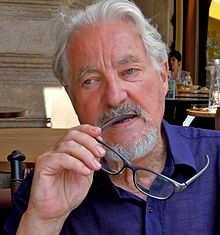
Marc Augé
Personal Information
Description
Marc Augé (born September 2, 1935 in Poitiers) is a French anthropologist. Source: Wikipedia
Books
The future
"The consequential age we are living in will be remembered as one of the great turning points in civilization. Once we turn, though, where will we be? That is the compelling question Al Gore sets out to answer by examining the drivers of global change, connecting the dots among the social, economic, and political forces shaping our present and future. A rising global consciousness is forcing people around the world, but especially Americans, to rethink their basic assumptions about how the world works, and, even more fundamentally, how it should and can work. Borders matter less than ever. Technology is constantly reordering the way we live, think, work, learn, love, pray, and play"--
An anthropology for contemporaneous worlds
"Under what conditions is anthropology possible today, when a crisis of social meaning - a crisis that makes it more difficult to conceive and manage our relation to the other - makes the need for anthropology appear more clearly than ever before? This book sets forth at least the beginning of an answer to this question." "Positioned in opposition not only to political theories of universalization and homogenization more or less tied to the theme of "the end of history," but also to "postmodernist" versions of anthropological theories of multiplicity and relativism, the author argues that social anthropology, through its self-critical tradition, is fully capable of adapting to the accelerated change that is continuously recomposing relations between universalism and particularism. It is for social anthropology to select, analyze, and understand the new modes of sociality and the new spaces in which (not without calamities and contradictions) these utterly new recompositions, a major aspect of our contemporary world, manifest themselves."--Jacket.
Everyone Dies Young
"We are awash in time, savoring a few moments of it; we project ourselves into it, reinvent it, play with it; we take our time or let it slip away: it is the raw material of our imagination. Age, on the other hand, is the detailed account of the days that pass, the one-way view of the years whose total sum when set forth can stupefy us. Age wedges each of us between a date of birth that, at least in the West, we know for certain and an expiration date that, as a general rule, we would like to defer. Time is a freedom, age a constraint." Marc Augé remembers his beloved childhood cat, who seemed to grow wise with age, though her essential nature remained unchanged. He considers our belief that objects mature, when it is our perception of them that evolves over time. He wonders why public demonstrations of affection between the elderly make the young so uncomfortable and why we torture ourselves with regret at what might have been. Time can be liberating, he finds; it is a resource we can squander or relish. Yet age is a burden, bound by our personal and cultural neuroses. With an ethnologist's understanding of construct and practice, Augé isolates age from the development of consciousness, desire, and representations of the self. In bold, eye-opening strokes, he casts age as a physical marker and treats one's youthful approach to the world as the true measure of life's value.--
Oblivion
Donald Justice's work has received acclaim from nearly all of his fellow poets and peers. This book of critical prose - only the second by this Pulitzer Prize-winner - collects fourteen essays which examine such diverse topics as obscurity, sincerity, memory, meter and free verse. Providing counterpoint to the critical discussions are homages to past masters Yvor Winters, William Carlos Williams, Weldon Kees, and Philip Larkin. Oblivion closes with generous excerpts from two of Justice's notebooks, providing a rate glimpse into his creative process.
Elogio de la bicicleta
Este delicioso Elogio de la bicicleta pasa por tres etapas narrativas: el mito, la epopeya y la utopía. A pesar de que sus dimensiones mítica y heroica han sufrido algunos reveses derivados de su vinculación a las desviaciones del deporte profesional y el doping, la bicicleta, impulsada por las nuevas políticas de la ciudad, regresa con fuerza a los escenarios urbanos y su imagen es objeto de un renovado entusiasmo popular, como atestiguan los ejemplos de París y Barcelona. La bicicleta encarna una bella utopía: una promesa de felicidad. Podemos soñar y proyectar a grandes rasgos una ciudad utópica del mañana en donde la bicicleta y el transporte público sean los únicos medios de desplazamiento. Incluso imaginar un mundo en el que las exigencias de los ciclistas dobleguen el poderío político siempre y cuando, en el mundo, reinen la paz, la igualdad y el aire puro. Porque, en su humildad, la bicicleta nos enseña, ante todo, a estar en armonía con el tiempo y el espacio. Nos hace redescubrir el principio de realidad en un mundo invadido por la ficción y las imágenes. El ciclismo es un humanismo que abre con renacidos bríos las puertas de la utopía y de un futuro más esperanzador: el símbolo de un futuro ecológico para la ciudad del mañana y de un proyecto urbano que tal vez podría reconciliar a la sociedad consigo misma.
A sense for the other
This book outlines an approach to anthropology that focuses on negotiating the social meanings we and others use in making sense of the world, and on the processes of identification that create the difference between same and other. Why trace a line of demarcation between societies thought to warrant and require anthropological observation and others (namely, our own) thought to demand a different type of study? Once anthropology, through its study of rites, takes social meaning as its principal object, the necessity for a "generalized anthropology" that includes the entire planet seems obvious, especially in view of the rapid proliferation of new networks of communication and the integration of individuals into those networks.
Los no lugares, espacios del anonimato
Marc Augé acuñó el concepto "no-lugar" para referirse a los lugares de transitoriedad que no tienen suficiente importancia para ser considerados como "lugares". Los no lugares no existían en el pasado. Son espacios propiamente contemporáneos de confluencia anónimos, donde personas en tránsito deben instalarse durante algún tiempo de espera, sea a la salida del avión, del tren o del metro que ha de llegar.
Non-places
"Shopping malls, motorways, airport lounges - we are all familiar with these curious spaces which are both everywhere and nowhere. But only now do we have a coherent analysis of their far-reaching effects on public and private experience. Marc Auge has become their anthropologist, and has written a timely and original book." "An ever-increasing proportion of our lives is spent in supermarkets, airports and hotels, on motorways or in front of TVs, computers and cash machines. This invasion of the world by what Marc Auge calls "non-space" results in a profound alteration of awareness: something we perceive, but only in a partial and incoherent manner. Auge uses the concept of "supermodernity" to describe a situation of excessive information and excessive space. In this fascinating essay he seeks to establish an intellectual armature for an anthropology of supermodernity."--Jacket.