
UNITED STATES AUTHOR · AFRICAN AMERICANS · BIOGRAPHY
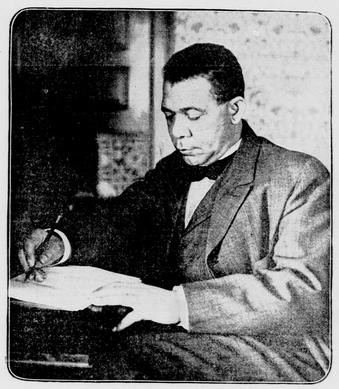
Booker T. Washington
Also known as: Booker Washington, Booker Taliaferro Washington
Booker Taliaferro Washington (April 5, 1856 – November 14, 1915) was an American educator, author, and orator. Between 1890 and 1915, Washington was the primary leader in the African-American community and of the contemporary Black elite.
THE TUCKAHOE is a quiet creek.
— from Frederick Douglass, 1970
Most acclaimed

Frederick Douglass
1970
"We are deeply honored to announce that Thornwillow Press is working with renowned literary critic, historian, filmmaker, and Harvard University professor Henry Louis Gates Jr. to publish an exquisite letterpress, hand-bound edition: Frederick Douglass: Portrait of a Free Man. This exciting publication brings together the powerful Narrative of the Life of Frederick Douglass, with two monographs by Professor Gates, which offer readers new and profound insights. In many ways, Henry Louis Gates Jr.'s scholarship has defined the field of African American studies. He is one of the foremost public intellectuals of our day. "As any biographer of Douglass knows," says Gates, "there was not a Frederick Douglass; there were many Douglasses. And that, for him, was his ultimate claim on being fully and equally and complexly human." In Frederick Douglass: Portrait of a Free Man, Gates brings us the monograph "Binary Opposition in Douglass' Narrative", which explores the literary conventions and binary oppositions Douglass used, and gives the reader a deeper insight into the narrative. Gates second monograph, "Camera Obscura", examines the vital power photos have on public opinion, both in terms of abolition and contemporary society, and brings to light the fact that Frederick Douglass was the most photographed American of the 19th century. In a time when caricatures in mainstream media portrayed Black people as naturally subjugated and unintelligent, Douglass knew that art, in the hands of racist whites, did not depict reality. Photography, on the other hand, gave a true "likeness" and as a tool for social change, could be key in altering long-held stereotypes and prejudices about Black people. Douglass posed for 160 photographs over the course of his lifetime, and in doing so, gave people a new image: that of a dignified, intelligent, free Black man. Because how we see things, says Henry Louis Gates Jr. in Frederick Douglass: Portrait of a Free Man is how we view them. The edition contains fine art photographs throughout to illustrate this salient point. The timing of the publication of Frederick Douglass: Portrait of a Free Man is particularly poignant because Thornwillow Press calls Newburgh, NY home, and in 1870, Frederick Douglass visited our city to commemorate the passage of the Civil Rights Act that enforced the terms of the 15th Amendment. In honor of his visit to Newburgh and his legacy of voter rights, a city-wide commemoration is being planned for 2020. We are exceptionally pleased to bring this publication into being at such an auspicious moment."--Publisher's kickstarter prospectus (viewed 2019 May 13).
The Future Of The American Negro
1991
The Future of the American Negro (1899) is a novel by American educator Booker T. Washington. The novel presented his opinions on the history of enslaved and freed African-American people, as well as his ideas regarding using education as a means to advance themselves. The Future of the American Negro (1899) is a novel by American educator Booker T. Washington. The novel presented his opinions on the history of enslaved and freed African-American people, as well as his ideas regarding using education as a means to advance themselves.
An Autobiography
This inspiring life-story by a towering figure of our era is an epic of genius in relation to the twentieth century. In these pages, Frank Lloyd Wright's personal revelations illumine an astonishing variety of experiences, opening with his life as a child with his Welsh forebears in the Midwest, his running away to plunge into the creative ferment of the Chicago of the Nineties, the beginning of one of the world's most productive careers, through his long dramatic life which culminated in his transforming influence on the modern world. His autobiography is a book of triumph over nearly incredible adversity. It is filled with memorable descriptions: of the young architect's apprentice with the pioneer Louis Sullivan; the fire which destroyed his renowned home, Taliesin, in the tragedy that took several lives, and his courageous re-building of his Imperial Hotel, in which he reveals why it rode out the disastrous 1923 earthquake in Tokyo, unharmed, while the city lay bout it in ruins; his romantic meeting with the woman whose devotion was to transform his life; the ordeals to which he and Olgivanna Lloyd Wright were early subjected and out of which they built a new life; the story of how they established the Taliesin Fellowship, the now renowned school of architecture to which students come from every part of the world; his friendships with Carl Sandburg, Alexander Woollcott, Lloyd Lewis, Ferdinand Schevill, among his others; his journeys to Japan and Russia; his creation of building after building-low cost houses, skyscrapers, churches, celebrated dwellings such as Hollyhock House, La Miniatura, Fallingwater, the Jacobs House (cost $5,500, including the architect's fee in 1936), etc.-which revolutionized the architecture of our century. During what he called "a very bad time in my life" Mrs. Wright urged him to begin work on his life-story and encouraged him through the years to complete it; and it is to her that he dedicated this final, definitive edition. Shortly after the preceding version of his autobiography appeared thirty-five years ago, Frank Lloyd Wright began to revise it, adding material over a period of sixteen years. This is the first edition of the corrected manuscript. Besides all his revisions of the earlier (and unillustrated) version, this new edition includes eighty-two illustrations, photographs of his family and of the people involved in his life, as well as his architectural masterpieces produced over a span of seventy years (including houses built as recently as 1976). This volume consists of six books, of which Book Six, titled BROADACRE CITY, comprises one of the most important additions to this comprehensive edition: the master's concepts of the future city and government-a major presentation of his ideas, prophecies being increasingly borne out in our time and destined to have an enduring influence in the future. Frank Lloyd Wright's autobiography is an incomparable book, a frankly revealing and uncompromising personal achievement to stand with his great buildings.