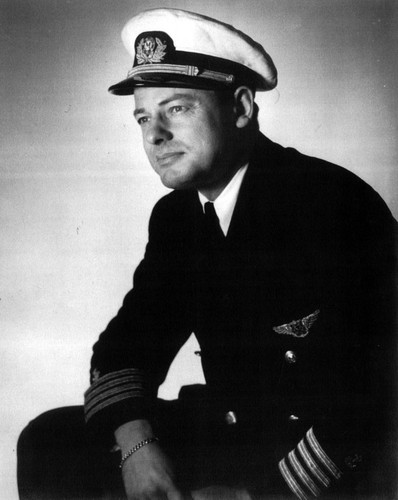

UNITED STATES AUTHOR · FICTION · HISTORY
Ernest K. Gann
Also known as: Ernest K Gann, Ernest Kellogg Gann
Image source
IN THE beginning many of us were scientific barbarians.
— from Fate Is the Hunter
Most acclaimed

Fate Is the Hunter
Ernest K. Gann’s classic memoir is an up-close and thrilling account of the treacherous early days of commercial aviation. In his inimitable style, Gann brings you right into the cockpit, recounting both the triumphs and terrors of pilots who flew when flying was anything but routine.
A hostage to fortune
The author of Fate Is the Hunter and The High and the Mighty unrolls his adventures in the air, in Hollywood, in far-flung exotic places with irony, heart, and unsparing honesty. The stars of his life-story are his swashbuckling father, a great business success and world-traveler, and his long-suffering first wife Eleanor, an arthritis victim and drug addict (painkillers); his supporting players are a host of early birdmen and such luminaries as Duke Wayne, Clark Gable, William Wellman, and Sterling Hayden. Born in Nebraska, Gann went to work in a silent-film processing factory at 14, saved up strips of undeveloped film, joined them, and shot his first film, Sweet Sixteen--which was a local hit. After washing out of Culver Military Academy, he was dispatched around the world by his father on company business (phone equipment), then returned to try and find himself a place in the New York theater. The March of Time sent him into Hitler's Germany to film the persecution of Jewish schoolchildren, a task aided by a saucy Dutch beauty. A stint of filming in an open cockpit led him into his great love, flight; into work as an airline copilot; and at last into ferrying secret equipment for the Air Force during World War II. At the same time, he began selling juvenile books, then writing his best-sellers, whose sales drew him to scriptwriting in Hollywood--source of much loot, more heartbreak, and little satisfaction. Meanwhile, he'd had a variety of air adventures, including a long search for a downed passenger plane in the Arctic. He later novelized his adventures as a yachtsman, and also wrote about the San Francisco police department, about Jewish history (he is Scotch-English and views himself as a kind of neo-pagan), and still more about the early days of flight. A long, bitter divorce by his wife of 35 years and the death of his eldest son on a supertanker have marred his recent years. Gripping as ever.
The Triumph
From the author of The High and the Mighty and Fate Is the Hunter, a sequel to his Biblical historical novel, The Antagontsts, which was filmed as the TV mini-series ""Masada."" In 73 A.D., or the fourth year of Vespasian, General Flavius Silva is serving as Commander of the Roman 10th Legion occupying Judea and engaged in destroying the last of the Jewish resistance. With the Jewish main force entrenched on the summit of Masada, Flavius Silva leads an attack against a surprisingly silent enemy. Pouring onto Masada's top, the Romans find that the Jews have committed mass suicide, every man, woman and child. This has a sobering effect on Flavius Silva, as does the strange behavior of one of his finest soldiers, Piso, who has become Christianized. To top off his troubles, Flavius Silva's childhood sweetheart, the gloriously beautiful Domittilia, daugther of Emperor Vespasian and unhappy wife to one of the richest senators in Rome, arrives in Judea with a message from her father--and promptly falls in love once more with Silva. Nor can Silva--battle-scarred, limping and half-blind at 36--resist her passionate advances. Their lovemaking on the beach is witnessed by Julius Scribonius, a homosexual spy, who hopes to use this knowledge to curry favor in Rome. Silva thinks he has strangled Scribonius to death but the slimy spy recovers and makes it back to Rome. Domittilia, also returning, asks her father for a divorce from Marcus Clemens, her porcine husband, but ailing Vespasius cannot risk giving Clemens any reason to abandon support for the Emperor. Meanwhile, Domittilia's brothers Titus and Domitian are seeking out each other's weaknesses. Elder Titus is about to inherit the throne, which hotheaded young drunk Domitian wants for himself and is amassing enough power to make his claim for it when the time comes. And the time does come, as Vespasian dies and Titus arranges the funeral triumph in honor of his father and in honor of his own assumption of power, with games in all four arenas, including the new Coliseum. Like Verdi's grand march in Aida, this grand climax is carried off with considerable skill and great detail, while the lovers part--if only for a year of face-saving for the masses. Few will deny Gann's pulsating storytelling and the roundedness of his stock characters, who often mature enough to go through a convincing change in their natures. The dialogue gallops nicely with a semi-rhetorical swing that's almost natural. A third volume looms, surely, to tie up the loose ends.