
IRELAND AUTHOR · BIOGRAPHY · HISTORY
Conor Cruise O’Brien
Also known as: Conor Cruise O'brien, Conor Cruise O'BRIEN
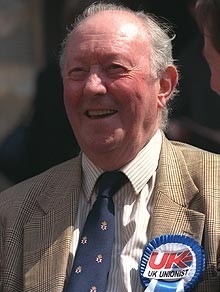
Donal Conor David Dermot Donat Cruise O'Brien (3 November 1917 – 18 December 2008), often nicknamed "The Cruiser", was an Irish diplomat, politician, writer, historian and academic, who served as Minister for Posts and Telegraphs from 1973 to 1977, a Senator for Dublin University from 1977 to 1979, a Teachta Dála (TD) for the Dublin North-East constituency from 1969 to 1977, and a Member of the European Parliament (MEP) from January 1973 to March 1973. His opinion of Britain's role in Ireland subsequent to the partition of the island and the independence of the Free State in 1921 changed during the 1970s, in response to the outbreak of The Troubles. He now saw opposing nationalist and unionist traditions as irreconcilable, and switched from a nationalist to a unionist view of Irish politics and history, and from opposition to support for partition. Cruise O'Brien's outlook was radical and seldom orthodox. He summarised his position as intending "to administer an electric shock to the Irish psyche".
In this chapter we are looking at Jefferson's life in Paris at a time when most people, including Jefferson, were quite unaware that they were living in the last years of the Ancien Regime.
— from The long affair, 1996
Most acclaimed

The Siege
Stephen White—author of over a dozen New York Times bestsellers— returns with a relentlessly propelled, thriller that will remind readers of his acclaimed Kill Me. Stephen White’s Alan Gregory novels are beloved by both fans and critics—the most recent, Dead Time, was a USA Today and Book-Sense bestseller. In The Siege, Gregory’s longtime friend Sam Purdy takes center stage in a story that feels ripped from tomorrow’s headlines. From the first page on, readers need to be buckled in for a nonstop ride full of terror and pathos. As a lovely weekend approaches on the Yale campus it appears that a number of students—including the sons of both the Secretary of the Army and newest Supreme Court justice—may have gone missing. Kidnapping? Terrorism? The authorities aren’t sure. But the high-profile disappearances draw the attention of the CIA and the FBI’s vaunted Hostage Rescue Team. Attention quickly focuses on the fortress-like tomb of one of Yale’s secret societies. Suspended Boulder police detective Sam Purdy soon finds himself in New Haven, where he is quickly snared by an unlikely pair of Feds: FBI agent Christopher Poe and CIA analyst Deirdre Drake. Sam, Poe, and Dee join together, desperately trying to solve the riddle of what is going on inside the windowless stone tomb on the edge of campus. The clock is pounding in their ears. The unknown enemy is playing by no known rules . . . is making no demands . . . is refusing to communicate with the hostage negotiator . . . is somehow anticipating every FBI move . . . is completely unconcerned about getting away . . . And . . . is sending students, one by one, out of the building’s front door to die.
The long affair
1996
Certain to be as controversial and explosive as it is elegant and learned, The Long Affair is Conor Cruise O'Brien's examination of Jefferson, as man and icon, through the critical lens of the French Revolution. Unable to speak the language, endowed with few close friends or colleagues, and curiously detached from Parisian intellectual life, Thomas Jefferson seemed an alienated and somewhat homesick Virginia farmer during most of his tenure as American Minister to France. But the advent of the French Revolution seized Jefferson with a new fervor, and in 1789 he returned to the United States an ardent admirer and ally of that cause. O'Brien argues that Jefferson, though enthralled with the ideological mystique of the French Revolution, nevertheless retained a shrewd political pragmatism, skillfully exploiting the Revolution's popularity with the American public. Ultimately, O'Brien suggests, Jefferson's egalitarian ideals came into conflict with his staunch political support for the slave-based Southern economy. Following the slave insurrection in Haiti inspired by the French Revolution, his revolutionary zeal was tempered and began to cool. Concluding with an evaluation of Jefferson's current role in the system of American political beliefs, O'Brien seriously questions whether we can sustain Jefferson's lofty status in an increasingly multiracial America, and he suggests a disturbing link between Jefferson's vision and white supremacist, survivalist extremists. A provocative analysis of the supreme symbol of American history and political culture, The Long Affair will challenge our traditional perceptions of both Jeffersonian history and the Jeffersonian legacy.