
GENERALS · UNITED STATES
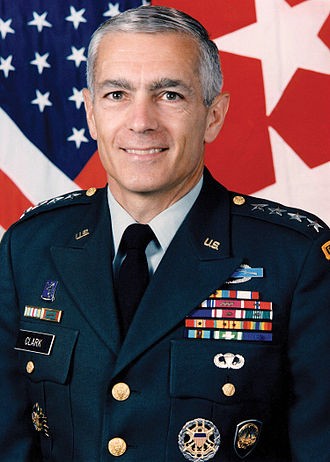
Wesley K. Clark
Wesley Kanne Clark, Sr. is a retired General of the United States Army. He graduated as valedictorian of the class of 1966 at West Point and was awarded a Rhodes Scholarship to the University of Oxford, where he obtained a degree in Philosophy, Politics and Economics. He later graduated from the Command and General Staff College with a master's degree in military science. He spent 34 years in the Army, receiving many military decorations, several honorary knighthoods, and the Presidential Medal of Freedom. Clark commanded Operation Allied Force in the Kosovo War during his term as the Supreme Allied Commander Europe of NATO from 1997 to 2000. Source: Wikipedia
"Ouch!" eight-year-old Andrew Jackson cried.
— from Andrew Jackson, 2002
Most acclaimed

Eisenhower
In his magisterial bestseller FDR, Jean Edward Smith gave us a fresh, modern look at one of the most indelible figures in American history. Now this peerless biographer returns with a new life of Dwight D. Eisenhower that is as full, rich, and revealing as anything ever written about America's thirty-fourth president. As America searches for new heroes to lead it out of its present-day predicaments, Jean Edward Smith's achievement lies in reintroducing us to a hero from the past whose virtues have become clouded in the mists of history. Here is Eisenhower the young dreamer, charting a course from Abilene, Kansas, to West Point, to Paris under Pershing, and beyond. Drawing on a wealth of untapped primary sources, Smith provides new insight into Ike's maddening apprenticeship under Douglas MacArthur in Washington and the Philippines. Then the whole panorama of World War II unfolds, with Eisenhower's superlative generalship forging the Allied path to victory through multiple reversals of fortune in North Africa and Italy, culminating in the triumphant invasion of Normandy. Smith also gives us an intriguing examination of Ike's finances, details his wartime affair with Kay Summersby, and reveals the inside story of the 1952 Republican convention that catapulted him to the White House. Smith's chronicle of Eisenhower's presidential years is as compelling as it is comprehensive. Derided by his detractors as a somnambulant caretaker, Eisenhower emerges in Smith's perceptive retelling as both a canny politician and a skillful, decisive leader. Smith convincingly portrays an Eisenhower who engineered an end to America's three-year no-win war in Korea, resisted calls for preventative wars against the Soviet Union and China, and boldly deployed the Seventh Fleet to protect Formosa from invasion. This Eisenhower, Smith shows us, stared down Khrushchev over Berlin and forced the withdrawal of British, French, and Israeli forces from the Suez Canal. He managed not only to keep the peace -- after Ike made peace in Korea, not one American soldier was killed in action during his tenure—but also to enhance America's prestige in the Middle East and throughout the world. Domestically, Eisenhower reduced defense spending, balanced the budget, constructed the interstate highway system, and provided social security coverage for millions who were self-employed. Ike believed that traditional American values encompassed change and progress. Unmatched in insight, Eisenhower in War and Peace at last gives us an Eisenhower for our time -- and for the ages. - Publisher.
Grant
"Ulysses S. Grant was the first four-star general in the history of the United States Army and the only president between Andrew Jackson and Woodrow Wilson to serve eight consecutive years in the White House. As general in chief, Grant revolutionized modern warfare. Rather than capture enemy territory or march on Southern cities, he concentrated on engaging and defeating the Confederate armies in the field, and he pursued that strategy relentlessly. As president, he brought stability to the country after years of war and upheaval. He tried to carry out the policies of Abraham Lincoln, the man he admired above all others, and to a considerable degree he succeeded. Yet today, Grant is rememebered as a brilliant general but a failed president." "In this biography, Jean Edward Smith reconciles these conflicting assessments of Grant's life. He argues convincingly that Grant is greatly underrated as a president. Following the turmoil of Andrew Johnson's administration, Grant guided the nation through the post-Civil War era, overseeing Reconstruction of the South and enforcing the freedoms of new African-American citizens. His presidential accomplishments were as considerable as his military victories, says Smith, for the same strength of character that made him successful on the battlefield also characterized his years in the White House."--BOOK JACKET.
Andrew Jackson
2002
The extraordinary story of Andrew Jackson--the colorful, dynamic, and forceful president who ushered in the Age of Democracy and set a still young America on its path to greatness--told by the bestselling author of The First American.The most famous American of his time, Andrew Jackson is a seminal figure in American history. The first "common man" to rise to the presidency, Jackson embodied the spirit and the vision of the emerging American nation; the term "Jacksonian democracy" is embedded in our national lexicon. With the sweep, passion, and attention to detail that made The First American a Pulitzer Prize finalist and a national bestseller, historian H.W. Brands shapes a historical narrative that's as fast-paced and compelling as the best fiction. He follows Andrew Jackson from his days as rebellious youth, risking execution to free the Carolinas of the British during the Revolutionary War, to his years as a young lawyer and congressman from the newly settled frontier state of Tennessee. As general of the Tennessee militia, he put down a massive Indian uprising in the South, securing the safety of American settlers, and his famous rout of the British at the Battle of New Orleans during the War of 1812 made him a national hero. But it is Jackson's contributions as president, however, that won him a place in the pantheon of America's greatest leaders. A man of the people, without formal education or the family lineage of the Founding Fathers, he sought as president to make the country a genuine democracy, governed by and for the people. Jackson, although respectful of states' rights, devoted himself to the preservation of the Union, whose future in that age was still very much in question. When South Carolina, his home state, threatened to secede over the issue of slavery, Jackson promised to march down with 100,000 federal soldiers should it dare. In the bestselling tradition of Founding Brothers and His Excellency by Joseph Ellis and of John Adams by David McCullough, Andrew Jackson is the first single-volume, full-length biography of Jackson in decades. This magisterial portrait of one of our greatest leaders promises to reshape our understanding of both the man and his era and is sure to be greeted with enthusiasm and acclaim.