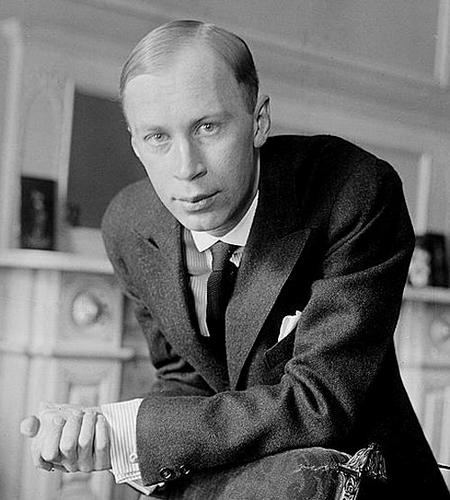
Sergey Prokofiev
Personal Information
Description
There is no description yet, we will add it soon.
Books
Pedro y el lobo
Retells the orchestral fairy tale of the boy who, ignoring his grandfather's warnings, proceeds to go into the forest where he encounters a wolf.
Selected letters of Sergei Prokofiev
This volume collects for the first time in English the most representative and enlightening of Prokofiev's letters, including some previously suppressed missives that have never before been published. Expertly translated and annotated by Harlow Robinson, the correspondence presented here covers Prokofiev's earliest years at St. Petersburg Conservatory, his extensive worldwide travels, and his return to Moscow. Among the correspondents are childhood friend Vera Alpers, harpist Eleonora Damskaya, ballet impresario Sergei Diaghilev, theatrical director Vsevolod Meyerhold, Soviet critic Boris Asafiev, composers Vernon Duke and Nikolai Miaskovsky, soprano Nina Koshetz, musicologist Nicolas Slonimsky, violinist Jascha Heifetz, conductor Serge Koussevitsky, and film director Sergei Eisenstein. Prokofiev vividly describes, often with dramatic flair and a quirky sense of humor, concerts, performances, his compositions, political events, and meetings with other musicians and composers. His observations are peppered with musical gossip as well as eccentric, original, and disarmingly apolitical insights.
Literary works
Li︠u︡bovʹ k trem apelʹsinam
Retells the story from a Prokofiev opera of a prince who is cursed by a witch to fall in love with three oranges, which he then must obtain from the giant who guards them in a desert castle.
Peti︠a︡ i volk
The narration is highlighted by the accompanying important musical themes.
Quartet No. 2, Op. 92
During that critical period of World War II in 1941 when the German armies were advancing all too rapidly on Moscow, the Soviet government evacuated a number of its important creative artists to safer areas. Prokofieff went to Nalchik in the Caucasus. It was here during the early part of 1942 that the String Quartet No. 2 in F Major, Op. 92 was composed. Nalchik which is located in the Karbardinao-Balkaria Autonomous Republic, is surrounded by a rich musical folklore. Prokofieff became very much interested in it and drew the thematic materials for his quartet from this little explored source. Like his first string quartet, the second is also written in three movements. Both of the first movements are written in the conventional sonata-allegro form, but the second movement of the first quartet is a brilliant scherzo, while the parallel portion of the second quartet is a lovely slow movement based on a Caucasian love song. In effect, Prokofieff has simply reversed procedures in the last two movements of these quartets, for the finale of Opus 50 is slow and lyrical, while the final movement of his latest quartet is wild and free, based on the weird and brilliant dance music of the people living in the mountains of the Nalchik region. The Second String Quartet was first performed in Moscow on April 7, 1942 by the Beethoven String Quartet. In the United States it has been widely performed by several distinguished chamber music organizations and has been hailed as one of the most important additions to string quartet literature in recent years. - Lee Fairley, inside front cover.
Prokofiev Ausgewahlte Stucke Aus Dem Ballet Romeo Und JuliaSelected Pieces From The Ballet Romeo And Juliet
Peter n'the wolf
In this dramatic adaptation of the famed Russian fairy tale the wolf is a lovable bad guy.